How to Choose a Screen Printing Washout Booth
How to Choose a Screen Printing Washout Booth
Choosing a screen printing washout booth starts with the screens and workflow—not with the outside width of the equipment. The right booth must accommodate the largest frame, contain overspray, support the screen securely, drain at the required flow rate, and fit the shop’s approach to stencil development and screen reclamation.
Material, backlighting, filtration, working height, installation space, and shipping requirements also affect the decision. A compact tabletop booth may be ideal for a small screen room, while a growing production department may benefit from a full-height station with more working clearance and space for a filtration system underneath.
The best screen printing washout booth is therefore not automatically the largest, most expensive, or most heavily equipped model. It is the unit that fits the shop’s actual frame sizes, processes, daily workload, utilities, and long-term production plan.
This guide explains how to evaluate those factors before requesting a quotation or placing an order.

Quick Selection Guide
Buyers who already know their screen dimensions can begin with the following checklist.
| Selection factor | What to confirm | Why it matters |
|---|---|---|
| Maximum frame size | Largest outside frame dimensions | Determines whether the screen can be supported and washed safely |
| Internal working clearance | Space around the frame | Allows access to edges, corners, and both sides of the screen |
| Installation format | Tabletop or freestanding | Affects footprint, working height, drainage, and future expansion |
| Construction material | Polypropylene, stainless steel, or combined construction | Influences weight, chemical compatibility, cleaning, and durability |
| Backlighting | Included, optional, or backlight-ready | Affects stencil and reclaimed-screen inspection |
| Screen supports | Position, width, stability, and adjustability | Helps keep the frame secure during spraying |
| Drainage | Outlet size, position, hose, flow, and access | Prevents slow drainage and simplifies installation |
| Filtration | Separate or integrated; solids capacity | Helps manage process residue but does not replace discharge compliance |
| Water delivery | Rinse nozzle, pressure washer, pump, or external supply | Development and reclamation may need different water pressure |
| Workload | Screens per shift and screen type | Affects booth size, filter capacity, cleaning frequency, and ergonomics |
| Delivery and assembly | Packed size, weight, access route, and assembly | Influences landed cost and installation planning |
Before comparing models, it is useful to understand what a screen printing washout booth does and how stencil development differs from screen reclamation. Once that distinction is clear, equipment selection becomes much easier.
1. Define What the Washout Booth Will Be Used For
Most screen rooms use a washout booth for one or both of the following processes:
• Developing newly exposed stencils
• Reclaiming used screens for another print job
The processes share the same wet workstation, but they place different demands on the equipment.
Stencil Development
After exposure, water removes the unexposed emulsion from the image area. Development requires controlled rinsing and clear visibility as fine lines, text, halftones, and other openings appear. A clean booth, stable screen support, and useful backlighting can make this work easier to inspect.
Excessive water pressure can damage a weak or underexposed stencil, so high-pressure capability should not be treated as the only measure of washout performance.
Screen Reclamation
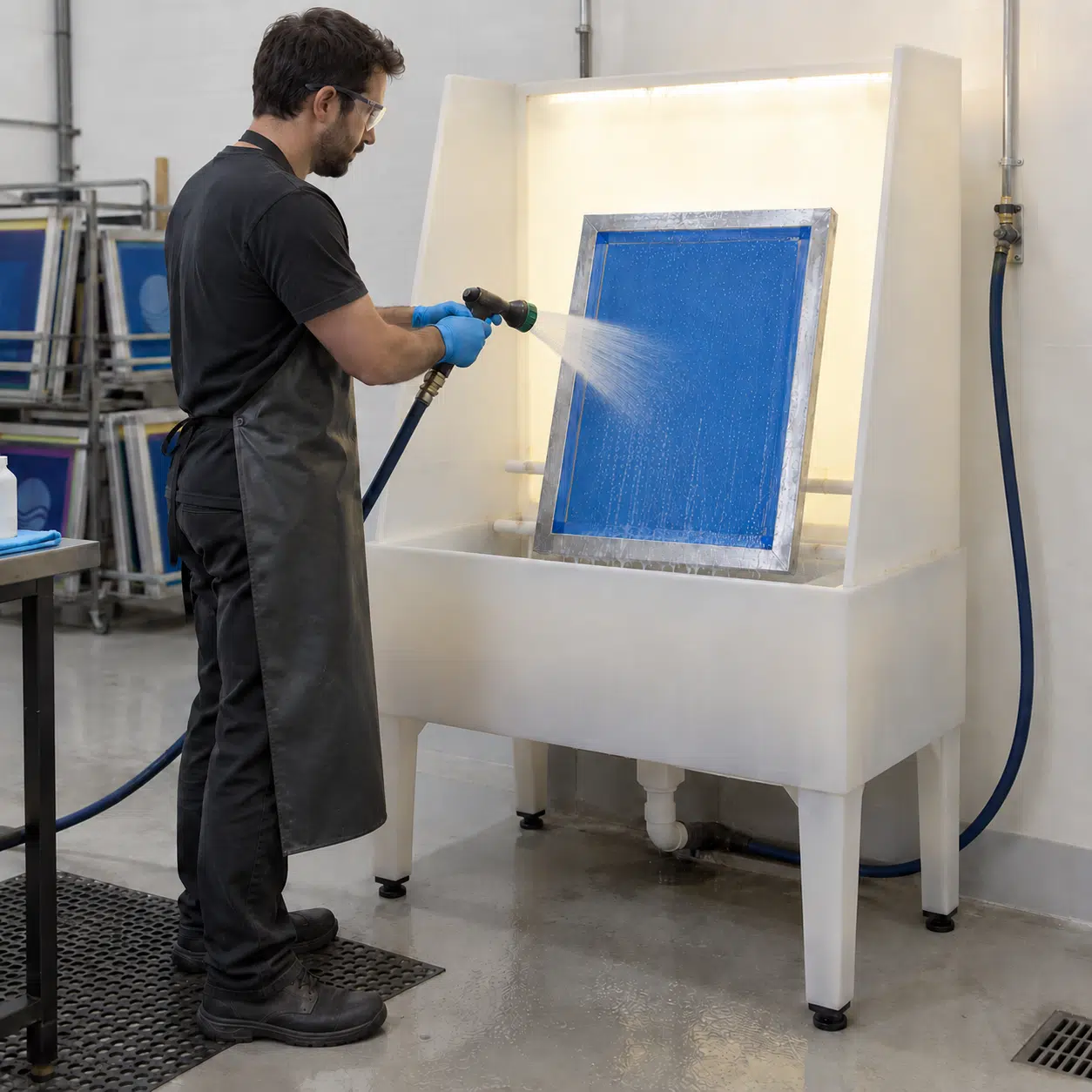
Reclamation removes remaining ink and the old stencil so the frame and mesh can be reused. The process may involve ink remover, emulsion remover, haze remover, degreaser, scrubbing tools, and a pressure washer.
Frequent reclamation places greater demands on splash containment, material compatibility, drain flow, residue collection, filter maintenance, and access for cleaning. A shop that only develops new screens may not need the same configuration as one reclaiming screens throughout every shift.
When One Booth Handles Both Processes
Many small and medium-sized shops use one booth for both operations. That can work well when tools are clearly labeled, residue is removed between processes, and clean stencil development is not contaminated by ink or reclaiming chemicals.
Higher-volume facilities may separate stencil development from dirty reclamation work. The decision depends on available space, screen volume, quality requirements, and how effectively one station can be cleaned between jobs.
2. Measure the Largest Screen Printing Frame
Frame capacity is the first technical specification to confirm. A booth that cannot safely hold the largest screen is unsuitable regardless of its material, lighting, or price.
Measure the Outside Frame Dimensions
Use the overall outside width, height, and frame-profile depth—not the print area or image size. The complete frame must fit between the side panels and rest securely on the support.
Record the largest standard frame currently used and any larger frames expected during the next equipment cycle. A growing shop should not select a booth only around today’s smallest or most common screen if larger work is already planned.
Maximum Frame Size Is Not the Same as Booth Width
Manufacturers may publish several measurements:
• Overall equipment width
• Internal chamber width
• Maximum supported frame size
• Maximum image or working area
Only the stated frame capacity directly answers whether a screen fits. Side walls, structural flanges, light panels, plumbing, and support hardware can reduce the usable opening.
Allow Practical Working Clearance
A screen that barely fits may still be difficult to wash. Operators need clearance to place the frame on its supports, reach the image edges, change the spray angle, and remove the wet screen without striking the booth.
The required clearance depends on the frame profile and whether screens must be rotated or turned during the process. Sending the supplier exact outside frame dimensions is more reliable than asking only for a nominal 20 × 24-inch or 23 × 31-inch booth.
Consider Multiple Screens and Oversized Work
Some large booths can hold two smaller frames side by side, but outside width alone does not confirm that arrangement. The location of supports, drain, back panel, and side clearance must also work for both screens.
Large-format graphics or industrial screens create additional handling demands. Frame weight, operator reach, screen clamps, booth depth, and access from both sides may become as important as width.
3. Choose Between a Tabletop and Freestanding Booth
The installation format affects more than floor space. It also determines working height, drain routing, storage or filtration space, assembly, and how easily the station can grow with production.
| Factor | Tabletop washout booth | Freestanding washout booth |
|---|---|---|
| Best suited to | Compact shops, training rooms, sample areas, and lower screen volume | Dedicated screen rooms and regular commercial production |
| Installation | Requires a strong, suitably sized counter or support | Includes its own legs or stand |
| Footprint | Conserves floor space | Requires a permanent floor location |
| Working height | Determined by the counter and booth dimensions | Determined largely by the equipment design |
| Space below booth | Depends on the counter arrangement | May accommodate filters, containers, or plumbing |
| Frame handling | Usually optimized for smaller standard screens | Often provides greater height and access |
| Expansion | Practical when space is the main constraint | Better suited to an integrated reclaiming station |
When a Tabletop Washout Booth Makes Sense
A tabletop unit can be a practical choice when screen sizes are limited, washout is not continuous, and floor space is valuable. It can also reduce shipping weight and simplify installation in a small screen room.
The supporting counter must be stable and resistant to water. Its height should place the working area at a comfortable level after the booth is installed. Drain hoses need a continuous route to the collection or filtration system without creating a trip hazard or a low point where residue collects.
When a Freestanding Washout Booth Is Better
A freestanding model is often more appropriate when screens are washed and reclaimed regularly. A fixed station gives the operator a consistent working height and can leave usable space beneath the pan for plumbing, filters, pumps, or containers.
Floor-standing equipment also avoids relying on an existing counter that may not have been designed for the combined weight of the booth, wet screens, hoses, water, and operating forces.
Plan for the Next Stage of Production
Buying far beyond realistic requirements wastes space and shipping cost. Buying only for today’s smallest workload can lead to an early replacement. A useful planning horizon includes expected screen sizes, new presses, possible automatic production, staffing, and reclaiming volume.
4. Compare Polypropylene and Stainless Steel Construction
Polypropylene and stainless steel are both common washout booth materials. Neither is universally better. The correct choice depends on the chemistry, cleaning method, workload, installation, transport, and maintenance expectations.
| Comparison point | Polypropylene washout booth | Stainless steel washout booth |
|---|---|---|
| Corrosion behavior | Does not rust and is widely used in wet processing | Resists corrosion when the steel grade and chemicals are compatible |
| Weight | Generally lighter | Generally heavier |
| Noise and vibration | Polymer panels may dampen spray vibration | Rigid metal panels may transmit more vibration |
| Cleaning tools | Plastic scrapers and non-damaging brushes are preferred | More tolerant of firm cleaning, but surfaces can still be scratched |
| Structural feel | Depends on panel thickness, welding, and support design | Typically rigid and impact-resistant |
| Shipping | Lower weight can simplify handling | Weight and crating may increase freight requirements |
| Repair and modification | Depends on fabrication method and local capability | Metal fabrication may be familiar to more industrial maintenance teams |
| Appearance | Light-colored panels make residue visible | Professional metal finish and easy visual inspection of the pan |
Why Buyers Choose Polypropylene
Polypropylene is commonly selected for wet screen-processing equipment because it does not rust, offers useful resistance to many chemicals, and can be fabricated into a welded pan. Lower weight may also reduce handling and freight demands.
Panel thickness, weld quality, structural reinforcement, support design, and the chemicals used are more important than the material name alone. Polypropylene can be scratched by aggressive metal tools, and no plastic should be assumed compatible with every solvent or haze remover.
Why Buyers Choose Stainless Steel
Stainless steel provides a rigid, durable surface and is often selected for busy industrial work areas. It can withstand routine handling well and is straightforward to wipe down when maintained regularly.
The term stainless steel is not a complete specification. Steel grade, sheet thickness, weld quality, finishing, exposure time, and chemical concentration all influence performance. Buyers should verify compatibility with their actual ink and reclaiming chemistry.
Ask About the Complete Construction
A booth may combine materials—for example, a polymer pan with a metal stand or a metal basin with a translucent polymer back panel. Request a clear bill of materials for the pan, side panels, supports, fasteners, legs, fittings, light housing, and seals.
Chemical compatibility should be checked against the safety data and technical guidance for every cleaning product used in the shop. A general claim such as “chemical-resistant” should not replace process-specific verification.
5. Decide Whether You Need a Backlit Washout Booth
Backlighting allows light to pass through the screen from behind while it is being washed or inspected. It is one of the most useful options for shops that produce detailed stencils or need dependable reclamation checks.
What Backlighting Helps You See
A properly illuminated screen can reveal:
• Image areas that have not fully opened
• Emulsion residue in fine lines or small text
• Pinholes and weak stencil areas
• Ghost images or haze after reclamation
• Blocked mesh and contamination near frame edges
Backlighting does not correct underexposure, overexposure, weak film density, incomplete drying, or an unsuitable mesh. It simply makes the result easier to evaluate.
Included, Optional, and Backlight-Ready Are Different
Product descriptions often use similar language for three different configurations:
| Configuration | What the buyer receives |
|---|---|
| Backlit booth | Light system is included and installed or supplied with the booth |
| Optional backlight | Light can be purchased as an added component |
| Backlight-ready booth | Translucent panel or installation space is provided, but the light may not be included |
Ask the supplier to state exactly what is included in the quotation. Voltage, plug type, switch position, light dimensions, installation method, and suitability for a wet environment should also be confirmed.
When Backlighting Is Most Valuable
Fine text, halftones, high mesh counts, technical graphics, and close-tolerance stencil work benefit most from improved visibility. Backlighting is also useful when reclaimed screens must be inspected quickly before returning to the coating department.
A shop producing simple, low-detail images at low volume may begin with a backlight-ready booth and add lighting later. The booth design should make that upgrade practical rather than requiring major modification.
6. Evaluate the Pan, Splash Panels, and Screen Supports
Two booths with similar dimensions can perform very differently because of their internal design.
Pan Shape and Drainage Slope
The lower pan should direct water and solids toward the outlet without leaving large areas of standing water. Rounded or accessible internal areas are easier to rinse than narrow corners that collect hardened emulsion.
Ask whether the pan is one welded assembly, how its joints are constructed, and whether the drain area can be reached for cleaning.
Splash Containment
Side and rear panels should be high and deep enough for the intended spray method. A powerful reclamation spray produces more rebound and mist than a gentle development rinse.
An open-front washout booth will not contain every droplet. The surrounding floor and wall area still need appropriate protection, but effective side panels and spray deflection can substantially reduce cleanup.
Screen Support
Built-in supports should hold the frame above the pan at a stable working angle. Check support width, position, load capacity, edge protection, and whether the design works with different frame profiles.
Large or heavy screens may need adjustable holders or clamps. A shallow ledge that works for a lightweight textile frame may not be sufficient for an oversized industrial screen.
Working Depth and Operator Reach
Extra depth can improve splash containment, but excessive depth may force the operator to reach too far. The relationship among booth depth, support position, pan height, and frame angle determines practical ergonomics.
Whenever possible, evaluate a dimensioned drawing rather than relying only on a front-view product photograph.
7. Match the Booth to the Water and Spray System
A standard washout booth normally contains and drains water; it does not automatically create water pressure. The rinse nozzle, pressure washer, pump, hoses, and water supply may be separate components.
Development and Reclamation Need Different Handling
Newly exposed stencils are usually developed with controlled water pressure, beginning gently. Old, fully cured emulsion may require chemical softening followed by higher-pressure rinsing during reclamation.
Using the highest available pressure for every screen is not good process control. Water pressure, nozzle distance, spray pattern, and dwell time should match the stencil, mesh, and operation.
Questions to Ask About Water Delivery
Confirm whether the quoted system includes:
• Spray gun or rinse nozzle
• Hose and fittings
• Pressure washer or pump
• Water inlet connection
• Pressure regulation
• Electrical requirements for powered equipment
If a pressure washer will be sourced locally, check that it can connect to the shop’s water supply and that the booth can contain the resulting spray without excessive rebound.
Avoid Treating PSI as the Only Specification
Pressure alone does not describe cleaning performance. Flow rate, nozzle design, distance from the mesh, chemical action, stencil condition, and operator technique all affect the result.
A system strong enough to reclaim a cured screen can also damage mesh or a newly developed stencil when used incorrectly. Equipment selection should support controlled adjustment rather than maximum force alone.
8. Plan Drainage, Collection, and Filtration Together
Drainage is one of the most frequently underestimated parts of a washout booth installation. A correctly sized booth can still perform poorly if water backs up in the pan or solids accumulate in inaccessible plumbing.
Confirm the Drain Specification
Request the following information before ordering:
• Drain outlet diameter and thread or fitting type
• Outlet position and required clearance
• Supplied hose length and material, if included
• Recommended slope and flow capacity
• Access for removing solids and clearing blockages
• Compatibility with the intended filter, tank, pump, or drain connection
A long flexible hose may help reach remote plumbing, but it must be routed without sharp bends, crushing, or low sections that collect sediment.
Understand What a Filter Can and Cannot Do
Washout water can contain emulsion pieces, ink solids, adhesive residue, and chemicals from reclaiming. A staged filtration system may capture large material first and progressively smaller solids afterward.
Mechanical filtration does not automatically remove dissolved chemicals, neutralize the wastewater, or make it legal to discharge. Filter selection should be based on the waste stream, screen volume, local requirements, and the instructions supplied with the ink and cleaning chemicals.
Check Filter Capacity Against Workload
Filter fineness is only one part of the specification. Buyers should also compare:
• Maximum flow rate
• Holding or reservoir capacity
• Gravity-fed or pumped operation
• Number and type of filter stages
• Replacement-filter availability
• Cleaning frequency
• Access for servicing
• Final route for captured solids and wastewater
A very fine filter that blocks quickly may interrupt production if it is undersized for the shop’s actual volume.
Verify Local Wastewater Requirements
Requirements differ by country, municipality, sewer authority, ink system, and chemical process. Before installation, identify what will enter the wastewater, whether a permit or approval is required, and how captured waste must be handled.
The washout booth should be considered a collection and containment point. Compliance depends on the complete wastewater-management system, not on the booth alone.
9. Check Installation Space and Utilities
Equipment dimensions are only the beginning of installation planning.
Measure the Complete Route
Check the shipping package against loading doors, elevators, corridors, stairs, and the final room entrance. A booth that fits its operating location may not pass through the access route when fully assembled.
For imported equipment, request packing dimensions, gross weight, number of packages, and assembly instructions before confirming freight.
Leave Maintenance Clearance
The booth needs enough space for operators to load screens, move the spray gun, remove filters, service hoses, reach the drain, and clean behind or underneath the equipment.
Installing the unit tightly against walls without considering service access may reduce the usable workspace and make routine maintenance unnecessarily difficult.
Confirm Water, Drain, and Electrical Connections
Record the water connection, available pressure and flow, drain or collection route, voltage, frequency, plug type, and electrical protection required for lights, pumps, or pressure equipment.
Electrical components near the wet zone must be suitable for the environment and installed according to applicable local requirements. The equipment supplier can provide specifications, but final site compliance should be confirmed locally.
Separate Wet and Dry Screen-Making Areas
Coated-screen drying, film handling, and exposure benefit from clean, controlled conditions. Overspray and humidity from the washout station can interfere with those operations.
A practical screen-room layout places the washout area near the exposure workflow while maintaining sufficient separation, barriers, or ventilation to protect the dry side. See the Complete Screen Making Process for the relationship among coating, drying, exposure, washout, and final inspection.
10. Match Capacity to Daily Screen Volume
Screen count affects more than the chamber size. Higher volume increases demand on operators, filters, drainage, cleaning schedules, chemical storage, and screen movement.
Low-Volume Production
A compact booth may be sufficient when a shop prepares or reclaims only a small number of standard screens. Simple installation and easy cleanup may be more valuable than a large chamber or integrated reclaiming system.
Regular Commercial Production
When washout occurs throughout the day, working height, frame stability, drain speed, backlighting, and maintenance access have a direct effect on labor. A freestanding booth with planned filtration and organized chemical storage usually provides a more scalable workstation.
High-Volume or Large-Format Production
Large frames and frequent reclamation may require adjustable screen restraints, deeper splash containment, high-capacity drainage, powered filtration, multiple operators, or automatic reclaiming equipment.
A manual booth remains useful for development, inspection, sampling, or exception work, but it should not become a bottleneck in a production line designed for much higher throughput.
Avoid Arbitrary Screen-Count Thresholds
Two shops processing the same number of screens can have very different requirements. Large industrial frames, thick stencils, solvent ink, high-detail textile work, and simple water-based graphics do not create identical workloads.
Describe the actual process to the supplier rather than relying on a single number such as screens per day.
11. Compare Total Cost, Not Only Purchase Price
The equipment price is only one part of the investment. A lower quotation can become more expensive after freight, crating, plumbing, lighting, filters, pressure equipment, and replacement components are added.
Include These Costs in the Comparison
| Cost category | Items to include |
|---|---|
| Equipment | Booth, stand, screen support, back panel, and included fittings |
| Options | Backlight, holders, splash extensions, or custom dimensions |
| Water delivery | Nozzle, hoses, pressure washer, pump, and regulators |
| Wastewater | Filter system, reservoir, pump, replacement media, and disposal |
| Installation | Plumbing, electrical work, floor or wall preparation, and labor |
| Logistics | Packing, crating, freight, duties, delivery equipment, and unloading |
| Operation | Water, chemicals, filter replacements, cleaning tools, and labor |
| Maintenance | Drain service, hose replacement, lighting, seals, and repairs |
Evaluate Serviceability
Simple access to the drain, filter, hoses, back panel, and lighting can reduce downtime. Ask whether replacement fittings and consumable filters are standard components or proprietary parts with long lead times.
Assembly drawings, installation instructions, parts lists, and technical support are meaningful parts of the purchase even when they do not appear in the main equipment specification.
Consider Useful Life in the Actual Environment
Durability depends on more than material thickness. Chemical compatibility, weld quality, frame impacts, cleaning habits, water quality, maintenance frequency, and correct installation all influence service life.
Avoid accepting unsupported lifetime claims. A more useful comparison is whether the construction and maintenance plan match the conditions in which the booth will operate.
12. Purpose-Built Booth, Utility Sink, or DIY Station?
A utility sink or DIY station may be adequate for occasional hobby work or very small screens. Commercial production introduces different expectations for frame support, splash control, inspection, chemical compatibility, drainage, and operator consistency.
| Option | Main advantage | Main limitation |
|---|---|---|
| Utility sink | Low cost and easy local availability | Usually lacks screen-specific supports, high splash panels, and inspection lighting |
| DIY washout station | Can be built around unusual space constraints | Performance depends on design, material, drainage, structural, and electrical decisions |
| Purpose-built washout booth | Designed around screen handling, containment, drainage, and optional backlighting | Higher initial investment and shipping requirements |
A low purchase price should not be compared with a complete booth unless the DIY or utility-sink cost also includes waterproof surfaces, supports, plumbing, lighting, filtration, labor, and future maintenance.
13. Selection Recommendations by Shop Type
| Shop profile | Recommended starting configuration | Main reason |
|---|---|---|
| Startup using smaller standard frames | Tabletop or compact booth, backlight-ready, simple drain route | Conserves space while creating a dedicated wet station |
| Manual textile shop with regular screen making | Freestanding booth sized above the largest frame, optional backlight, planned solids filtration | Supports repeatable daily development and reclamation |
| Detail-focused graphics department | Backlit booth with generous frame clearance and clean-development procedures | Improves inspection of fine image areas |
| Shop reclaiming screens every shift | Durable freestanding construction, high-flow drainage, accessible filtration, organized pressure equipment | Reduces bottlenecks and service interruptions |
| Large-format or industrial printer | Oversized booth with verified support capacity, clamps, deep splash control, and high-capacity waste handling | Accommodates heavy frames and higher process loads |
| Facility expanding its screen room | Modular or upgrade-ready layout with space for lighting, filtration, and additional stations | Avoids replacing the entire wet area as production grows |
Recommendations should be adjusted for the actual frame and process. Industry label alone is not enough to determine the correct booth.
14. Choosing Between HANZE Washout Booth Models
HANZE currently offers two polypropylene configurations for compact and standard screen-room layouts. Both use 5/16-inch natural polypropylene construction with a welded main pan, locking side and back panels, built-in screen supports, and a backlight-ready design.
| Model | Equipment dimensions | Maximum frame size | Packing information | Suitable use |
|---|---|---|---|---|
| HZI-CBT-MINI2227 Tabletop Washout Booth | 26 × 18 × 34 in | 22 × 27 in | 790 × 700 × 230 mm; 15.50 kg packed | Compact screen rooms, training areas, sample departments, and countertop installation |
| HZI-CBT-STD2331 PP Washout Booth | 32 × 24 × 64 in | 23 × 31 in | 850 × 890 × 260 mm; 34.20 kg packed | Freestanding installation and regular processing of standard commercial frames |
Choose the 22 × 27-Inch Tabletop Model When
Floor space is limited, screens fit within the stated 22 × 27-inch maximum, and the shop has a suitable counter or stand. The lower packed weight also makes the model easier to handle during delivery and installation.
Choose the 23 × 31-Inch Freestanding Model When
The shop uses frames up to 23 × 31 inches, wants a dedicated floor-standing workstation, or needs more permanent integration with its screen-making area.
Confirm Before Ordering
Send the outside frame dimensions rather than relying only on a nominal frame name. Also confirm the drain connection, included hose and fittings, backlight requirements, water-delivery equipment, filter arrangement, voltage where applicable, packing, and destination.
View both configurations on the Screen Printing Washout Booth category page.
15. Information to Include in Your RFQ
A detailed request for quotation helps the supplier recommend the correct booth and reduces revisions after the order.
Provide the following:
| RFQ item | Information to send |
|---|---|
| Screen dimensions | Outside width × height × profile depth; largest and most common sizes |
| Screen weight | Especially for large or industrial frames |
| Main process | Stencil development, reclamation, or both |
| Daily workload | Typical and peak screen volume |
| Ink and stencil system | General ink type, emulsion type, and reclaiming process |
| Installation format | Tabletop or freestanding preference |
| Available space | Maximum equipment width, depth, and height |
| Utilities | Water connection, pressure, drain route, voltage, frequency, and plug type |
| Backlighting | Included, optional, or not required |
| Filtration | Existing system or required arrangement |
| Delivery | Destination country, port or address, and preferred shipping method |
| Documentation | Drawings, assembly instructions, packing list, and any required commercial documents |
Photos or a simple plan of the proposed washout area can also help identify drain-routing or clearance problems before shipment.
Common Purchasing Mistakes
Selecting by Nominal Frame Name
A “20 × 24 screen” may describe an outside frame size in one catalog and a working size in another. Use measured outside dimensions.
Buying a Booth That Barely Fits
Insufficient clearance makes screen loading, edge cleaning, and inspection difficult. Allow room to work, not just room to insert the frame.
Assuming the Light Is Included
Backlit, optional-backlight, and backlight-ready specifications are not equivalent. Ask for an itemized quotation.
Ignoring the Drain Until Installation
Outlet position, hose routing, filter height, gravity flow, and maintenance access need to work together. A last-minute drain solution often creates slow flow or difficult cleaning.
Treating Filtration as Automatic Compliance
Capturing visible solids does not prove that the remaining water meets local discharge requirements. Evaluate the full waste stream.
Using One Pressure Setting for Every Screen
Gentle stencil development and old-stencil reclamation are different processes. Maximum pressure is not the goal.
Comparing Only the Booth Price
Freight, crating, lighting, pressure equipment, filters, utilities, installation, and replacement parts can change the total investment substantially.
Placing the Wet Station in the Drying Area
Humidity and overspray can interfere with coated-screen drying and contaminate clean prepress work. Plan wet and dry zones as one workflow.
Frequently Asked Questions
What size washout booth do I need for screen printing?
Choose a booth based on the largest outside frame dimensions and allow additional working clearance around the screen. Do not use image size or overall booth width as a substitute for the manufacturer’s stated maximum frame capacity.
What is the best screen printing washout booth?
The best booth is the one that fits the largest frame, workflow, daily volume, installation space, drainage plan, and budget. A larger or more expensive model is not automatically better if it creates unnecessary freight, space, or maintenance demands.
Should I choose a polypropylene or stainless steel washout booth?
Polypropylene does not rust, is relatively lightweight, and offers useful resistance to many wet-processing chemicals. Stainless steel is rigid, durable, and easy to wipe down. Verify the exact construction and compatibility with the shop’s ink and reclaiming chemicals before choosing.
Is a backlit washout booth worth it?
Backlighting is particularly useful for fine text, halftones, detailed stencils, high-mesh-count work, and inspection after reclamation. Shops doing simple, low-detail work may choose a backlight-ready booth and add lighting later.
Does a washout booth include a pressure washer?
Not usually unless the quotation specifically lists one. Many booths provide the containment pan, splash panels, supports, and drain while the rinse nozzle, pressure washer, pump, and hoses are supplied separately.
How much clearance should be left around a screen?
There is no universal clearance because frame profiles, supports, and working methods differ. The operator should be able to load, support, rinse, inspect, and remove the frame without striking the side panels. Send exact frame measurements to the supplier for confirmation.
Can one washout booth handle both development and reclamation?
Yes. Many shops use one booth for both, provided the area and tools are cleaned between processes. Higher-volume operations may separate clean stencil development from dirty reclamation to reduce contamination and workflow conflict.
Does a washout booth need a filtration system?
Filtration is commonly used to capture emulsion and ink solids and protect downstream plumbing. The required system depends on screen volume, materials, chemicals, and local wastewater rules. A booth drain alone does not provide filtration.
Can filtered washout water always go down the drain?
No. Mechanical filtration does not necessarily remove dissolved chemicals or satisfy local discharge limits. Consult the local sewer authority or relevant environmental agency and follow ink and chemical disposal instructions.
Where should the washout booth be installed?
Install it in a designated wet area with water, drainage or collection, ventilation, safe electrical provisions, maintenance access, and a protected floor. Keep overspray and humidity away from emulsion coating, screen drying, film storage, and exposure equipment.
Is a tabletop washout booth suitable for a commercial shop?
Yes, when the frame size, workload, supporting counter, drainage, and operator access are suitable. A freestanding station is usually easier to integrate as screen volume and reclaiming frequency increase.
What should I ask a washout booth supplier before ordering?
Confirm maximum frame size, internal and overall dimensions, materials, panel thickness, support design, drain specification, included fittings, backlight configuration, pressure equipment, filtration, assembly, packing, weight, voltage, documentation, and delivery terms.
Related Reading
• What Is a Screen Printing Washout Booth? Complete Guide
• Complete Screen Making Process: Step-by-Step Guide
• How to Expose a Screen for Screen Printing
• Screen Printing Exposure Time: Complete Guide
• How to Choose a Screen Printing Exposure Unit
Final Selection Checklist
Before approving the order, verify that:
• The largest outside frame fits with adequate working clearance.
• Tabletop or freestanding installation suits the available space and working height.
• The construction material is compatible with the intended chemicals and cleaning method.
• Screen supports can hold the frame securely.
• The backlight configuration is clearly stated in the quotation.
• The water-delivery equipment is suitable for both development and reclamation.
• Drain size, outlet position, hose routing, and flow capacity have been planned.
• Filtration or wastewater collection is sized for the actual process and volume.
• Water, electrical, ventilation, floor, and maintenance requirements are available at the site.
• Packing dimensions, weight, freight, assembly, and local installation costs are included in the total budget.
• Replacement filters, fittings, lights, hoses, and technical documents are available when needed.
Final Thoughts
Choosing a screen printing washout booth is a process-design decision, not simply a comparison of equipment width and price.
Start with the largest screen frame and determine how much clearance the operator needs. Then compare tabletop and freestanding formats, polypropylene and stainless steel construction, backlighting, supports, splash containment, water delivery, drainage, filtration, and installation requirements.
The selected booth should fit naturally into the complete screen-making workflow. It must support controlled stencil development, practical screen reclamation, easy inspection, and manageable maintenance without introducing excess humidity or contamination into the dry prepress area.
HANZE supplies compact and freestanding polypropylene washout booths for different screen-room layouts. View our screen printing washout booth models or send your largest frame dimensions, daily screen volume, destination, and installation requirements to request a suitable configuration and quotation.