How to Choose a Screen Printing Exposure Unit | Hanze
How to Choose a Screen Printing Exposure Unit | Hanze
A screen printing exposure unit is one of the most important pieces of equipment in a screen-making department.
The printing press may receive most of the attention, but print quality begins much earlier. If the stencil is poorly exposed, fine lines can disappear, halftones can close, small text can lose definition, and an undercured stencil may fail prematurely during production.
Choosing the right screen printing exposure unit is therefore not simply a question of buying the machine with the shortest exposure time or the highest lamp wattage.
A good exposure unit should match your:
- screen size;
- stencil resolution requirements;
- emulsion system;
- daily screen volume;
- film-positive workflow;
- electrical supply;
- available space;
- and expected future production.
Current commercial exposure systems illustrate this clearly. M&R offers different UV LED exposure sizes for small and medium-volume shops, while Vastex offers models capable of exposing either one large screen or multiple smaller screens. Anatol similarly recommends choosing equipment according to screen size, shop growth, vacuum requirements, and available electrical power rather than treating one machine as suitable for every printer.
This guide explains the major factors you should compare before buying an exposure machine and how to determine which type is appropriate for your screen-printing workflow.
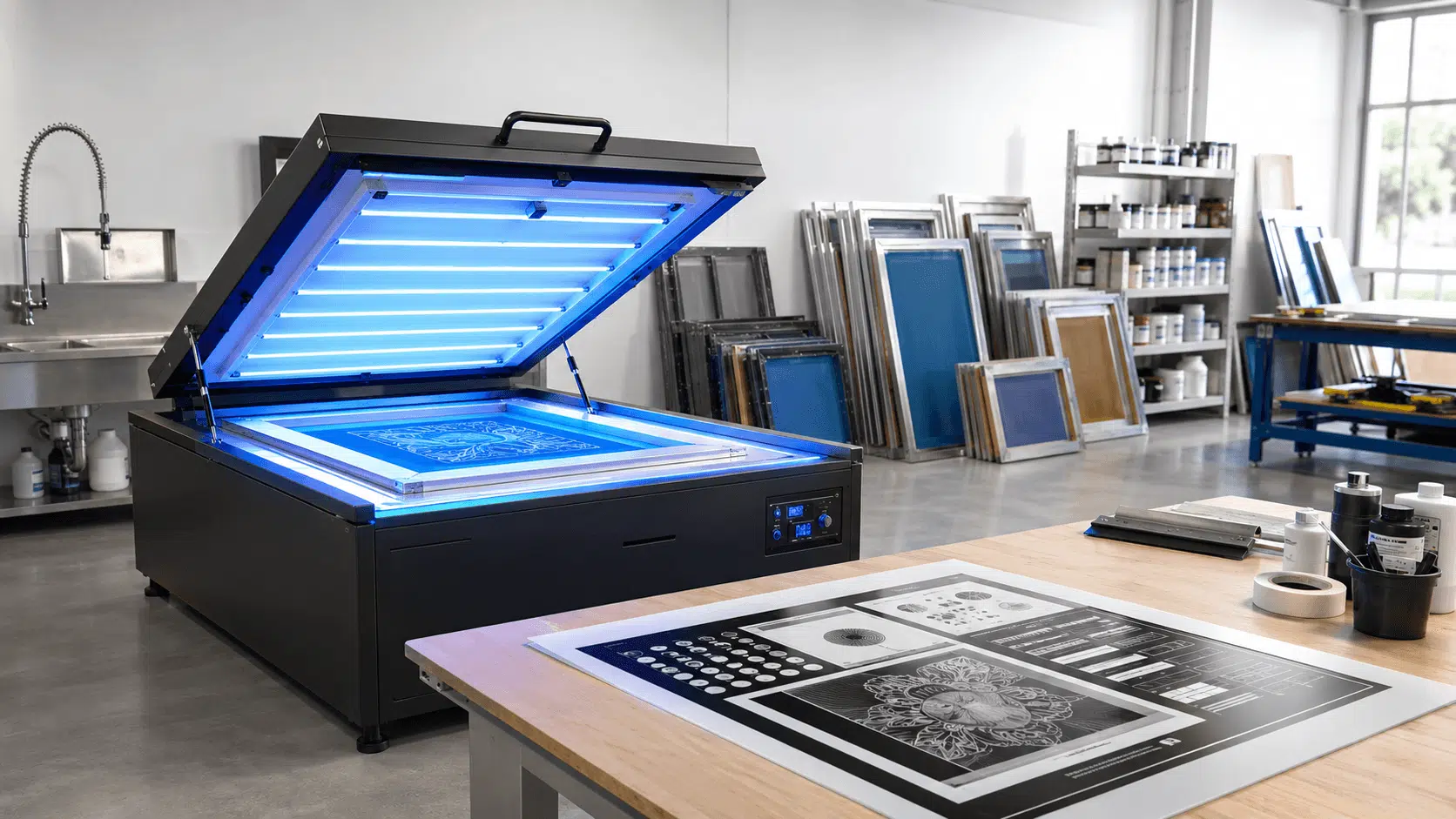
What Does a Screen Printing Exposure Unit Do?
A conventional exposure unit exposes a photo-emulsion-coated screen to controlled ultraviolet light.
A film positive placed against the coated screen blocks UV light in the artwork areas. The surrounding emulsion receives UV energy and hardens, while the image areas remain capable of washing open during development.
The equipment therefore needs to perform two jobs well:
1. Deliver suitable UV energy consistently across the stencil.
2. Maintain accurate contact between the film positive and coated screen.
The second point is especially important.
Even when exposure time is correct, a gap between the film and emulsion can allow light to spread around artwork edges. That can reduce definition in:
- fine lines;
- small lettering;
- halftones;
- registration marks;
- and detailed graphics.
For conventional film-positive workflows, this is one reason many professional exposure units include a vacuum frame or vacuum blanket.
Vastex and M&R both use vacuum systems in their current conventional exposure equipment to hold the positive and screen tightly against the exposure glass.
What Is the Best Exposure Unit for Screen Printing?
There is no single best exposure unit for screen printing for every shop.
A better question is:
Which exposure unit gives you the resolution, size, speed, repeatability, and capacity your production actually requires?
As a general starting point:
| Production Need | Exposure Unit Direction |
|---|---|
| Small shop, standard textile frames | Compact LED or UV exposure unit |
| Frequent screen production | LED unit with vacuum and repeatable timer |
| Fine lines and halftones | Good film contact plus controlled light geometry |
| Large-format printing | Large exposure area sized for the largest frame |
| Multiple screens per cycle | Larger bed capable of simultaneous exposure |
| Limited floor space | Tabletop or compact unit |
| Multiple repeat jobs | Digital presets can improve workflow |
| Film-positive workflow | Vacuum exposure is highly valuable |
| CTS workflow | Consider dedicated computer-to-screen equipment |
Do not select a machine based on one specification alone.
A fast machine that does not accommodate your frames is useless.
A large unit with poor contact control may not solve fine-detail problems.
And a sophisticated machine that far exceeds your actual screen volume may unnecessarily increase the investment.
1. Start with Your Maximum Screen Frame Size
Frame size should be one of the first specifications you check.
Do not confuse:
exposure area
with
screen frame outside dimensions.
The screen needs to physically fit on or inside the exposure system according to the manufacturer’s design.
Measure the largest frames you currently use:
width × length × frame profile
and check them against the machine specification.
Do not size the machine only for today’s jobs
Anatol recommends considering not only the screens a shop exposes today, but also the larger screens it may need if production equipment is upgraded later.
That is particularly relevant if you expect to move from:
- small manual textile screens to larger automatic-press frames;
- standard textile work to oversized graphics;
- one screen per exposure to multiple screens per cycle.
Buying slightly more usable exposure area than you currently need can make sense when future production requirements are reasonably predictable.
Buying far more capacity than you are likely to use usually does not.
2. Choose the Exposure Area Around Your Actual Frames
Exposure machines are available in significantly different working sizes.
For example, Hanze currently offers conventional screen exposure equipment with the following listed maximum exposure areas:
| Model | Maximum Exposure Area |
|---|---|
| LED Exposure Machine 20″ × 24″ | 20″ × 24″ / 50 × 60 cm |
| LED Exposure Machine 24″ × 32″ | 24″ × 32″ / 60 × 80 cm |
| Cold Light Exposure Machine | 24″ × 36″ / 60 × 90 cm |
| LED Exposure Machine 40″ × 48″ | 40″ × 48″ / 105 × 127 cm |
These sizes allow a buyer to match the exposure bed more closely to the screen formats being processed rather than using the same machine for every production scale.
The same approach is common across the industry. M&R’s current Starlight range, for example, is offered for maximum frame sizes of approximately 23 × 31 inches or 31 × 40 inches, while Vastex offers equipment capable of handling a single large screen or two smaller screens.
A practical rule
Choose an exposure bed that comfortably supports:
your largest regular screen + positioning tolerance + realistic future growth.
3. Decide Whether LED Is Right for Your Shop
UV LED technology is now widely used in screen exposure equipment.
Compared with older lamp technologies, purpose-built LED systems can provide several practical advantages:
- fast switching;
- low operating heat;
- efficient energy use;
- long light-source life;
- repeatable output;
- and short exposure cycles when properly matched to the emulsion.
M&R currently describes its UV LED Starlight systems as operating at lower temperatures and using less energy than metal-halide systems, while Vastex’s E-200 LED series highlights low power consumption, long LED life, and high-resolution exposure.
That does not mean every LED exposure machine produces the same result.
Two LED units may differ substantially in:
- wavelength;
- LED quantity;
- LED density;
- lamp-to-screen distance;
- light direction;
- output uniformity;
- optical design;
- and exposure area.
So a buying decision should not be reduced to:
LED = good
non-LED = bad.
The actual design of the exposure system matters.
LED Exposure Unit vs Traditional UV Exposure Unit
A simplified comparison looks like this:
| Factor | UV LED Exposure Unit | Traditional Lamp System |
|---|---|---|
| Warm-up | Usually immediate | May depend on lamp type |
| Heat output | Generally lower | Often higher |
| Exposure speed | Often fast | Depends heavily on source |
| Energy use | Generally lower | Can be higher |
| Light-source replacement | Usually infrequent | Depends on lamp technology |
| Maintenance | Relatively low | Lamp replacement may be required |
| Initial cost | Varies widely | Varies widely |
| Fine-detail capability | Depends on optical design | Depends on light geometry |
| Emulsion compatibility | Must be verified | Must be verified |
Older metal-halide systems historically became popular because a strong single-point UV source can produce sharp image edges.
Modern LED equipment has reduced many of the traditional operating disadvantages associated with older lamps, but LED array design is still important.
SAATI emphasizes that both wavelength and directionality influence stencil curing and resolution. Its current Pro-Lite systems use controlled 405 nm exposure and highlight the difference between directional single-source exposure and light arriving from multiple angles.
The purchasing lesson is simple:
Do not judge exposure quality by “LED” alone.
Ask how the light is delivered to the stencil.
Check the UV Wavelength and Emulsion Compatibility
Exposure equipment should produce light within a wavelength range that effectively activates the photo emulsion you use.
Different emulsions have different photosensitive characteristics.
For that reason, do not buy a screen exposure machine based only on its wattage.
A 300 W system operating inefficiently for a particular stencil chemistry is not automatically better than a lower-power system that delivers more useful UV energy.
Professional equipment manufacturers increasingly specify wavelength as part of exposure-system design. SAATI’s current exposure systems, for example, use targeted 405 nm light and identify wavelength as one of the major factors affecting stencil exposure.
Before purchasing, ask:
- What wavelength does the exposure unit use?
- Is it suitable for my current emulsion?
- Can the supplier provide exposure-test results?
- Does the emulsion manufacturer provide spectral guidance?
- Will I need to change emulsion when changing exposure systems?
Avoid assuming a specific wavelength is universally best for every stencil.
Compatibility should be confirmed with the actual emulsion and exposure process.
Why a Vacuum Exposure Unit Matters
For conventional film-positive exposure, a vacuum system is one of the most useful features on a professional exposure machine.
A vacuum exposure unit removes air and presses the screen, film positive, and exposure surface into close contact.
Why does this matter?
Because unwanted space between the positive and the stencil allows light to spread around artwork edges.
Poor contact can contribute to:
- blurred image edges;
- missing fine lines;
- loss of small type;
- weak halftone definition;
- and inconsistent resolution.
Vastex describes the vacuum system on its exposure equipment as providing strong screen-to-film contact, while M&R’s current Starlight system automatically waits until the selected vacuum condition is reached before exposure begins.
A vacuum system becomes especially important for:
- detailed artwork;
- small text;
- halftones;
- fine lines;
- high mesh counts;
- multi-color jobs;
- repeat production;
- and shops where multiple operators need consistent results.
For simple, low-resolution graphics, less sophisticated contact systems may still produce acceptable screens.
But if stencil sharpness and repeatability matter, vacuum performance deserves serious attention.
Vacuum Strength Is Not the Only Thing to Check
Buyers sometimes focus only on the vacuum pressure specification.
The complete vacuum system matters more.
Check:
- how quickly the unit pulls down;
- whether the blanket seals evenly;
- whether different frame profiles can be accommodated;
- whether vacuum remains stable during exposure;
- whether the pump is easy to service;
- and whether the system starts exposure only after proper contact has been established.
For example, Hanze currently lists a vacuum degree of 0.08 MPa on its 20 × 24 inch and 24 × 32 inch LED exposure units.
That specification is useful, but buyers should still evaluate the complete frame-contact system rather than treating one pressure number as a guarantee of stencil quality.
Evaluate Light Uniformity Across the Entire Exposure Area
A large exposure bed is useful only if it exposes the usable stencil area consistently.
Uneven UV output can cause one area of the screen to receive sufficient energy while another area remains underexposed.
This becomes increasingly important when exposing:
- large frames;
- multiple screens at once;
- oversized graphics;
- industrial screen-printing screens;
- or artwork covering most of the stencil.
M&R specifically emphasizes the density and uniform coverage of the LED array in its current Starlight exposure systems, while Vastex uses multiple LED light bars across its larger E-2000 exposure beds.
When comparing machines, ask whether the manufacturer can provide:
- exposure-area layout;
- lamp arrangement;
- uniformity information;
- sample exposure results;
- or test screens from different parts of the bed.
A machine should not be judged only by total lamp wattage.
Uniform usable exposure matters more than a large headline power figure.
Think About Resolution, Not Only Exposure Speed
Fast exposure is attractive.
It is easy to compare:
Machine A: 20 seconds
Machine B: 60 seconds
But exposure time alone does not tell you which machine makes the better stencil.
The real question is:
What resolution does the machine maintain at a properly cured exposure?
You need to consider whether your work includes:
- solid spot-color graphics;
- small lettering;
- thin rules;
- detailed logos;
- halftones;
- four-color process;
- technical printing;
- electronics;
- graphics printing;
- or other high-resolution applications.
SAATI’s current technical guidance emphasizes the relationship between light direction and edge definition, while Vastex rates some current LED systems for detailed halftone reproduction.
For a textile shop printing mostly bold designs, extremely high stencil resolution may not be the highest purchasing priority.
For a printer producing fine halftones or precision graphics, it may be one of the most important.
Match Exposure Speed to Daily Screen Volume
Exposure time starts to affect productivity when a shop makes many screens per day.
Suppose two exposure units require:
Unit A: 180 seconds per screen
Unit B: 30 seconds per screen
The difference may seem minor when producing two screens.
It becomes much more significant when producing dozens of screens every shift.
However, do not calculate productivity from UV exposure time alone.
The real cycle can also include:
- loading the screen;
- positioning the positive;
- vacuum drawdown;
- exposure;
- vacuum release;
- unloading;
- and preparing the next screen.
M&R’s current Starlight controller, for example, automates vacuum, exposure, and shutdown, while allowing saved exposure profiles.
That illustrates an important buying principle:
Workflow automation can matter almost as much as raw exposure speed.
How Much Production Capacity Do You Need?
A useful way to classify your requirement is:
Low Screen Volume
If you expose only a few screens each day, prioritize:
- reliable stencil quality;
- appropriate size;
- simple operation;
- and reasonable investment.
The difference between a 30-second and 90-second exposure may have little effect on total shop productivity.
Medium Screen Volume
As screen volume increases, start paying more attention to:
- LED exposure speed;
- vacuum cycle time;
- digital timer accuracy;
- saved settings;
- and operator consistency.
High Screen Volume
For high-volume production, evaluate:
- multiple-screen capacity;
- very short cycle times;
- repeatable presets;
- automated vacuum control;
- registration workflow;
- and whether computer-to-screen imaging may eventually make economic sense.
Consider Whether You Need Exposure Presets
A basic timer is enough for many screen-printing operations.
But shops working with several repeatable screen specifications may benefit from digital presets.
For example:
Preset 1
156 mesh + Emulsion A + 1/1 coating
Preset 2
230 mesh + Emulsion A + 1/1 coating
Preset 3
110 mesh + Emulsion B + thicker stencil
The operator can recall the tested exposure instead of entering the time manually for every screen.
Vastex’s E-2000 currently provides multiple exposure presets, while M&R’s Starlight can save and recall vacuum and exposure profiles.
Presets do not replace an exposure calculator.
You still need to test the screen first.
The preset simply makes the approved exposure easier to reproduce.
Check the Timer Range and Control Accuracy
Exposure time varies substantially depending on:
- emulsion;
- coating thickness;
- mesh;
- UV output;
- and light source.
For that reason, a useful control system should cover the exposure range required by your stencil system.
Hanze’s current 20 × 24 and 24 × 32 inch LED exposure units, for example, list timer ranges of 0–999 seconds.
More important than the maximum number is repeatability.
A screen room should be able to establish a tested exposure and reproduce it consistently.
For a detailed explanation of how to determine that value, see the separate Screen Printing Exposure Time: Complete Guide rather than relying on a universal time chart.
Check Your Electrical Supply Before Ordering
Electrical compatibility is easy to overlook when comparing equipment online.
Verify:
- voltage;
- frequency;
- phase;
- plug type;
- total power;
- and local electrical requirements.
Anatol specifically recommends confirming whether the shop can support the exposure unit’s electrical requirements before purchase because different equipment may require different supply voltages.
This becomes particularly important for international buyers.
Hanze’s current conventional exposure models list both 110 V and 220 V single-phase configurations depending on the model.
Before placing an order, confirm the exact electrical configuration with the supplier instead of assuming the machine will match the local workshop supply.
Consider the Machine Footprint
Exposure units can occupy significant darkroom space.
Before selecting one, measure:
machine width × depth × lid-opening height × operator working space
Do not use only the packing dimensions or exposure area.
You need enough space for:
- opening the lid;
- loading frames;
- positioning film;
- operating controls;
- maintenance;
- and moving screens between drying, exposure, and washout.
Compact exposure systems can be particularly useful in small screen rooms. Vastex and M&R both offer conventional exposure designs intended for tabletop or compact installation, and Vastex specifically markets some units as suitable for mounting above a drying cabinet to conserve space.
Look at the Entire Screen-Making Workflow
The exposure machine does not operate by itself.
Think about the path a screen follows:
stretching → degreasing → coating → drying → film positioning → exposure → washout → drying → inspection
The best exposure machine is one that fits smoothly into that workflow.
For example, placing the exposure unit close to:
- screen storage;
- drying cabinets;
- film preparation;
- and washout equipment
can reduce unnecessary screen handling.
However, protect coated, unexposed screens from unwanted UV light.
M&R notes that its enclosed Starlight system prevents the UV source from operating while the blanket frame is open, which allows the system to be used safely within an appropriate light-controlled screen-making environment.
Do You Need a Tabletop or Floor-Standing Exposure Unit?
Both arrangements can work well.
Tabletop Exposure Unit
Best suited when:
- screen size is moderate;
- floor space is limited;
- production volume is low to medium;
- or the machine will be integrated with other screen-room furniture.
Floor-Standing Exposure Unit
Useful when:
- screens are large;
- equipment is heavy;
- production is frequent;
- dedicated working height is preferred;
- or storage below the machine is not required.
Some commercial systems offer both configurations. M&R, for example, currently offers its conventional LED exposure platform as a tabletop or stand-mounted system.
The correct choice is primarily a workflow and ergonomics decision rather than an exposure-quality issue.
Think About Maintenance and Light-Source Life
Equipment cost does not stop at purchase.
Consider:
- replacement lamps;
- vacuum pump maintenance;
- vacuum blanket replacement;
- glass replacement;
- electrical components;
- filters;
- control boards;
- and availability of spare parts.
One reason LED exposure systems have become attractive is reduced dependence on frequently replaced traditional lamps.
M&R and Vastex both currently promote long LED operating life as a benefit of their exposure systems.
Ask the supplier:
- What components are considered consumable?
- Can the LEDs be replaced individually?
- How is the vacuum blanket replaced?
- Is replacement glass available?
- Are electrical components standard or proprietary?
- What technical support is available after purchase?
For an overseas equipment purchase, spare-part availability can be as important as the original machine price.
Consider the Total Cost, Not Just Purchase Price
The cheapest screen exposure machine is not always the lowest-cost machine to own.
Compare:
Purchase price
plus
energy use
plus
light-source replacement
plus
maintenance
plus
operator time
plus
rejected screens
plus
production downtime.
A more repeatable exposure process can reduce waste in ways that are difficult to see from the machine price alone.
For example, a screen that must be recoated and re-exposed because of inconsistent stencil quality consumes:
- emulsion;
- water;
- labor;
- film handling time;
- screen-room capacity;
- and production time.
The exposure unit should therefore be treated as a process-control investment, not simply a UV light box.
Ask for Actual Exposure Samples
One of the best ways to compare two exposure systems is to test them.
Anatol specifically recommends having actual shop screens exposed on the equipment being considered so stencil and print quality can be compared.
If possible, send the supplier:
- your typical mesh;
- your emulsion;
- your film positive;
- and representative artwork.
Include challenging details such as:
- small text;
- thin lines;
- halftones;
- solid areas;
- and registration marks.
Then evaluate:
- washout;
- edge sharpness;
- fine-detail retention;
- stencil cure;
- and exposure consistency.
A real screen test can reveal much more than comparing wattage tables.
Do You Need Conventional Film Exposure or CTS?
Not every shop needs film positives forever.
Computer-to-screen, or CTS, systems image artwork directly onto the screen and can remove film-output and manual film-registration steps from the workflow.
M&R currently offers both conventional UV LED exposure equipment and combined CTS imaging/exposure systems, while SAATI offers direct imaging and exposure platforms for higher-end screen-making workflows.
CTS can make sense when:
- screen volume is high;
- film consumption is significant;
- registration labor is substantial;
- automation is valuable;
- and the investment can be justified by production throughput.
For many small and medium-sized screen-printing operations, however, conventional film-positive exposure remains a practical and economical solution.
Do not buy CTS simply because it is more advanced.
Buy it when the economics and workflow justify it.
Screen Printing Exposure Unit Comparison Checklist
Before requesting quotations, build a comparison sheet.
| Item | What to Confirm |
|---|---|
| Exposure area | Will your largest screen fit? |
| Maximum frame size | Check outside dimensions |
| Light source | LED, fluorescent, metal halide, cold light, etc. |
| Wavelength | Is it suitable for your emulsion? |
| Light uniformity | Is the entire working area evenly exposed? |
| Vacuum system | Is contact strong and stable? |
| Vacuum cycle | How quickly does it reach working vacuum? |
| Timer | Is the range and control suitable? |
| Presets | Can repeat jobs be saved? |
| Resolution | Can it hold your required lines and halftones? |
| Exposure speed | What is the actual tested cycle? |
| Voltage | Does it match your facility? |
| Power consumption | Useful for operating-cost comparison |
| Footprint | Does it fit the darkroom? |
| Lid clearance | Is there enough vertical space? |
| Maintenance | Lamps, vacuum blanket, pump, glass |
| Spare parts | Can replacements be supplied easily? |
| Warranty | What components are covered? |
| Support | Is technical guidance available? |
| Future capacity | Can it support larger screens or more volume? |
This type of comparison is much more meaningful than comparing machines by price alone.
Which Exposure Unit Is Right for Different Types of Shops?
Small Startup or Low-Volume Screen Printer
Prioritize:
- compact footprint;
- standard textile frame compatibility;
- straightforward controls;
- reliable vacuum contact;
- and reasonable purchase cost.
A smaller LED screen exposure unit can be sufficient if your frame sizes are unlikely to increase substantially.
For example, Hanze’s current 20 × 24 inch LED model provides a 50 × 60 cm maximum exposure area, 0–999 second timer range, and listed vacuum system in a relatively compact format.
Growing Textile Printing Shop
Prioritize:
- larger frame capacity;
- faster LED exposure;
- stable vacuum;
- repeatable settings;
- and enough size for future automatic-press frames.
A medium-size unit can provide more flexibility without moving immediately into very large industrial equipment.
Hanze’s current 24 × 32 inch LED machine provides a 60 × 80 cm maximum exposure area and listed 0.08 MPa vacuum degree.
Large-Format or Industrial Screen Printer
Prioritize:
- large usable exposure area;
- light uniformity;
- structural stability;
- adequate vacuum/contact;
- and screen-handling ergonomics.
Hanze’s current 40 × 48 inch LED exposure model lists a maximum exposure area of approximately 105 × 127 cm, making it a more relevant format for larger screens than smaller textile-oriented models.
Fine-Detail and Halftone Printer
Prioritize:
- film-positive density;
- film-to-screen contact;
- vacuum reliability;
- light direction and uniformity;
- compatible wavelength;
- stable exposure control.
Do not make exposure speed your first criterion.
A slower system that consistently resolves your target detail is more valuable than a faster system that forces repeated screen remakes.
Common Mistakes When Buying a Screen Exposure Machine
Mistake 1: Choosing Only by Price
A low purchase price can be attractive, but an undersized or inconsistent exposure system may need to be replaced quickly.
Mistake 2: Choosing Only by Wattage
Lamp wattage does not directly tell you stencil resolution or usable UV energy.
Mistake 3: Assuming All LED Units Are the Same
LED wavelength, layout, directionality, density, and distance all affect the system.
Mistake 4: Ignoring Vacuum Contact
Fine detail depends heavily on keeping the film positive close to the stencil.
Mistake 5: Buying Exactly for Today’s Frame Size
A planned press upgrade may require larger screens later.
Mistake 6: Ignoring Voltage
Always confirm the actual power supply before shipment.
Mistake 7: Believing the Manufacturer’s Exposure Time Will Be Your Exposure Time
Actual exposure depends on your:
- emulsion;
- mesh;
- coating thickness;
- film;
- and screen-making process.
Exposure should always be tested with your own system.
Mistake 8: Assuming the Fastest Machine Is the Best
Stencil quality and repeatability are more important than the smallest number of seconds.
Questions to Ask an Exposure Unit Supplier
Before buying, ask the supplier:
- What is the maximum exposure area?
- What is the largest outside frame size the machine can accept?
- What UV light source is used?
- What wavelength does the unit operate at?
- Does it include a vacuum system?
- What vacuum specification does it provide?
- How long does vacuum drawdown normally take?
- What is the timer range?
- Can exposure presets be saved?
- What voltage and frequency configurations are available?
- What is the machine’s actual power consumption?
- What screen emulsions have been tested?
- Can the supplier expose a sample screen before purchase?
- What spare parts are available?
- What is the expected light-source service life?
- What warranty is provided?
- What is included in the shipment?
- What are the packed dimensions and weight?
- Is technical documentation provided?
- Can the machine support the screen sizes you may use in the future?
A supplier that can answer these questions clearly makes equipment comparison much easier.
Frequently Asked Questions
What is the best exposure unit for screen printing?
There is no single best machine for every printer. The best exposure unit is the one that matches your frame size, stencil-resolution requirements, screen volume, emulsion, film workflow, electrical supply, and expected future production.
Is an LED exposure unit better for screen printing?
UV LED exposure systems can offer fast switching, low heat, low energy use, and long light-source life. However, stencil quality also depends on wavelength, light geometry, uniformity, vacuum contact, and compatibility with the emulsion.
Do I need a vacuum exposure unit?
For conventional film-positive exposure, vacuum is highly useful because close film-to-screen contact improves image definition and repeatability. It becomes increasingly important when exposing fine lines, small text, halftones, and other detailed artwork.
What size exposure unit should I buy?
Measure the outside dimensions of the largest screen frames you regularly use, then choose a machine with sufficient usable area and sensible room for future growth. Anatol specifically recommends considering future frame-size needs when selecting equipment.
How many watts should a screen exposure unit have?
There is no universal wattage requirement. Total wattage alone does not indicate wavelength, light uniformity, spectral efficiency, or stencil resolution. Compare the complete exposure system rather than wattage by itself.
How fast should a good exposure unit expose a screen?
There is no universal target time. Exposure depends on the light source, emulsion, mesh, coating thickness, and stencil requirements. Establish the correct exposure with an exposure calculator rather than buying solely on a published number of seconds.
Can I expose two screens at once?
Some larger exposure units are designed to process multiple smaller screens simultaneously. Vastex, for example, currently offers a larger E-2000 configuration capable of holding either one larger screen or two smaller screens.
Can I use the same exposure unit for different emulsions?
Potentially, yes, provided the UV output is compatible with the emulsions. Each emulsion and screen combination should still be exposure-tested rather than using the same timer setting automatically.
Should I buy a larger exposure machine than I currently need?
A moderate amount of additional capacity can be useful if larger screens or higher production are realistically expected. Oversizing without a clear future requirement may add unnecessary cost and floor-space demand.
Is CTS better than a conventional exposure unit?
CTS eliminates film and some manual imaging steps, which can be valuable in high-volume operations. Conventional exposure remains practical for many small and medium screen rooms. The choice should be based on volume, workflow, registration requirements, and investment return rather than technology alone.
Final Thoughts
Choosing a screen printing exposure unit should begin with your printing process, not with the equipment catalog.
First determine:
What is the largest screen I need to expose?
Then ask:
How much detail do I need to reproduce?
How many screens do I make each day?
Which emulsions do I use?
Do I need vacuum contact?
How much screen-room space do I have?
What voltage is available?
Will my screen size or production volume increase?
Once those questions are answered, specifications such as LED technology, exposure area, vacuum system, timer range, and equipment size become much easier to compare.
For most conventional film-positive workflows, a well-matched exposure unit should provide four things above all:
suitable UV output, reliable film contact, sufficient screen capacity, and repeatable exposure control.
Exposure speed is important, but it should come after stencil quality and consistency.
If you are still determining the correct exposure itself, read Screen Printing Exposure Time: Complete Guide to understand how emulsion, mesh, coating thickness, UV source, and exposure calculators affect the final setting.
For the complete stencil-making procedure, see How to Expose a Screen for Screen Printing.
If you are ready to compare equipment, Hanze currently offers screen printing exposure units ranging from compact 20 × 24 inch and 24 × 32 inch LED models to 40 × 48 inch LED equipment and a 60 × 90 cm cold-light exposure machine for different screen formats and production requirements.