What Is a Screen Printing Drying Cabinet?
What Is a Screen Printing Drying Cabinet?
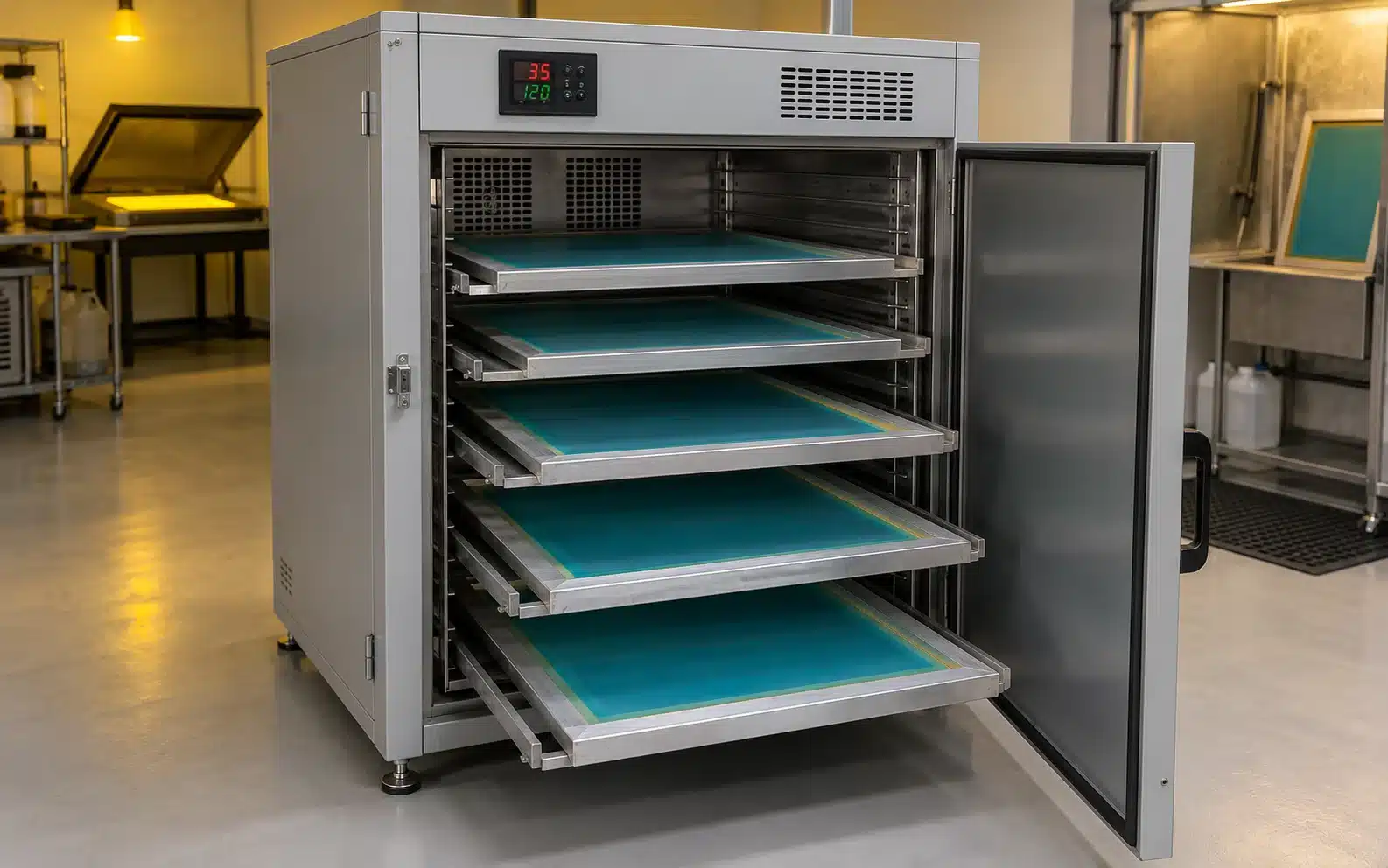
A screen printing drying cabinet is an enclosed machine used to dry screen frames during stencil preparation. Compared with leaving screens on an open rack, a cabinet provides a cleaner and more controlled environment for managing airflow, warmth, dust exposure, screen position, and drying consistency.
A drying cabinet is commonly used at three points in the screen-making process:
- after washing or degreasing the mesh and before applying emulsion;
- after coating the screen with photo emulsion and before exposure;
- after washing out the exposed stencil and before inspection or printing.
A screen drying cabinet prepares screen frames. It should not be confused with a flash dryer or conveyor dryer, which applies heat to ink printed on garments or other substrates.
Screen Printing Drying Cabinet at a Glance
| Question | Quick Answer |
|---|---|
| What does it dry? | Clean screen mesh, emulsion-coated screens, and washed-out stencils |
| Where is it used? | Screen room, darkroom, or stencil-making department |
| What does it control? | Air movement, temperature, screen position, light exposure, and contamination risk |
| What is it not used for? | Flashing or curing ink on printed products |
| Who benefits most? | Print shops and screen-making departments processing multiple screens regularly |
| What determines the setting? | Emulsion instructions, coating thickness, humidity, airflow, screen size, and cabinet load |
Where Does a Drying Cabinet Fit in the Screen-Making Process?
Screen drying is not an isolated operation. It connects mesh preparation, emulsion coating, exposure, washout, and final stencil inspection.
The complete screen-making process normally follows this sequence:
| Process Stage | Main Objective | Role of the Drying Cabinet |
|---|---|---|
| Mesh cleaning and degreasing | Remove oil, dust, ink residue, and chemicals | Dry the clean mesh before emulsion coating |
| Emulsion coating | Apply a controlled stencil layer | — |
| Coated-screen drying | Remove moisture before UV exposure | Provide a clean, light-controlled drying environment |
| Screen exposure | Harden the required stencil areas | — |
| Washout | Open the image areas | — |
| Final drying | Remove water from the developed stencil | Prepare the screen for inspection, blockout, or printing |
The coated-screen stage is particularly sensitive because photo emulsion reacts to light and must be thoroughly dried before exposure. Residual moisture can make exposure results less predictable and may contribute to soft stencil areas, difficult washout, or reduced stencil durability.
Once the coated screen is completely dry, continue with the correct procedure for exposing a screen for screen printing.
Why Is Controlled Screen Drying Important?
Photo emulsion contains water that must be sufficiently removed before the screen is exposed. Surface appearance alone does not always confirm that the entire coating has dried, especially when the stencil is thick, humidity is high, or airflow is limited.
An open drying rack may work inside a clean, dark, climate-controlled room. However, drying conditions can change with the season, workshop activity, room humidity, and the number of wet screens being processed.
A dedicated drying cabinet can reduce these variations by providing a more consistent drying environment.
More Repeatable Screen Preparation
Keeping screen position, temperature, airflow, and loading reasonably consistent makes it easier to repeat the same process across different batches.
A drying cabinet does not correct an unsuitable emulsion, uneven coating, poor film contact, or incorrect exposure. It controls one important variable so problems in other stages are easier to identify.
If screens continue to wash out poorly after drying conditions have been stabilized, review the factors covered in the screen printing exposure time guide.
Reduced Exposure to Dust
Wet emulsion can collect lint and airborne particles. Contamination may later appear as pinholes, weak stencil areas, or image defects.
An enclosed cabinet reduces direct exposure to the surrounding workshop. The actual level of protection still depends on cabinet sealing, air intake design, filtration, cleanliness, and maintenance.
Better Production Flow
Waiting for screens to dry can become a bottleneck when a screen room prepares several jobs per shift. A cabinet with suitable screen capacity allows coating, drying, exposure, and washout to be scheduled more predictably.
Drying capacity should match the complete prepress workflow. Increasing cabinet capacity provides limited value if the exposure unit or washout area cannot process the same number of screens.
How Does a Screen Printing Drying Cabinet Work?
Most screen drying cabinets combine an enclosed chamber with screen supports and a controlled heating system. Designs range from compact tray or drawer cabinets to larger vertical units for industrial screen formats.
| Cabinet Component | Function | What Buyers Should Verify |
|---|---|---|
| Enclosed chamber | Separates screens from the general workshop | Door fit, sealing, construction, and cleaning access |
| Trays, drawers, or supports | Hold screens during drying | Maximum outer frame size, clearance, and screen position |
| Heating system | Provides controlled warmth | Working range, controller accuracy, and safety protection |
| Air circulation | Moves moisture away from the screen | Airflow direction and distribution |
| Timer or controller | Helps repeat the selected process | Setting range, display, and parameter memory |
| Air intake or exhaust | Manages incoming air and moisture removal | Filtration, exhaust path, and maintenance requirements |
Not every cabinet includes active filtration, exhaust, or dehumidification. These features should be confirmed from the technical specification rather than assumed from the product name.
What Types of Screens Can Be Dried?
Clean Screens Before Emulsion Coating
After reclaiming, washing, or degreasing, the mesh must dry completely before emulsion is applied. Water remaining around the mesh or frame can interfere with coating uniformity and may carry residue back into the image area.
Screens entering the cabinet at this stage should be thoroughly rinsed. Chemical residue, ink remover, or dirty runoff should not be introduced into an area also used for freshly coated screens.
Emulsion-Coated Screens Before Exposure
Coated screens require the most controlled drying conditions. They should be protected from unintended UV exposure and kept away from dust.
Many direct-emulsion instructions specify horizontal drying with the print side facing downward and the squeegee side facing upward. The correct orientation and maximum drying temperature should always follow the technical data sheet for the specific emulsion.
The maximum temperature shown on a drying cabinet is an equipment limit. It should not be treated as the recommended operating temperature for every stencil material.
Developed Screens After Washout
After exposure and washout, water remaining on the stencil and inside fine image openings must be removed before the screen is inspected or taken to the press.
Clean airflow remains important, although protection from light is generally less critical after the stencil has been properly exposed and developed.
For the preceding development procedure, read how to wash out a screen after exposure.
How Is a Screen Drying Cabinet Different from Other Equipment?
Several types of drying equipment may appear in a screen printing workshop, but they do not perform the same function.
| Equipment | Main Purpose | Typical Use |
|---|---|---|
| Screen drying cabinet | Dries screen frames in a controlled enclosure | Mesh and stencil preparation |
| Screen drying rack | Holds screens or flat products during ambient drying | Storage and low-volume drying |
| Screen printing flash dryer | Gels or partially dries printed ink | Between print colors |
| Conveyor dryer | Continuously cures finished prints | Production printing |
A drying rack may be suitable for occasional production when it is installed inside a clean, dark, climate-controlled room. A drying cabinet becomes more valuable when humidity, dust, drying time, or daily screen volume begins affecting production consistency.
Using a screen drying cabinet to cure printed ink—or using an ink dryer to dry coated screens—can result in unsuitable temperature, airflow, and handling conditions.
Does Every Screen Printing Shop Need a Drying Cabinet?
A drying cabinet is not mandatory for every workshop. A small shop preparing only a few screens may use a clean, dark, low-humidity room with a suitable rack and controlled airflow.
Dedicated equipment becomes more useful when:
- multiple screens are coated every day;
- seasonal humidity changes drying time;
- dust contamination repeatedly causes defects;
- screens must be prepared on a predictable schedule;
- exposure results vary despite unchanged exposure settings;
- the screen room has limited space for a separate climate-controlled drying area;
- production is expanding from occasional jobs to repeat commercial work.
Industrial printers and centralized screen-making departments should also consider how cabinet capacity fits their exposure, washout, inspection, and screen-storage capacity.
For workshops planning several production stages together, the HANZE screen printing machines and equipment section explains how drying cabinets fit alongside exposure units, washout booths, presses, racks, and other equipment.
Information to Prepare Before Requesting a Quote
A suitable drying cabinet should be selected according to the actual screen frame and production requirement. Before contacting a supplier, prepare the following information:
- Maximum outer frame dimensions and frame thickness
- Number of screens required per batch and per working day
- Horizontal or vertical drying requirement
- Local voltage, frequency, and plug requirements
- Emulsion type and permitted drying conditions
- Installation space, packaging, and documentation requirements
Maximum image size should not be used as a substitute for outer frame size. The complete frame must fit inside the tray or cabinet with enough clearance for loading and air circulation.
HANZE currently supplies different configurations, including a compact 2-layer screen drying cabinet, a 4-layer screen drying cabinet, and larger vertical screen drying ovens.
Electrical and Market Compliance
Voltage, frequency, plug type, grounding, over-temperature protection, and conformity documentation may vary by destination market. Importers and distributors should confirm the applicable electrical and equipment-safety requirements before placing an order.
Installation and commissioning should be completed by qualified personnel where required by local regulations. Any certification or compliance mark should be confirmed for the exact model and configuration being supplied rather than assumed to apply to the entire product range.
Common Screen Drying Mistakes
Treating Maximum Temperature as the Working Setting
Higher temperature does not automatically produce a better stencil. Excessive heat may be unsuitable for the selected emulsion, adhesive, mesh, or frame.
Always follow the technical data for the emulsion being used and verify the drying process through actual production testing.
Overloading the Cabinet
Closely packed screens can restrict air circulation and create uneven drying. Cabinet capacity should reflect usable loading conditions, not only the number of available trays.
Mixing Dirty and Coated Screens
Recently reclaimed screens may carry moisture or chemical residue. Keep the cabinet clean and separate dirty-screen processing from coated-screen preparation through cleaning procedures or production scheduling.
Relying Only on Touch
A surface that feels dry may still retain moisture. Commercial screen rooms should validate drying through controlled conditions, recorded process times, humidity monitoring, or suitable moisture measurement rather than touch alone.
Screen Drying as Part of Process Control
A screen printing drying cabinet does more than shorten a waiting period. Its main value is reducing variation between screens.
Reliable stencil preparation depends on the complete system:
Clean Mesh + Consistent Coating + Complete Drying + Correct Exposure + Controlled Washout
Improving only the drying stage will not solve every stencil problem. However, controlling screen dryness makes coating and exposure results easier to repeat, diagnose, and document.
Explore all available screen printing drying cabinet configurations, or send HANZE your maximum frame size, frame thickness, daily screen quantity, local voltage, and intended application for an equipment recommendation and quotation.
Frequently Asked Questions
What is a screen printing drying cabinet used for?
It is used to dry screen frames during stencil preparation, including clean mesh before coating, photo-emulsion-coated screens before exposure, and developed screens after washout.
Is a screen drying cabinet the same as a screen drying oven?
The terms are sometimes used for similar equipment. “Screen drying cabinet” usually describes an enclosed prepress unit for screen frames, while “screen drying oven” may also describe larger or higher-capacity industrial equipment.
Buyers should verify the intended material, frame position, airflow, capacity, and working temperature rather than relying only on the product name.
Can a screen drying cabinet cure ink on T-shirts?
No. Ink on garments and other printed substrates is normally flashed or cured using equipment designed for the relevant ink system, such as a flash dryer or conveyor dryer.
What temperature should be used for drying emulsion-coated screens?
There is no universal setting. Use the maximum temperature and drying instructions provided for the specific emulsion.
Do not assume that the cabinet’s highest available temperature is suitable for routine drying.
Should coated screens dry horizontally?
Many direct-emulsion manufacturers recommend horizontal drying with the print side facing downward. This allows the coating to settle toward the print side.
The correct orientation should always be confirmed in the technical instructions for the stencil material being used.
Can reclaimed and coated screens use the same drying cabinet?
They can use the same cabinet if contamination is properly controlled. Reclaimed screens should be thoroughly rinsed, and the cabinet, trays, and supports must be kept clean.
Many production environments separate these stages through cleaning procedures or scheduled batches.
Is a drying cabinet better than a drying rack?
A cabinet provides greater protection from changing room conditions, dust, and unwanted light. A rack may still be suitable for occasional production when installed inside a clean, dark, climate-controlled room.