Tabletop vs Freestanding Screen Printing Washout Booth
Tabletop vs Freestanding Screen Printing Washout Booth
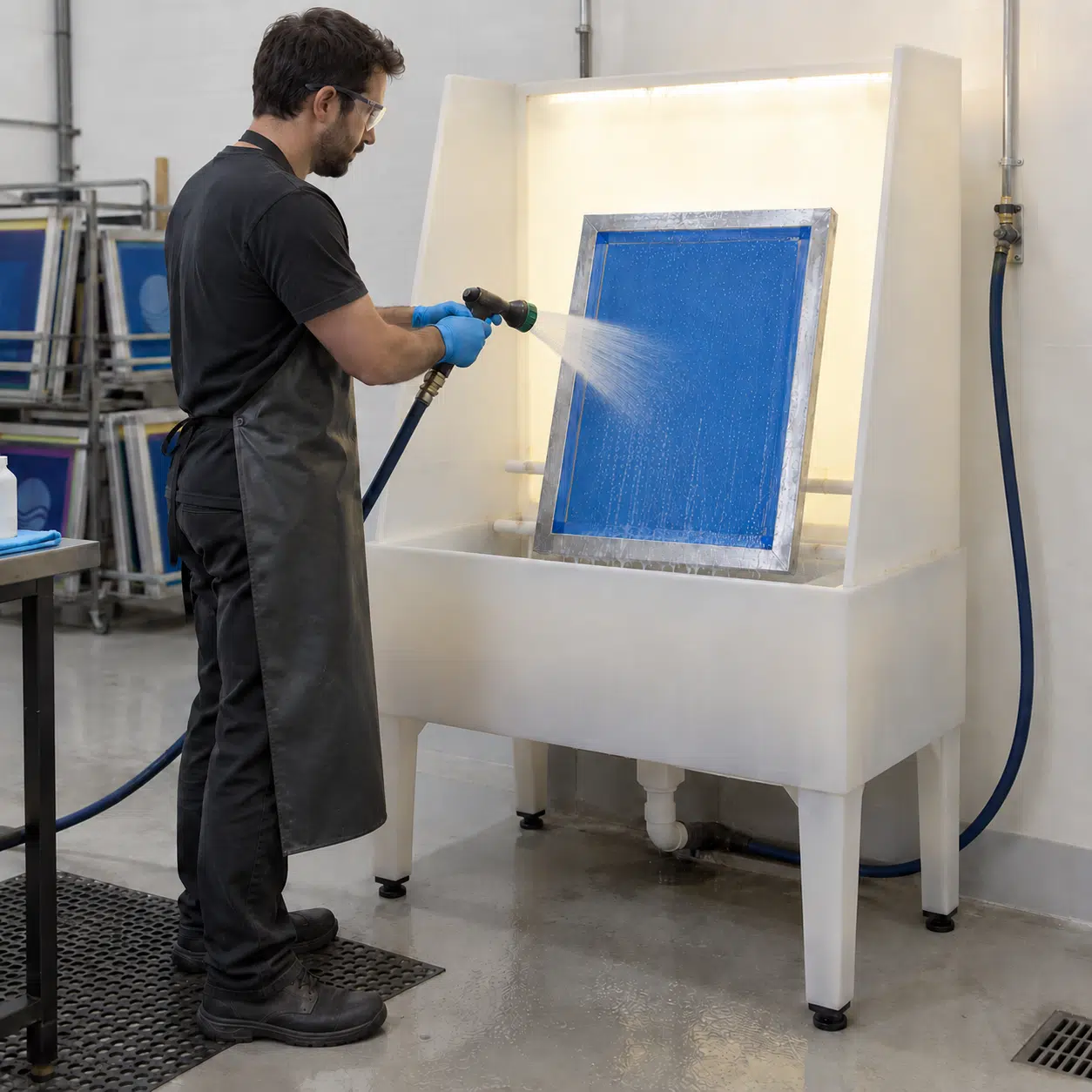
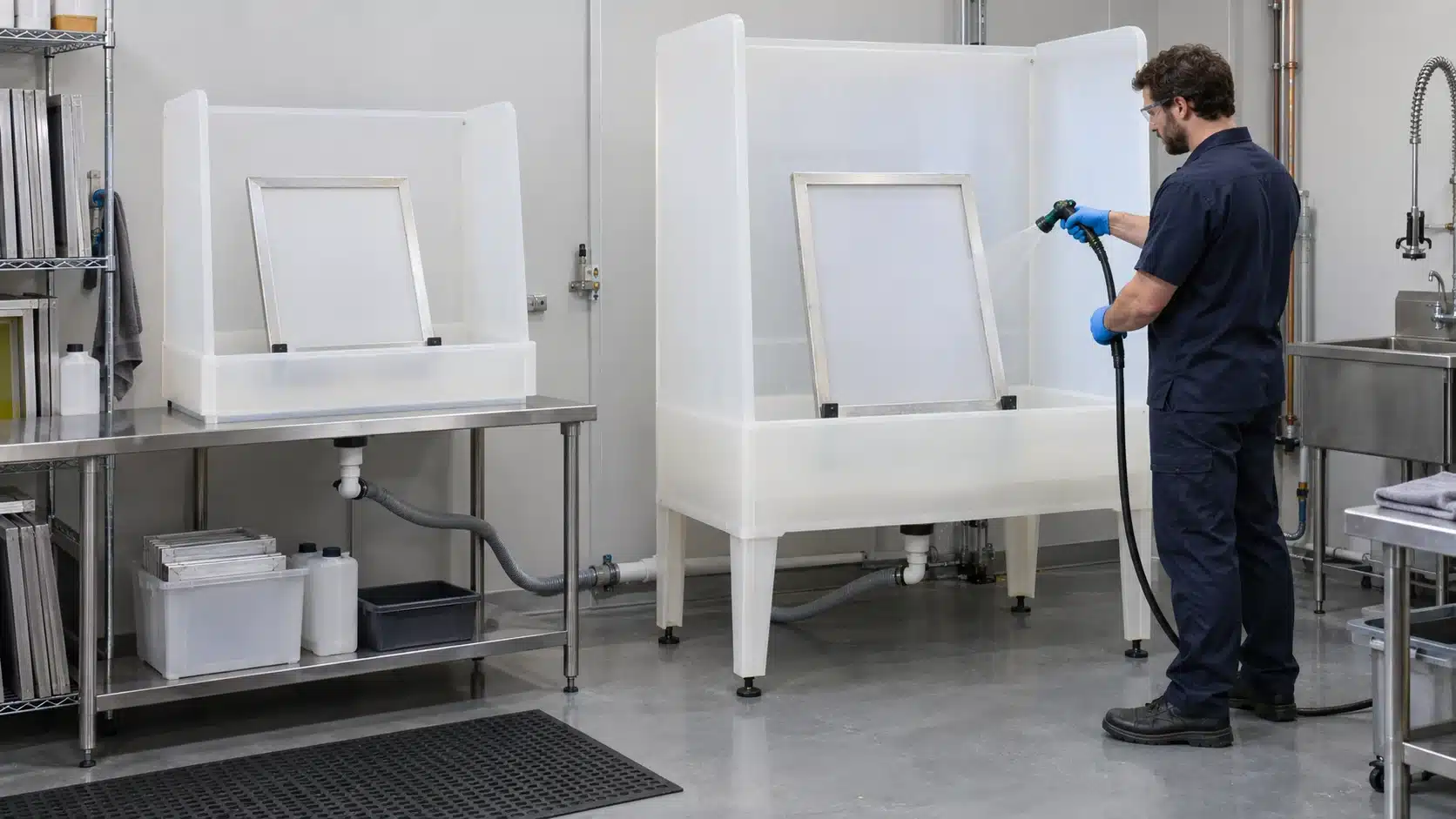
Tabletop and freestanding screen printing washout booths both provide a controlled place to develop exposed stencils and reclaim used screens. The real difference is not simply that one is smaller and the other is larger. The installation format affects frame clearance, operator posture, drainage layout, stability, storage, filtration access, and how easily the screen room can handle future production.
A tabletop booth is usually the practical choice for smaller frames, limited floor space, training rooms, sampling departments, and occasional screen processing. A freestanding booth generally makes more sense for regular production, larger or heavier screens, permanent plumbing, and a dedicated wet-processing area.
Neither format is automatically better. Choose according to the largest outside frame dimensions and the complete installed workflow—not the booth name alone.
Quick Comparison
| Selection Factor | Tabletop Washout Booth | Freestanding Washout Booth |
|---|---|---|
| Installation | Sits on a suitable counter, bench, cabinet, or stand | Installs directly on its own legs or base |
| Typical space use | Compact equipment footprint, but requires a supporting surface | Uses dedicated floor space |
| Frame capacity | Commonly selected for smaller standard frames | Better suited to larger or heavier frames |
| Working height | Determined by the booth plus supporting surface | Usually established by the equipment design |
| Stability | Depends partly on the supporting structure and anchoring | Integrated base generally provides a more permanent station |
| Drain routing | Must work around the counter and available drop below the drain | Often provides more direct access beneath the basin |
| Filtration placement | May require a cabinet, adjacent unit, or separate floor space | Filters or collection equipment can often be planned below or beside the booth |
| Relocation | Usually easier to move after utilities are disconnected | Better suited to a fixed screen-room layout |
| Typical application | Small shops, samples, training, backup station | Regular screen making and reclaiming |
1. Start with the Largest Outside Frame Size
Frame capacity should be the first decision. Measure the complete outside width and height of the largest screen that will enter the booth. Do not use the printed image size, mesh opening, or a nominal frame description as a substitute for an actual measurement.
A screen that only just fits may still be difficult to use. The operator needs enough clearance to place the frame on its supports, reach the corners, direct the spray across the mesh, inspect the edges, and remove the screen without striking the side panels.
Tabletop models are often appropriate when all production screens remain within a smaller, consistent size range. A freestanding unit becomes more practical when the shop processes several frame sizes, handles heavier frames, or needs more room around the screen.
Before ordering, send the supplier the largest outside frame dimensions, frame profile depth, and approximate weight. Ask for the stated maximum frame capacity rather than judging capacity from the booth’s overall width.
2. Compare Real Space Use, Not Just Booth Dimensions
A tabletop washout booth can conserve floor space because it uses an existing counter or stand. It may also leave storage space below the work surface. However, the supporting surface is part of the installation and must be included in the layout.
Check whether the bench is:
- wide and deep enough to support the complete booth;
- level, water-resistant, and easy to clean;
- strong enough for the booth, screen, water, hoses, and operating load;
- positioned at a comfortable working height;
- and arranged so the unit cannot slide or tip during spraying.
A tabletop booth does not save much space if a new oversized cabinet has to be built solely for it. Measure the complete bench-and-booth footprint before comparing it with a freestanding unit.
A freestanding booth occupies a defined floor area but simplifies layout planning. Its legs or base create a dedicated wet station, and the area below or beside the basin may be used for drain routing, a collection container, or compatible filtration equipment. Confirm the actual access space because braces, panels, and drain fittings can limit what fits underneath.
3. Consider Daily Workflow and Ergonomics
The number of screens processed per day matters, but screen size and handling effort matter just as much.
A compact tabletop booth can work efficiently for short runs, samples, occasional stencil development, and low-volume reclamation. If operators process screens repeatedly throughout a shift, an improvised counter height or limited internal clearance can create unnecessary bending, reaching, and frame repositioning.
A freestanding booth normally provides a more permanent loading position and is easier to integrate into a repeatable workflow. It is often preferable when the station is used every day, when screens are heavy, or when reclamation involves pressure washing after the correct chemical treatment.
Evaluate the operator’s position with a frame in place. The user should be able to control the rinse gun or pressure-washer wand without lifting the shoulders excessively, bending continuously, or twisting around the side panels. Also check that hoses do not cross the main walking path.
4. Plan Drainage Before Choosing the Format
Drainage is one of the biggest practical differences between a successful installation and a frustrating one.
With a tabletop booth, the drain outlet must pass through or around the supporting surface. There must be enough vertical drop for the hose, trap, filter, or collection container without creating a kink or a section that holds residue. If the booth sits on a closed cabinet, maintenance access must be designed into that cabinet.
A freestanding unit often provides a clearer route from the pan to equipment below or beside it. Even so, confirm the drain position, outlet size, gravity-flow route, hose diameter, filter height, and service access before installation.
Neither format automatically includes wastewater filtration. A drain simply transfers runoff. Ink, emulsion, reclaiming residue, and dissolved chemicals still require an appropriate collection, filtration, treatment, or disposal plan based on the materials used and local discharge requirements.
5. Do Not Assume Freestanding Means Better Backlighting
Backlighting is determined by the booth construction and selected options, not by whether the unit is tabletop or freestanding.
A translucent or backlight-ready rear panel can help an operator see unopened image areas, residual emulsion, pinholes, blocked mesh, and haze. It is useful for both developing newly exposed screens and inspecting reclaimed mesh.
Confirm whether the quotation includes an installed light, only provides a panel that can be backlit, or excludes lighting entirely. Any light and electrical components used near water should be installed according to the applicable equipment instructions and local electrical requirements.
6. Compare Total Installed Cost
The tabletop model usually has a lower equipment and shipping cost, but the booth price alone is not the final cost. Add the counter or stand, waterproofing, plumbing modifications, lighting, hose kit, filtration, and installation labor.
A freestanding model may cost more to purchase and ship, yet it can reduce the need to fabricate a separate support. It may also provide a cleaner route for permanent plumbing and future filtration.
Compare both options using the same cost scope:
| Cost Item | Questions to Ask |
|---|---|
| Booth | What panels, supports, fittings, and legs are included? |
| Supporting structure | Does the tabletop model require a new bench or cabinet? |
| Water delivery | Are the rinse hose, spray gun, pump, or pressure washer included? |
| Backlight | Is it installed, optional, or supplied locally? |
| Drainage | What fittings, hose, trap, and plumbing work are required? |
| Waste handling | Is filtration or collection equipment included? |
| Freight and assembly | What are the packed dimensions, weight, and assembly requirements? |
| Future changes | Can the station accept larger screens or added filtration later? |
Which Washout Booth Should You Choose?
| Your Situation | Better Starting Choice | Why |
|---|---|---|
| Limited space and consistently small frames | Tabletop | Compact installation without committing a full floor station |
| Training room or sample department | Tabletop | Suitable for intermittent use and easier relocation |
| Existing counter with suitable strength and drainage access | Tabletop | Uses infrastructure already available |
| Screens processed every working day | Freestanding | Creates a stable, repeatable wet-processing station |
| Larger, heavier, or mixed frame sizes | Freestanding | Usually provides more capacity and handling clearance |
| Regular screen reclamation and pressure washing | Freestanding | Better suited to a permanent, stable installation |
| Planned filtration beneath or beside the basin | Usually freestanding | Often provides easier drainage and service access |
| Screen room expected to expand | Freestanding | Offers a stronger base for a long-term workflow |
The table is a starting point, not a substitute for checking dimensions. A well-supported tabletop booth can serve regular production, while a compact freestanding booth may still be unsuitable for an oversized frame.
HANZE Tabletop and Freestanding Options
HANZE offers two polypropylene configurations for different screen-room layouts. Both use 5/16-inch natural polypropylene, a welded main pan, locking side and back panels, built-in screen supports, and a structure designed to be easy to backlight.
| Model | Installation | Equipment Dimensions | Maximum Frame Size | Packed Size and Weight | Best Fit |
|---|---|---|---|---|---|
| HZI-CBT-MINI2227 22 × 27 Washout Booth | Tabletop | 26 × 18 × 34 in | 22 × 27 in | 790 × 700 × 230 mm; 15.50 kg | Compact screen rooms, samples, training, and countertop installation |
| HZI-CBT-STD2331 23 × 31 Washout Booth | Freestanding | 32 × 24 × 64 in | 23 × 31 in | 850 × 890 × 260 mm; 34.20 kg | Dedicated screen rooms and regular processing of standard commercial frames |
Choose the tabletop model when all frames fit within its verified capacity, a suitable counter is already available, and flexibility is more valuable than a permanent floor station.
Choose the freestanding model when the additional frame capacity is needed, the booth will be used regularly, or the screen room requires a dedicated station with more straightforward utility integration.
Seven Checks Before Ordering
Before requesting a quotation, confirm:
- The largest outside frame width, height, profile depth, and weight.
- The available equipment space, including loading and operator clearance.
- Whether a suitable bench is available for a tabletop model.
- The drain outlet, hose route, gravity drop, filtration, and maintenance access.
- Whether backlighting, rinse equipment, fittings, and hoses are included.
- The typical and peak number of screens processed per shift.
- The packed size, shipping method, assembly requirements, and destination utilities.
A photo or simple drawing of the proposed washout area can help the supplier identify clearance and drain-routing problems before shipment.
Frequently Asked Questions
Can a tabletop washout booth sit on any table?
No. The surface must support the complete operating load, resist water, remain level, and provide enough depth to support the booth safely. Drain access, working height, and protection against sliding or tipping must also be considered.
Is a freestanding booth always better for pressure washing?
Freestanding construction is often preferable for regular reclamation because it creates a stable station, but installation format alone does not guarantee safe pressure washing. Screen supports, frame condition, nozzle pattern, pressure, distance, and operator technique remain important.
How should washout booth capacity be checked?
Measure the largest frame from outside edge to outside edge and compare it with the manufacturer’s stated maximum frame size. Leave enough working clearance to load, support, rinse, inspect, and remove the frame safely.
Can both types be used for stencil development and screen reclamation?
Yes, if the material, supports, drainage, and operating method suit both processes. Stencil development normally uses controlled, gentler water pressure, while reclamation may use compatible chemicals and higher pressure after the old stencil has softened.
Does a tabletop washout booth need a filter?
Filtration requirements depend on the process waste and local discharge rules, not on installation format. A tabletop booth may connect to a separate filter or collection container, but the available drain height and maintenance space must be checked.
Is backlighting necessary?
It is not essential for every job, but it makes fine-detail development and reclaimed-screen inspection easier. Verify whether the booth is backlit, backlight-ready, or supplied without lighting.
Final Recommendation
Choose a tabletop screen printing washout booth when space is limited, frames are consistently small, and the facility has a strong, correctly sized work surface with practical drain access.
Choose a freestanding screen printing washout booth when screen processing is a regular part of production, frames are larger or heavier, or the wet area needs a stable station with permanent plumbing and room for future accessories.
The safest purchasing decision is based on measured outside frame dimensions, usable working clearance, daily workflow, drainage, and total installed cost. For a broader specification checklist, read How to Choose a Screen Printing Washout Booth, or view the complete Screen Printing Washout Booth category.
To request a recommendation, send HANZE your largest frame dimensions, daily screen volume, available installation space, preferred tabletop or freestanding format, drainage plan, backlight requirement, and delivery destination.