What Are the Advantages of Rotary Screen Printing?
What Are the Advantages of Rotary Screen Printing?
A cream motif on navy fabric, a glitter accent on apparel yardage, and a scarf that shows its pattern on the back all pose different printing problems. Rotary screen printing is useful in each case because the mill can choose a print paste and control how it is deposited on the fabric. The same process also lends itself to long runs of repeat patterns once the screens are engraved and the colors are lined up.
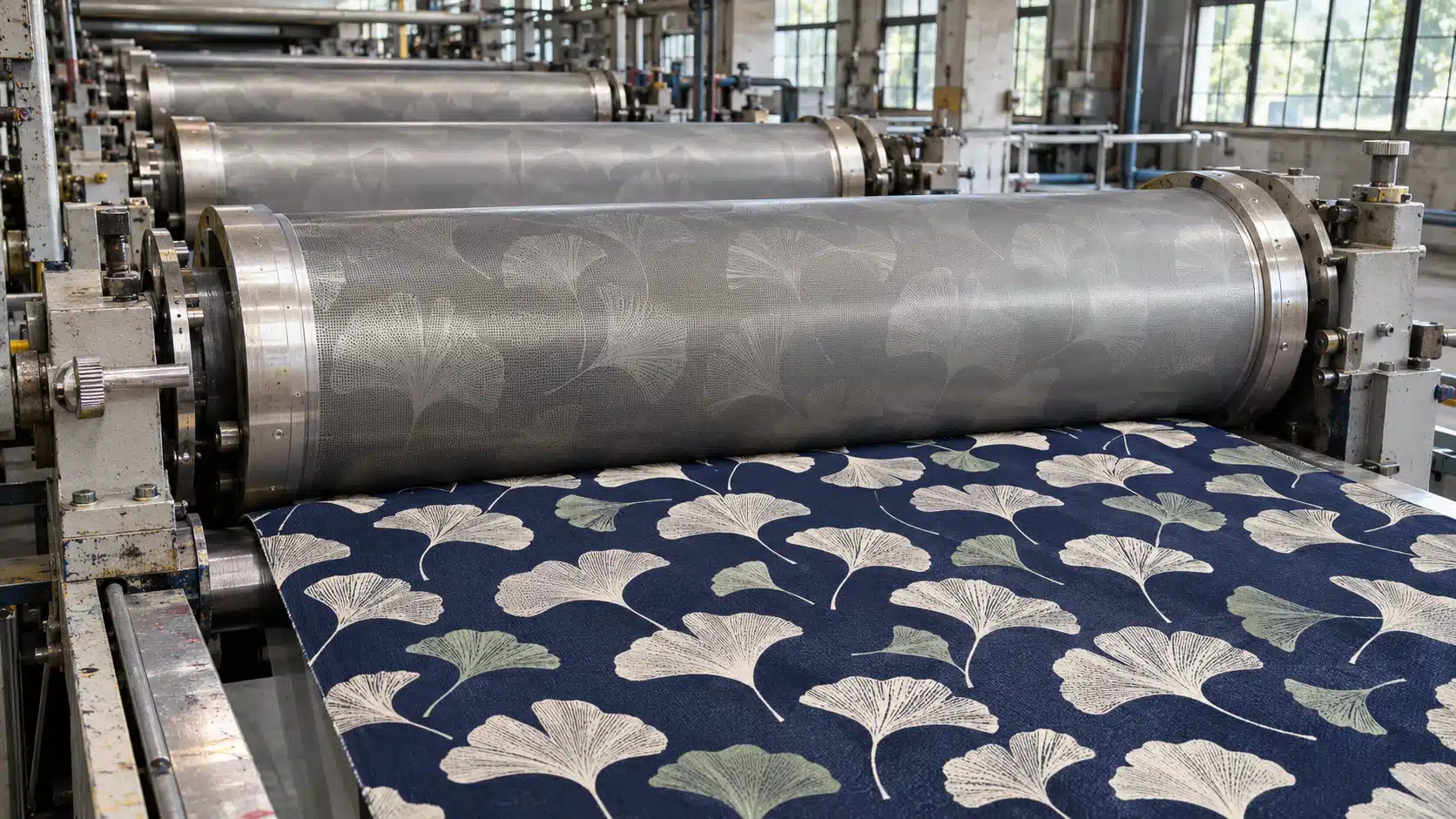
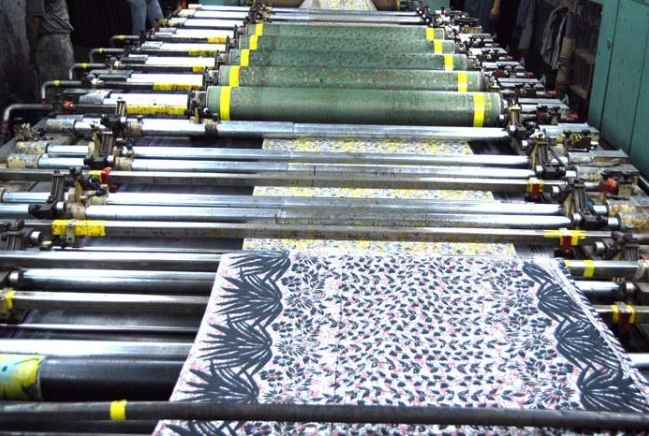
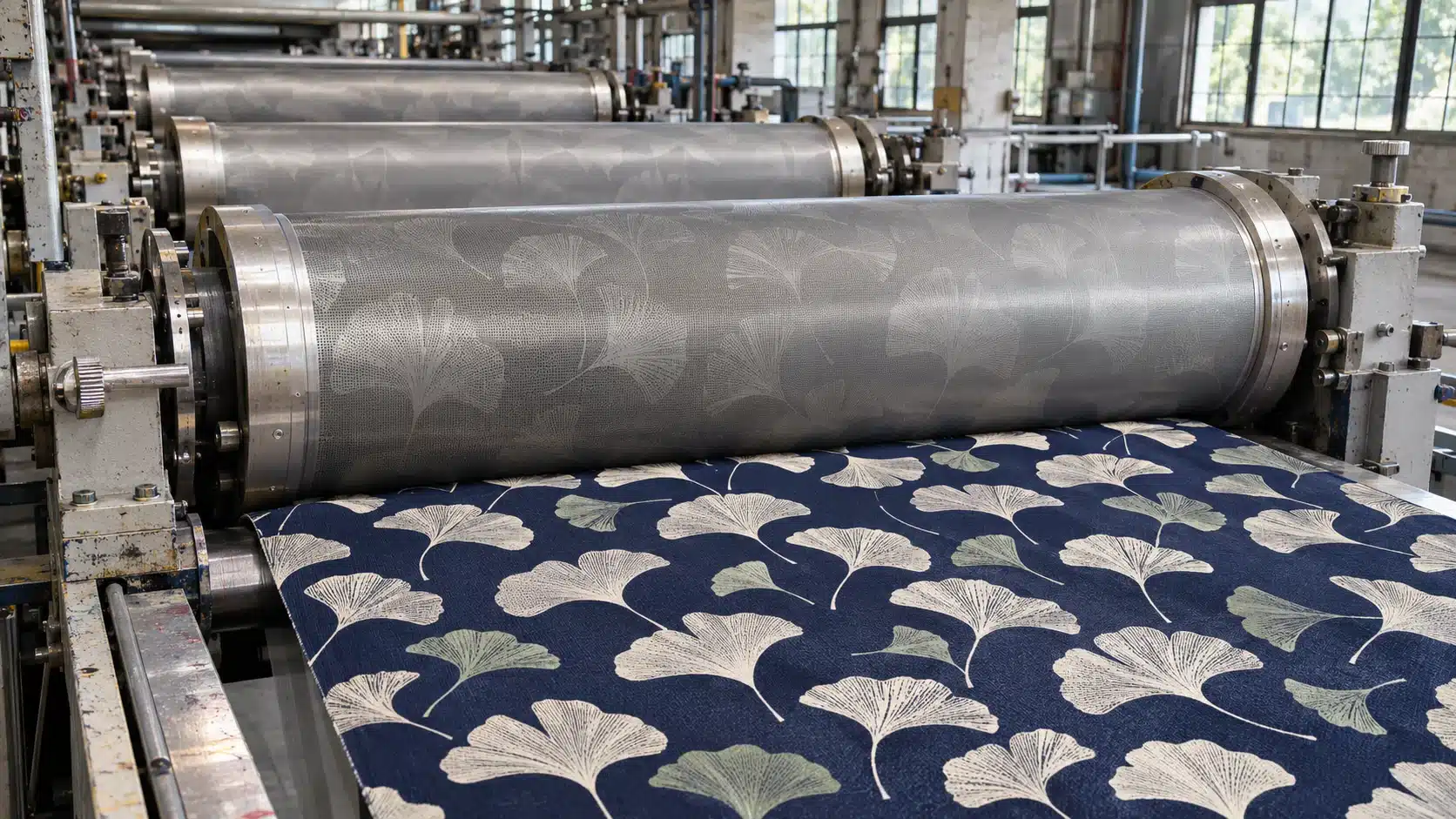
A rotary line prints fabric by the roll. Inside each rotating nickel screen, a squeegee or magnetic rod pushes paste through the open parts of the stencil. A conventional spot-color design typically uses one screen per printed color or effect layer. The screen, paste, and fabric work together, so the best way to judge a job is to approve a finished sample on the intended fabric.
>> Rotary screen printing workflow
1. Print Light Motifs on Dark Fabric
If the brief calls for a cream design on navy cotton, the mill can trial two routes. Discharge printing uses a paste that breaks down the ground dye in the printed areas. The paste can leave a lighter mark or add a new color in those areas. The result depends on the original dye, so the same recipe can give different shades on two fabrics that look like the same navy.
Opaque pigment printing uses a paste formulated to cover the dark ground. It is worth sampling when the ground dye gives an uneven discharge or the brief calls for strong surface coverage. Compare the finished proofs for shade, opacity, hand feel, and rubbing fastness. Use fabric from the intended production dye lot and judge the samples after the required curing or washing steps.
2. Run Different Fabrics on a Suitable Rotary Line
A mill can use a suitable rotary line for more than one fabric by changing the paste, fabric handling settings, and finishing route. Cotton can be printed with reactive dyes, which typically need steaming and washing, or with pigments held by a binder that is cured. A mill printing a cotton–polyester blend may trial a pigment system to color both fibers with one formulation. Start with the fiber content, then confirm that the chosen process delivers the required shade, hand feel, and fastness.
Fabric construction matters as much as the fiber name. A stretch knit needs to feed evenly for the repeat to keep its shape. On a pile fabric, a solid patch can look different when the pile is brushed in the opposite direction. For those jobs, proof the actual construction and check repeat size, coverage, and shade after finishing.
3. Apply Glitter, Grip Dots, and Other Special Effects
A rotary screen can deposit more than color. The same basic method can apply a glitter paste to a pattern, a functional coating to a backing, or a paste that changes the texture of selected areas. Each effect has its own screen and finishing requirements.
| Effect | What to check on a finished trial |
|---|---|
| Glitter accents on fashion yardage | Check that particles pass through the screen consistently, the edges stay clear, and the glitter stays bonded after the specified care test. |
| Grip dots on textile backing | Check dot shape, adhesion, and grip against the intended contact surface after the applicable wear or cleaning test. |
| Burnout, also called devoré, on a compatible fabric | Check that the paste selectively removes the intended fiber in the pattern and that the remaining fabric meets the required strength and appearance. |
For thicker deposits, look at the actual hole size and open area, the percentage of screen surface occupied by openings. With a particle-loaded paste, the hole size helps determine whether the particles can pass. Open area, the paste’s flow, and press settings also affect how much material lands on the cloth. For heavy backgrounds or coatings, a high-open-area screen is one option to trial with the actual paste and artwork.
4. Control How Much of the Design Shows on the Back
A scarf twists and folds as it is worn, so the back can matter almost as much as the face. Rotary printing gives the mill ways to adjust how far the paste penetrates, including screen selection, paste viscosity, and the squeegee or magnetic rod setting. The fabric’s thickness and structure also affect the result. A change that brings more color through may soften fine edges, so check both sides of the trial.
Agree on what the back needs to look like before bulk production. For one design, a recognizable motif on the reverse may be enough. For another, the buyer may require a close shade match on both faces. Compare both sides of the finished proof under the same lighting. If the cloth is thin, inspect it over an opaque backing so you can tell how the back looks without light passing through the fabric.
5. Spread Screen and Setup Costs Across Long Runs
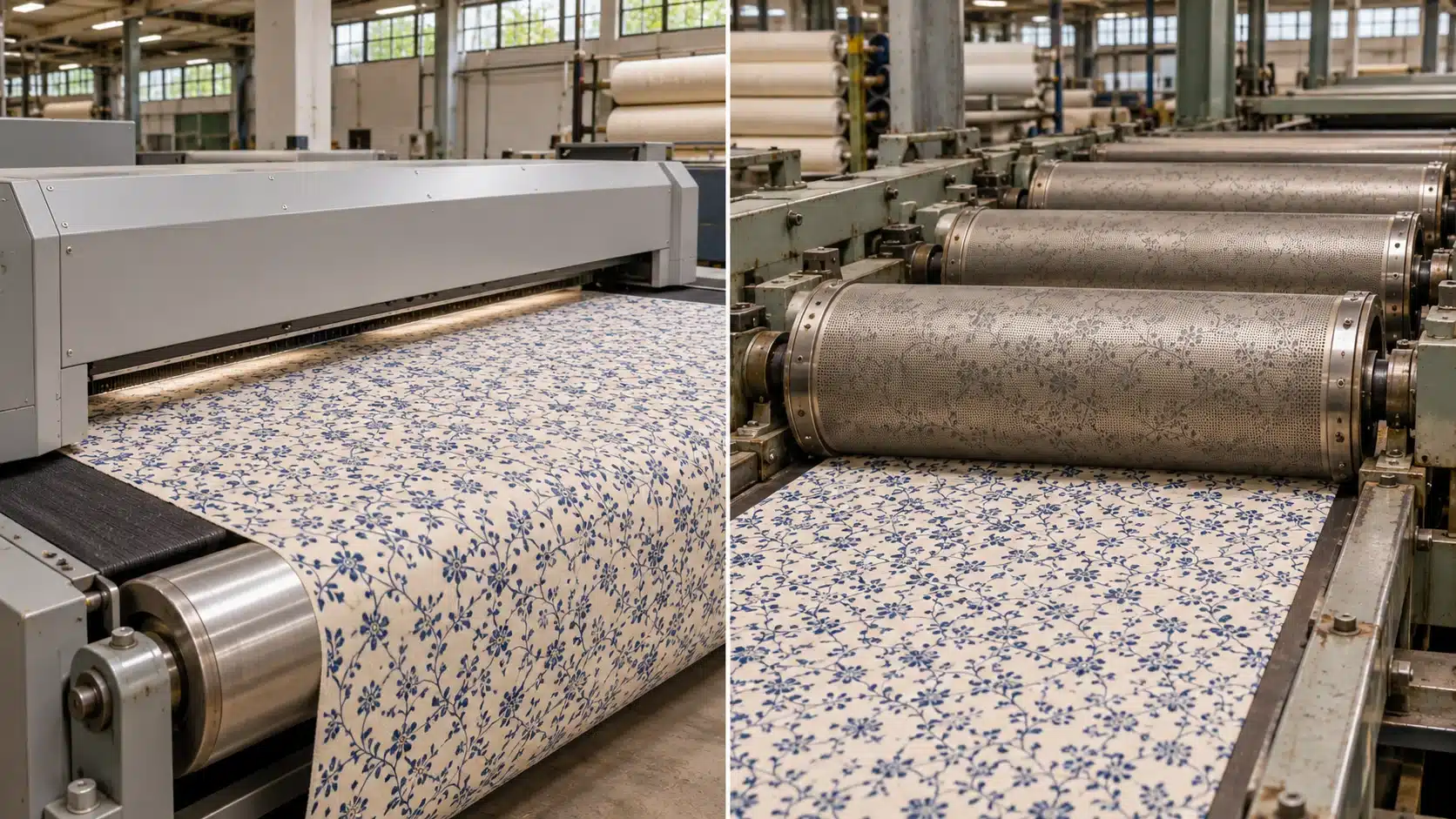
Every new rotary design carries preparation costs such as separation, engraving, and registration. Once the line is set up, the cylinders repeat the design as the fabric runs. With the same setup charge, a 5,000-meter run carries one-tenth of the setup cost per meter of a 500-meter run. The overall price still depends on paste, labor, finishing, changeovers, and usable yield.
When quoting a reorder, ask which engraved screens are still in good condition and can be used again. If the same separations work for a new colorway, the screens may carry over while the mill still budgets for paste changes and a proof. Compare setup and running costs at the actual meters per design and colorway.
>> Digital vs. rotary printing cost comparison
What to Approve Before a Bulk Rotary Run
Give the mill an artwork file, the production fabric, and a description of the finished effect. Use a trial that runs at representative settings so the approval covers the way the design will actually be printed.
| Approval item | What to record |
|---|---|
| Pattern and registration | Check whether adjacent colors line up and whether a join shows where the design repeats. |
| Shade and coverage | Keep the approved finished swatch and agree on the lighting for comparison. Check the solid areas and the smallest details. |
| Front and back appearance | Approve both sides if the reverse will be visible in use. Record the expected depth of color and clarity on each face. |
| Durability and hand feel | Agree on the relevant tests for the end use, such as washing, rubbing, or coating adhesion, and compare the feel of the finished cloth. |
| Production consistency | Check across the usable fabric width and at intervals along the trial run. Record any shade drift, repeated marks, or changes in coverage. |
Keep the approved swatch with the screen IDs, paste recipe, and trial settings. The production team can use that record to set up the bulk run or diagnose a change in shade or coverage.
Frequently Asked Questions
Does a 640 mm screen require a 640 mm artwork repeat?
The artwork repeat in the running direction can fill the circumference or divide evenly into it. For example, two 320 mm repeats fit around a 640 mm screen at engraving size. Ask the mill to confirm the artwork dimensions before engraving, especially when the order specifies a repeat size on the finished cloth.
Can rotary screen printing reproduce fine details and gradients?
A rotary screen can reproduce fine detail and use halftone dots to simulate a gradient. The smallest detail the line can hold depends on screen and engraving resolution, how the paste flows, and how much it spreads on the fabric. Put the smallest lines and the lightest halftones on the trial and assess them after finishing.
Can a mill combine rotary and digital printing on the same fabric?
Yes, where the line and materials support it. One example is a digitally printed base design with a rotary-applied effect layer. If the layers have to line up, approve their registration on the combined sample. Also check that curing or finishing the effect layer preserves the base print.
Request a Rotary Screen Quote for Your Application
If you are specifying screens for a new design or a repeat order, send HANZE your press model, screen circumference and length, usable print width, and endring type. Include the fabric construction, paste type, artwork or swatch, and expected order quantity. If you are replacing an existing screen, include its mesh and open area when available. These details help match the screen to the press and the deposit you need. Ask for the applicable MOQ and lead time when you request a quote. Rotary nickel screens · Aluminum endrings