How to Choose a Screen Printing Drying Cabinet
How to Choose a Screen Printing Drying Cabinet
Choosing a drying cabinet is not simply a choice between two or four layers. The cabinet must fit your largest frame, hold enough screens for peak production, match the destination power supply and dry coated screens under controlled conditions.
This B2B buyer’s guide explains how to choose a screen printing drying cabinet without paying for unsuitable capacity or discovering an installation problem after delivery. It focuses on equipment selection. For a basic equipment overview, read what a screen printing drying cabinet is.
If you already know your frame size and production target, you can also compare HANZE screen printing drying cabinets while using the checks below.
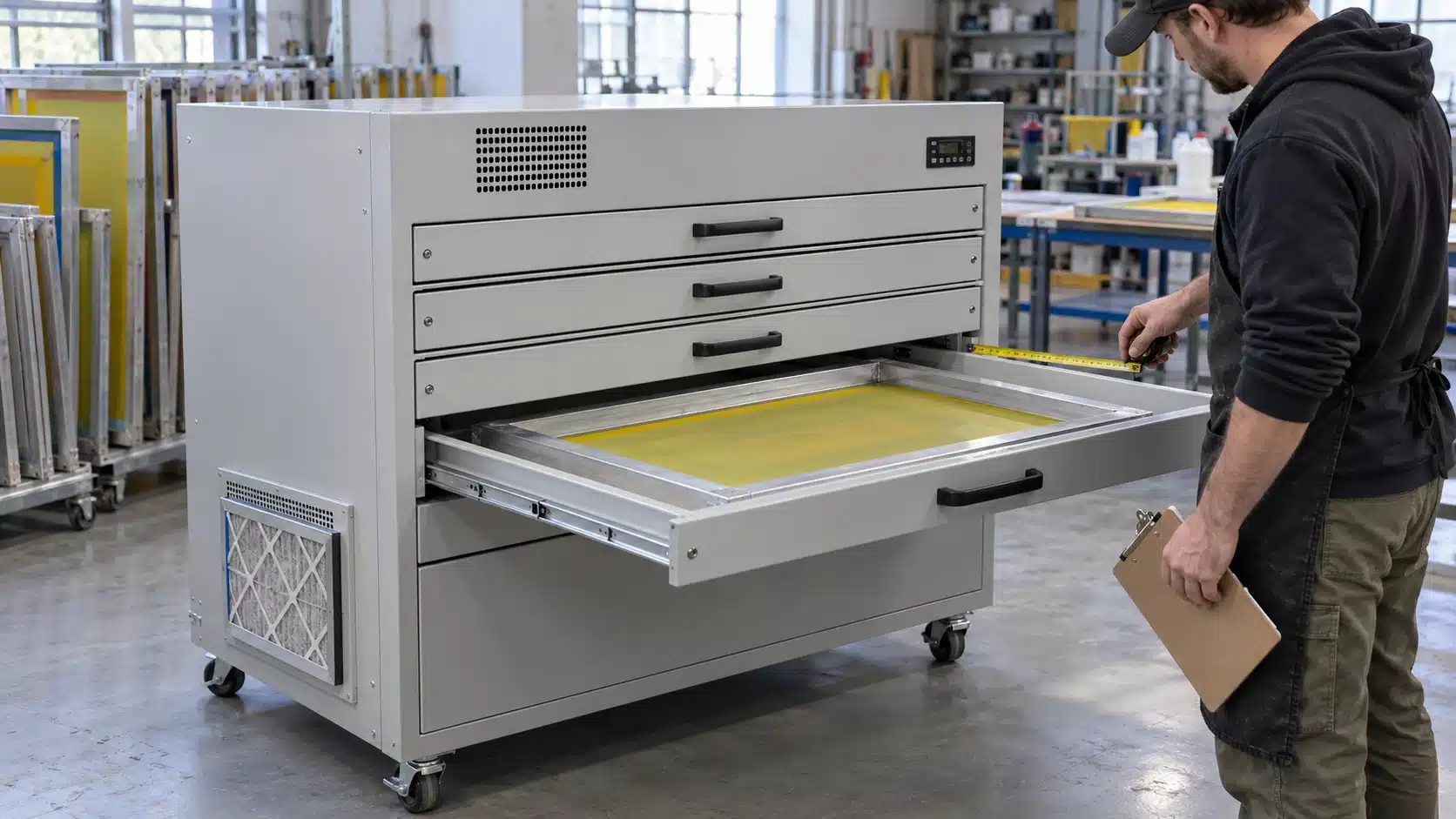
Screen Printing Drying Cabinet Buying Checklist
Before comparing quotations, confirm these ten items:
| Item to confirm | What the supplier should state |
|---|---|
| Maximum frame size | Usable internal width, depth and clearance—not only the machine’s outside dimensions |
| Screen orientation | Horizontal or vertical, and whether it suits the intended process |
| Usable capacity | Number of your actual frames that fit without restricting airflow |
| Temperature control | Adjustable range, displayed process temperature and control accuracy |
| Air management | Airflow path, intake filter, circulation and exhaust arrangement |
| Humidity strategy | Whether humidity is measured or controlled, or must be managed in the room |
| Electrical supply | Voltage, frequency, phase, rated power, current and plug or hard-wiring requirement |
| Construction | Tray support, seals, insulation, interior material and cleaning access |
| Delivery data | External and packed dimensions, net and gross weight, crate type and assembly needs |
| Documentation | Manual, wiring diagram, warranty terms, spare-parts list and market-specific compliance documents |
If a quotation omits one of these points, request clarification before comparing prices.
1. Choose the Right Screen Drying Cabinet Size
Start with the largest external frame dimensions, not the image area. Include the frame profile, registration attachments and any handles or clamps that remain on the frame during drying.
Ask the supplier for three internal measurements:
- usable tray width and depth;
- clear height above each tray; and
- door-opening dimensions.
A frame that matches the nominal tray size exactly may still be difficult to load. Allow practical handling clearance and confirm that the frame rests on its edges rather than on wet emulsion.
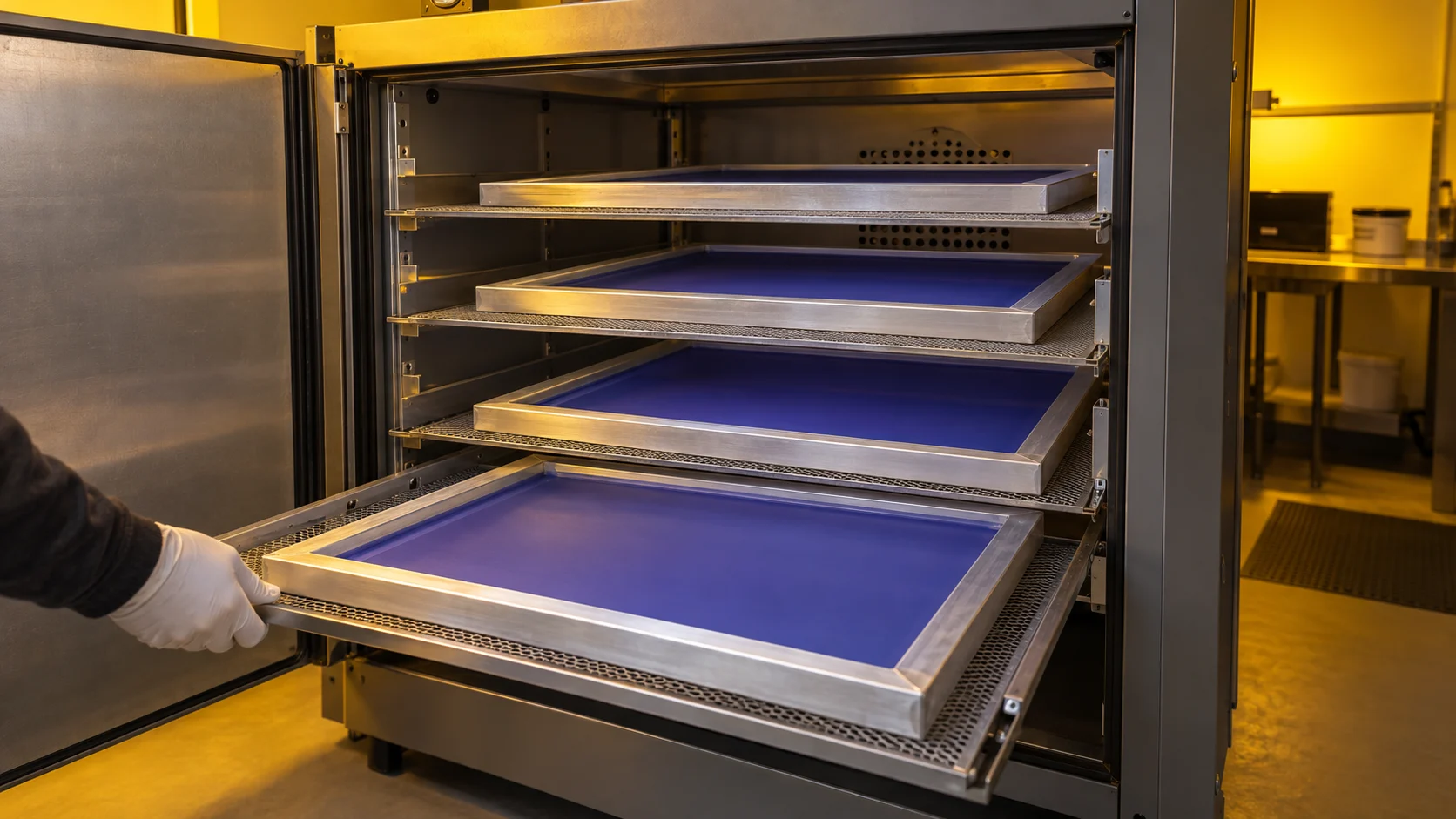
Orientation matters too. Many direct-emulsion instructions call for freshly coated screens to dry horizontally with the print side down. This helps the coating level toward the print side. A vertical cabinet can be useful for large-format screens, washed screens or other approved processes, but it should not automatically replace horizontal drying for freshly coated direct emulsion. Check the emulsion manufacturer’s technical data sheet first.
For the operating procedure after coating, see how to dry emulsion-coated screens before exposure.
2. Calculate Screen Drying Cabinet Capacity from Throughput
Tray count alone does not define screen drying cabinet capacity. A cabinet may have four trays, but the useful hourly output still depends on frame size, coating thickness, airflow, humidity and the verified drying cycle.
Use this planning formula:
Minimum simultaneous capacity = peak coating rate per hour × verified drying time in hours
For example, if a shop coats 8 screens per hour and its verified drying cycle is 45 minutes:
8 × 0.75 = 6 screen positions
Six positions are the mathematical minimum. The selected cabinet should also leave a practical buffer for batch variation, seasonal humidity, door opening and rework. This example is for capacity planning, not a universal drying-time recommendation.
When comparing capacity, ask:
- Is the stated capacity based on the largest frame or a smaller frame?
- Can more than one small screen fit per tray without blocking airflow?
- Does the supplier’s cycle time refer to one screen or a fully loaded cabinet?
- What ambient temperature and humidity were used for the test?
- Can the cabinet keep pace with the exposure unit and washout area during the busiest shift?
For variables that change cycle time, use the screen printing emulsion drying time guide.
3. Compare Horizontal Drawer, Freestanding and Vertical Cabinets
| Cabinet format | Main advantage | Limitation to check | Typical fit |
|---|---|---|---|
| Horizontal drawer cabinet | Separate trays simplify loading and keep coated screens flat | Tray opening and usable frame clearance | Small and medium screen-making departments |
| Large horizontal cabinet | Higher batch capacity and easier expansion to larger frames | Floor space, airflow at full load and delivery access | Higher-volume or mixed-size production |
| Vertical cabinet | Can accommodate tall or very large frames efficiently | Suitability for freshly coated emulsion and three-phase power requirements | Large-format, washed-screen or process-specific applications |
The best format follows the process. A taller cabinet is not necessarily more productive, and a cabinet with more layers is not necessarily suitable for a larger frame.
4. Evaluate Temperature, Airflow and Humidity Together
Drying performance is a system. Heat helps water evaporate, airflow carries moisture away, and room humidity affects how quickly evaporation can continue.
Temperature control
Do not choose a cabinet simply because it has the highest maximum temperature. A machine’s maximum rating is not the recommended setting for photo emulsion.
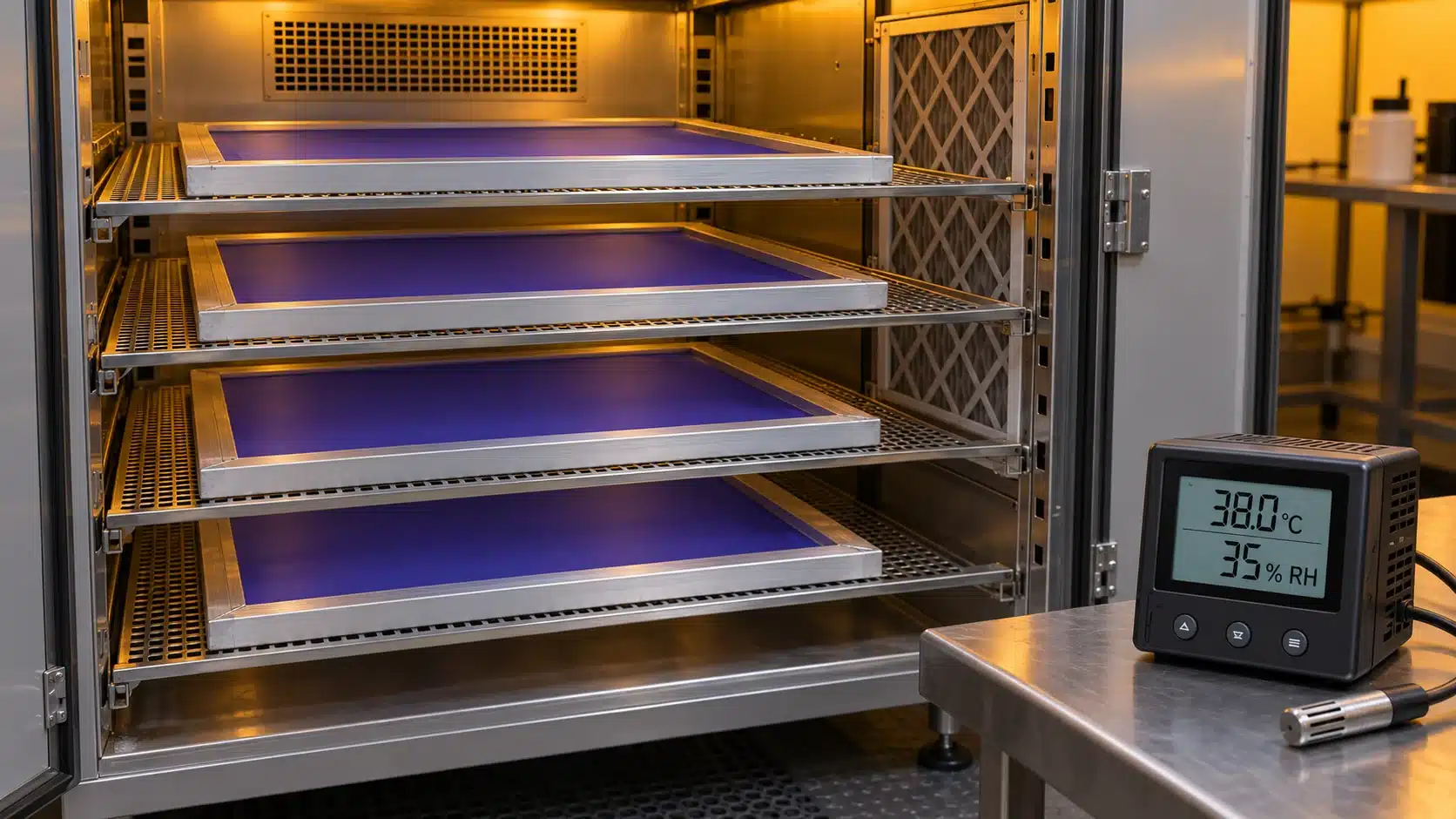
Many emulsion manufacturers specify drying coated screens at about 35–40°C (95–104°F) and warn that excessive heat can affect stencil performance. The correct limit is always the current technical data sheet for the exact emulsion in use.
Ask whether the controller displays the actual chamber temperature as well as the setpoint. Also request information about temperature uniformity, sensor position, over-temperature protection and calibration.
Airflow and filtration
Ask the supplier to explain the airflow path—not only provide a fan-power figure. Useful design details include:
- filtered air entering the cabinet;
- circulation across all loaded trays;
- a defined moisture-exhaust route;
- door seals that limit uncontrolled air and dust entry; and
- filters that operators can inspect and replace easily.
Airflow figures are not directly comparable when cabinet volumes and test methods differ. A loaded-cabinet result is more useful than an isolated fan rating.
Humidity control
A heated cabinet is not automatically a dehumidifier. If the drying room is humid, the cabinet may repeatedly circulate moisture-laden air unless fresh-air and exhaust provisions are suitable. Confirm whether relative humidity is only monitored, actively controlled, or not included. A room air conditioner or dehumidifier may still be required.
5. Confirm Electrical Supply, Controls and Compliance
International buyers should send the destination electrical standard with the first inquiry. “110 V” or “220 V” alone is incomplete.
Confirm all of the following on the final quotation:
| Electrical item | Why it matters |
|---|---|
| Voltage and tolerance | Must match the facility supply |
| Frequency: 50 or 60 Hz | Can affect fans, controls and component selection |
| Single- or three-phase | Determines installation availability and cost |
| Rated power and current | Used to size the circuit and protective device |
| Plug type or hard wiring | Prevents an unusable arrival configuration |
| Controller language and units | Simplifies operation and training |
| Over-temperature protection | Provides protection separate from normal process control |
Electrical installation and grounding should be completed or checked by a qualified electrician under the destination’s local rules. Certification requirements also vary by country. Request the declaration, test report or certificate for the exact quoted configuration; do not assume that documentation for a similar model applies.
6. Inspect Construction and Maintenance Access
A drying cabinet works near wet screens and light-sensitive coatings, so practical construction details affect daily reliability.
Look for:
- a light-restricting enclosure and well-fitted door or drawers;
- smooth, cleanable internal surfaces;
- removable trays with edge support that avoids wet image areas;
- corrosion-resistant materials in moisture-exposed areas;
- insulation appropriate to the operating temperature;
- accessible filters, fans, sensors and heating components; and
- stable feet, levelers or lockable casters where required.
No cabinet should be described as completely “dust-free” unless that performance has been tested to a stated standard. Filtered, well-sealed airflow can reduce contamination, but housekeeping, clean screens and filter maintenance remain necessary.
Ask which components are considered consumables and whether replacement filters, controllers, sensors and heating elements can be supplied with the machine.
7. Plan Shipping and Installation Before Ordering
The cabinet’s operating dimensions are only part of the installation plan. Obtain the packed dimensions, gross weight and center-of-gravity or lifting instructions where relevant.
Check:
- container and crate dimensions;
- forklift or pallet-jack access;
- loading-bay, doorway, corridor and elevator clearances;
- whether the cabinet ships assembled;
- ventilation or exhaust connection requirements;
- final placement and service clearance; and
- commissioning, training and warranty procedures.
For imported equipment, confirm the Incoterm, packing method, included accessories and spare parts in writing. Let the buyer’s customs broker verify the tariff classification and local import requirements. The supplier should provide accurate product and packing information, but should not make a universal customs or certification claim for every destination.
HANZE Drying Cabinet Configuration Guide
HANZE currently lists horizontal drawer cabinets and vertical ovens. The table below is a selection aid, not a substitute for the final approved specification.
| Configuration | Published key specifications | Suitable purchasing scenario | Confirm before ordering |
|---|---|---|---|
| 2-layer screen drying cabinet | Model HZI-HGX-6484/2; 2 trays; listed maximum frame 840 × 640 mm; 1.5 kW; 110 or 220 V | Lower batch volume using frames within the stated envelope | Usable opening in mm, frequency, plug and final temperature setting |
| 4-layer screen drying cabinet | Model HZI-HGX-5364/4; 4 trays; listed drying area 640 × 530 × 45 mm per position; 2 kW; page lists 110 V/60 Hz | More simultaneous positions for compatible frame sizes | Destination voltage option, loaded airflow and verified cycle with the buyer’s emulsion |
| vertical screen printing oven | 10-screen configuration; model-dependent drying areas from 700 × 900 to 1700 × 2700 mm; 4–10 kW; 380 V/50 Hz listed | Large-format or approved upright processes | Emulsion/process compatibility, phase, installation height and delivery access |
Published specifications can change or vary by configuration. The signed quotation and approved technical sheet should control the order. View the full range of screen printing drying cabinets before selecting a model.
Information to Include in Your RFQ
A complete inquiry allows the supplier to recommend a model instead of guessing. Send:
- largest and most common external frame dimensions;
- frame thickness and any attached registration hardware;
- screens coated per hour and per shift at peak production;
- emulsion brand, product name and coating method;
- intended use: after degreasing, after coating, after washout or multiple stages;
- required screen orientation;
- destination voltage, frequency, phase and plug standard;
- ambient temperature and relative-humidity range;
- available floor space, doorway size and exhaust restrictions;
- delivery city/country and required trade term; and
- required compliance documents, spare parts and warranty support.
HANZE can then compare frame fit, realistic capacity and electrical configuration. Contact HANZE for a drying cabinet recommendation and quotation.
Frequently Asked Questions
What size screen printing drying cabinet do I need?
Measure the outside of your largest complete frame and compare it with the cabinet’s usable tray and door-opening dimensions. Include frame thickness, registration parts and loading clearance. Do not select from external machine dimensions alone.
How do I calculate screen drying cabinet capacity?
Multiply the peak number of screens coated per hour by the verified drying time in hours. Then add operating headroom for humidity changes, uneven batches and rework. Verify that the quoted capacity applies to your actual frame size.
Should I choose a 2-layer or 4-layer drying cabinet?
Choose based on frame fit and peak simultaneous capacity. A 2-layer model may fit a larger frame, while a 4-layer model may hold more compatible frames per batch. Layer count should not be the only deciding factor.
Is a higher maximum temperature better?
No. Maximum temperature is an equipment rating, not the normal emulsion setting. Many emulsion instructions specify roughly 35–40°C, but the exact product technical data sheet takes priority.
Is horizontal or vertical drying better for coated screens?
Many direct-emulsion manufacturers specify horizontal drying with the print side down. Vertical cabinets may suit washed screens, large-format frames or other approved processes. Confirm the orientation with the emulsion supplier and the required stencil-quality target.
Does a drying cabinet control humidity?
Not necessarily. Heating and air circulation do not guarantee active dehumidification. Ask whether the cabinet measures or controls relative humidity and whether the room needs separate air conditioning or a dehumidifier.
What should an importer confirm before shipment?
Confirm the final model, technical sheet, voltage/frequency/phase, plug or wiring arrangement, packed dimensions, gross weight, accessories, spare parts, warranty, Incoterm and destination-specific compliance documents.
Make the Decision from Your Process Data
The right cabinet is the smallest configuration that safely fits the largest required frame, supports peak throughput and matches the installation conditions—with enough practical capacity for production variation.
Do not rank suppliers by tray count, wattage or maximum temperature in isolation. Compare usable dimensions, loaded drying performance, airflow, electrical compatibility, maintenance access, documentation and delivery requirements as one system.
For the wider workflow, see the complete screen-making process. To discuss a suitable configuration, send your frame and production details for a model recommendation.