Screen Printing Mesh Geometry: How Mesh Structure Affects Print Quality
Screen Printing Mesh Geometry: How Mesh Structure Affects Print Quality
Two screens can have the same mesh count and still print differently. One may release ink more easily. Another may produce a different ink deposit or lose small details. The difference often starts with the structure of the fabric.
Screen printing mesh geometry describes the thread size, spacing, openings and thickness of woven mesh. Mesh count is one part of that structure. Thread diameter, open area and fabric thickness also matter when comparing specifications.
Understanding how these parameters work together helps printers investigate inconsistent results. It also helps purchasing teams compare suppliers and specify replacement mesh more accurately.
What Is Screen Printing Mesh Geometry?
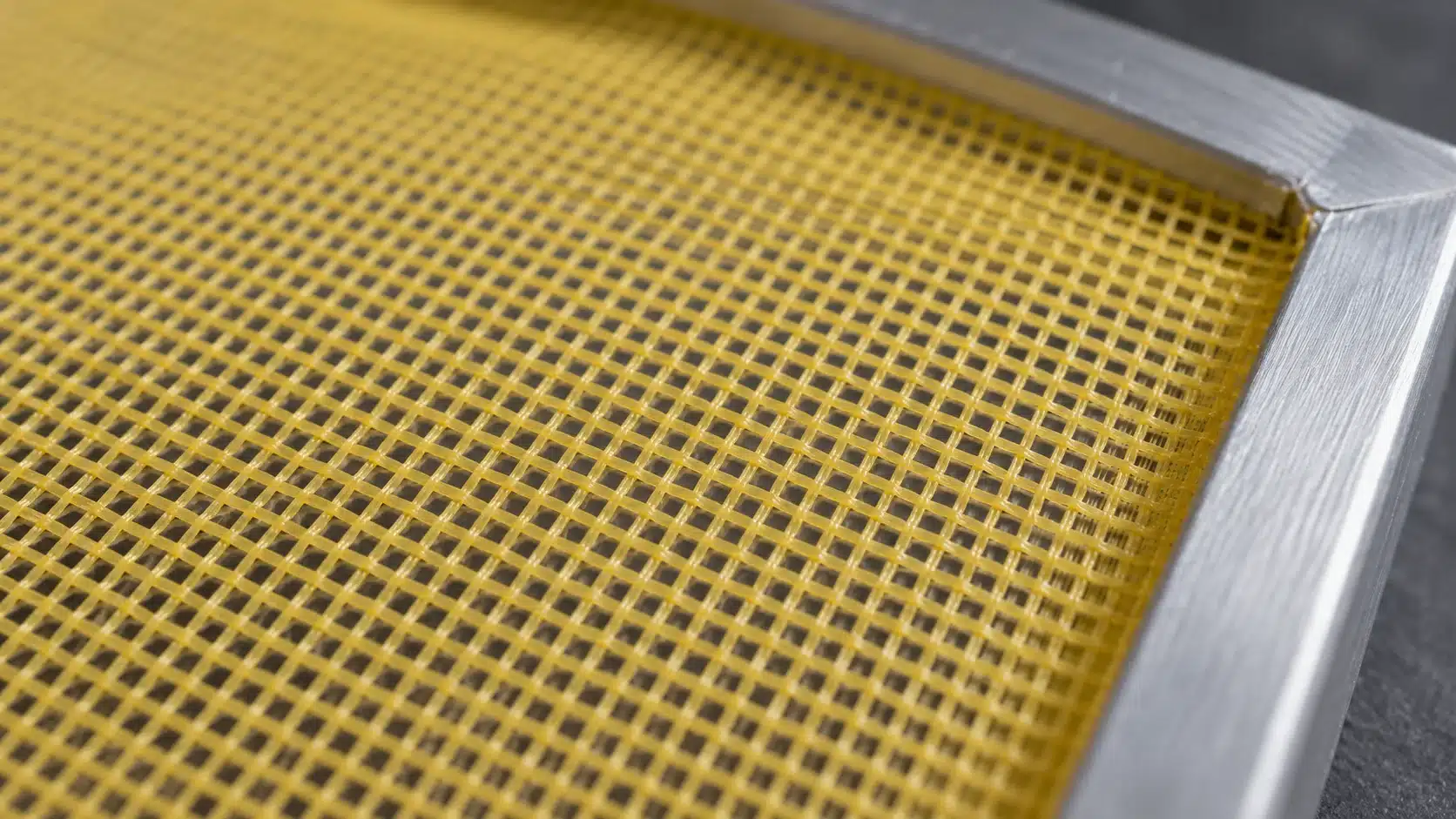
Look at woven mesh from above. Threads run in two directions and leave openings between them. Look from the side, and the crossing threads give the fabric its thickness. Those dimensions and their arrangement form the mesh geometry.
The threads running along the roll are the warp. Threads running across its width are the weft. Their crossing points are often called mesh knuckles.
Geometry should be considered alongside material and yarn construction. Polyester, nylon and stainless steel describe materials. Monofilament yarn uses one filament; multifilament yarn contains several. Plain weave and twill weave describe how yarns cross.
For example, polyester screen printing mesh can be supplied in different counts and thread diameters. The material name alone does not identify its geometry.
The explanations below mainly concern woven monofilament mesh, with square, balanced openings used for the calculation examples.
The Six Core Parameters of Screen Printing Mesh
A useful screen printing mesh specification includes several related measurements. Read them together before deciding whether two fabrics are equivalent.
| Parameter | Common unit | What it describes |
|---|---|---|
| Mesh count | Threads/in or threads/cm | Thread density along a measured length |
| Thread diameter | µm | Diameter of an individual filament |
| Mesh opening | µm | Clear distance between adjacent threads |
| Open area | % | Share of the projected fabric area occupied by openings |
| Mesh thickness | µm | Overall thickness of the woven fabric |
| Theoretical ink volume | cm³/m² | Calculated capacity based on fabric thickness and open area |
These are established data-sheet fields, but their stated measurement conditions matter. Specifications may describe relaxed fabric, while the production screen is under tension.
Mesh Count: Threads per Inch and per Centimeter
Mesh count states how many threads occur within a linear inch or centimeter. A 230 threads/in specification uses a different unit from 90 threads/cm, even though those values are close after conversion.
Multiply threads/cm by 2.54 to obtain threads/in. Divide threads/in by 2.54 for the reverse conversion. Commercial designations may round the result.
Count gives the thread spacing, but it does not tell you how much of that spacing the thread occupies. For application-based count selection, use the screen printing mesh count guide.
Thread Diameter: The Thickness of Each Filament
Thread diameter is usually expressed in micrometers. A smaller diameter leaves more clear space at the same count. A larger diameter occupies more of the available space.
Thin-thread mesh can therefore offer a more open structure without reducing the nominal count. However, its tension recommendation and handling requirements must match the specific fabric. Thread material and construction also affect mechanical behavior.
Mesh Opening: The Clear Space Between Threads
Mesh opening, also called aperture, is the clear gap between adjacent threads. It differs from pitch, which is the distance between their centers.
For an ideal uniform mesh, the clear opening is approximately the pitch minus the thread diameter. That explains why two fabrics with the same count can have different apertures. A micron value should always identify whether it means thread diameter, opening or fabric thickness.
Open Area: The Percentage Available for Ink Passage
Open area describes a proportion, rather than a distance. A fabric with 35% open area has openings occupying 35% of its projected surface area.
Two meshes can have similar apertures but different open-area percentages because their spacing differs. Conversely, identical counts can have different open areas because their thread diameters differ. Compare the percentage alongside the aperture.
Mesh Thickness: The Depth of the Woven Fabric
Mesh thickness measures the woven fabric as a whole. It is separate from the diameter of one filament.
Weaving and finishing affect this dimension. Use the published or measured thickness instead of assuming that it equals twice the thread diameter. Finished stencil thickness is another measurement: it includes the contribution of the emulsion coating. Measuring coated and uncoated screens helps distinguish that contribution.
Theoretical Ink Volume: A Calculated Mesh Property
Theoretical ink volume, or TIV, combines fabric thickness with open area. Its usual unit is cubic centimeters per square meter.
Use TIV as a comparison parameter for the mesh. Actual transfer also depends on the stencil, ink, substrate and press settings. The value does not directly specify the wet ink film left by a print stroke or the thickness after drying or curing.
Why the Same Mesh Count Can Produce Different Results
Compare Thread Diameter, Opening and Open Area Together
Consider two ideal square meshes, each containing 230 threads per inch. Give one a 40 µm thread and the other a 48 µm thread. Their pitch is identical, but their clear openings differ.
| Parameter | Illustrative Mesh A | Illustrative Mesh B |
|---|---|---|
| Mesh count — threads/in | 230 | 230 |
| Thread diameter — µm | 40 | 48 |
| Calculated pitch — µm | 110.4 | 110.4 |
| Calculated opening — µm | 70.4 | 62.4 |
| Calculated open area — % | 40.7 | 32.0 |
Calculated illustration for ideal, balanced square mesh. These values are not a supplier specification or a print-test result.
The thinner thread creates a larger opening and approximately 8.7 percentage points more open area. A purchase description containing only “230 mesh” would miss that difference.
Separate Geometric Differences from Actual Print Results
The comparison establishes a structural difference. It does not establish the finished ink thickness, allowable tension or screen life.
Those conclusions require more information. Fabric thickness is needed to estimate TIV. A controlled print trial is needed to compare coverage or detail. Tension and handling guidance must come from the selected product’s technical information.
Even supplier data for a similar nominal construction can differ from this calculation. Nominal thread diameter and actual woven geometry are not interchangeable measurements.
How Weave, Mesh Orientation and Tension Affect Geometry
Plain Weave, Twill Weave and Calendered Mesh
In plain weave, each thread alternates over and under adjacent threads. Twill uses a different repeating crossing sequence. Changing that sequence changes the fabric structure.
Calendering is a finishing treatment that flattens the fabric profile. It can change thickness and opening geometry. Compare the finished data sheet when evaluating calendered and uncalendered mesh.
Also distinguish thread shape from opening shape. A square aperture describes the gap seen from above. It does not mean the filament itself has a square cross-section.
Warp, Weft and Mesh Orientation
Three angles can appear in a screen-printing discussion: the angle between warp and weft, the orientation of the mesh relative to the frame, and the angle of a halftone pattern.
Rotating a square mesh relative to the frame changes its orientation. It does not require changing the right-angle relationship between its thread directions. Record mesh orientation when comparing screens for the same artwork.
Mesh Geometry Before and After Stretching
Stretching changes the state in which the fabric is measured. Compare specifications under equivalent conditions, especially when checking spacing or dimensional consistency.
Follow the recommended tension for the chosen construction. Record readings in both directions after the agreed stabilization period. Consistent frame support and calibrated tension measurement help make screen preparation repeatable
How Mesh Geometry Affects Ink Transfer and Print Detail
Ink Flow, Release and Coverage
Openings provide a route for ink through the mesh. A more open construction can make transfer easier in a suitable application. Thin-thread products are used for this purpose, including fabrics designed for water-based textile printing.
Easier transfer does not automatically mean a thicker deposit. A thinner fabric can have more open area while retaining a similar or lower theoretical capacity.
Judge coverage on the intended substrate. A visually opaque print and a heavy ink layer are different observations. Record the print appearance and any thickness measurement separately.
Fine Lines, Edge Definition and Halftone Dots
Fine details must be reproduced through a structure that contains both openings and solid threads. The position and size of those threads affect how a small feature interacts with the mesh.
Stencil quality remains part of the result. Include fine positive lines, reverse lines and small text in a comparison target. For halftones, include a tonal range rather than one isolated dot percentage.
Mesh count and halftone LPI are different measurements. LPI describes the artwork’s halftone frequency. Count-to-LPI ratios are starting points for testing; they cannot account for every thread diameter, angle and stencil condition.
Mesh Interference and Moiré
Moiré is an unwanted repeating pattern caused by interactions between periodic structures. In screen printing, mesh can interfere with a halftone pattern. Interactions between color separations or with a patterned substrate can also require investigation.
Check the halftone frequency, image angles and mesh orientation together. A setting that looks acceptable at one tone may still show interference elsewhere in a gradient. Test representative artwork before approving the combination.
| Print goal | Mesh parameters to review | Other conditions to record |
|---|---|---|
| Solid coverage | Open area, thickness and TIV | Ink, substrate and print settings |
| Fine lines | Thread diameter, aperture and weave | Stencil quality, exposure and tension |
| Halftone reproduction | Count, thread diameter and orientation | LPI, image angles and tonal range |
How to Calculate Mesh Opening, Open Area and Ink Volume
The following calculations describe ideal geometry. They are useful for understanding relationships and checking units. Actual fabric data should be assessed using the supplier’s definitions and measurement conditions.
Calculate Pitch and Mesh Opening
For a count measured in threads per inch:
Pitch p (µm) = 25,400 ÷ mesh count
For threads per centimeter, use 10,000 instead of 25,400.
Then estimate the clear opening:
Opening w (µm) ≈ pitch p − thread diameter d
For Illustrative Mesh A, the pitch is 25,400 ÷ 230 = 110.43 µm. Subtracting the 40 µm thread gives an opening of approximately 70.43 µm.
The pitch follows from count. The opening also requires thread diameter, so mesh count alone cannot produce a unique aperture in microns.
Calculate Open Area for Square Mesh
For balanced square mesh with uniform dimensions:
Open area (%) ≈ (opening ÷ pitch)² × 100
Using the same example:
(70.43 ÷ 110.43)² × 100 ≈ 40.7%
The squared relationship assumes equivalent geometry in both directions. For rectangular openings or unequal warp and weft spacing, use the opening fraction in each direction and multiply the two fractions.
Estimate Theoretical Ink Volume
A basic mesh-volume estimate is:
TIV (cm³/m²) ≈ mesh thickness (µm) × open area (%) ÷ 100
For a hypothetical 80 µm fabric with 30% open area:
80 × 30 ÷ 100 = 24 cm³/m²
The units follow because a 1 µm layer spread over 1 m² occupies 1 cm³. The estimate describes mesh capacity without adding an emulsion-over-mesh contribution. Use the supplier’s published TIV where available, and assess actual ink transfer separately.
How to Compare Mesh Specifications Before Ordering
Define the Ink, Substrate and Detail Requirements
Start the comparison with the printing task. Record the ink system, substrate, finest line or reverse detail, halftone frequency and coverage target. Include any ink-manufacturer guidance on particle size and suitable mesh.
Water-based, plastisol, UV and special-effect inks can create different requirements. A glitter ink, for example, needs an opening suited to its particles. A fine-line application also needs reliable stencil reproduction.
Share the current mesh specification and the problem being investigated. “Insufficient coverage on dark fabric” provides a more useful starting point than “need better mesh.”
Compare Complete Data Sheets Under the Same Conditions
Ask suppliers for the complete construction. Published specifications can include nominal thread diameter alongside measured fabric values. They may also identify temperature, humidity and whether measurements refer to relaxed material.
| Item | Information to confirm |
|---|---|
| Material and construction | Material, filament type, weave and finishing treatment |
| Mesh count | Unit, nominal designation and warp/weft values where relevant |
| Thread diameter | Nominal value, unit and definition |
| Aperture and open area | Values, tolerances and measurement method |
| Fabric thickness and TIV | Thickness conditions and volume calculation basis |
| Tension | Recommended range, stabilization and measurement procedure |
| Consistency | Opening uniformity, visible defects and batch identification |
| Roll format | Width, length, color and usable-width requirements |
| Order conditions | Sample availability, MOQ, lead time and protective packaging |
Compare the offered construction with the approved sample, rather than accepting an unreviewed substitution at the same mesh count. Review screen printing mesh options by material before narrowing the specification.
Verify Samples and Confirm the Supply Specification
Use an agreed inspection and trial procedure. Check count and openings with a suitable calibrated method. Measure thickness and tension under recorded conditions.
For a print comparison, keep the artwork, ink batch, substrate and screen-preparation procedure consistent. Record emulsion-over-mesh, blade condition, pressure, speed and off-contact. Include representative fine details and solid areas.
If a different press setting is needed for one mesh, record the adjustment. That distinguishes a direct material comparison from an optimized production trial.
Once approved, retain the specification, sample identification and acceptance criteria for repeat orders. Distributors and importers should also agree on roll labels and batch traceability before bulk shipment.
Common Mistakes When Comparing Screen Printing Mesh
A short review before ordering can prevent an incomplete specification from becoming a production variable.
| Mistake | Why it misleads | What to check instead |
|---|---|---|
| Buying by count alone | Equal counts can have different openings | Count, thread diameter and aperture |
| Mixing inch and centimeter counts | The numerical values use different units | Explicit threads/in or threads/cm |
| Confusing diameter, aperture and thickness | Each measures a different dimension | Named parameter and unit |
| Assuming more open area means more ink | Thickness and transfer conditions also matter | TIV and controlled print results |
| Treating TIV as measured film thickness | A capacity calculation is not a print measurement | Wet or cured thickness, as required |
| Comparing unlike measurement states | Relaxed and tensioned data can differ | Consistent measurement conditions |
Frequently Asked Questions
What Does a Mesh Specification Such as 230-48 Mean?
In a common naming format, 230 identifies the thread count per inch and 48 identifies nominal thread diameter in micrometers. Confirm the supplier’s convention. A complete specification should also identify material, weave and any treatment, rather than relying on a short product code.
Is 90T Mesh the Same as 230 Mesh?
When 90T means 90 threads/cm, the exact conversion is 228.6 threads/in, often described commercially as approximately 230 mesh. Confirm the catalog legend: T can also identify a thread grade in some naming systems. Similar count designations do not guarantee identical thread diameter or openings.
Can Mesh Count Be Converted Directly to Microns?
Count can be converted into thread pitch, but calculating a clear opening also requires thread diameter. Confirm which micron dimension is needed. A mesh-to-micron chart that omits diameter cannot uniquely describe the aperture of every screen-printing fabric.
Does Higher Mesh Count Always Mean Better Print Quality?
No. A higher count may suit some fine-detail work, but print quality also depends on thread diameter, aperture, ink compatibility and stencil preparation. Select a construction that transfers the required ink and reproduces the artwork on the intended substrate.
Is Thin-Thread Mesh Always the Better Choice?
No. It can provide more open area at a given count, but selection also depends on fiber properties, allowable tension, handling and production requirements. Compare the complete data sheet and follow the product’s stretching guidance. Use a sample trial to confirm the benefit for the job.
Does a Higher Open Area Always Produce a Thicker Ink Deposit?
No. Open area describes the available proportion of openings. Theoretical capacity also depends on fabric thickness, while actual transfer involves the stencil, ink and press conditions. A thinner mesh can have a higher open area without producing a thicker printed layer.
Request a Mesh Data Sheet or Sample
Share the ink system, substrate, artwork details and current mesh specification when requesting a comparison. Ask for the proposed thread diameter, aperture, open area, thickness and tension guidance. Confirm the selection with a representative sample before placing a repeat-production order.