How to Choose a Screen Printing Frame
How to Choose a Screen Printing Frame
Choosing a screen printing frame for bulk purchasing requires more than selecting a familiar size and mesh count. A frame may hold the artwork but still be incompatible with press clamps, squeegee travel or screen-room equipment. An incomplete specification also creates avoidable variation between repeat orders.
A reliable purchase order translates the printing process into measurable requirements: dimensions, profile, mesh, tension, bonding, workmanship, inspection and packing. The following guide is for print factories, importers and distributors evaluating pre-stretched aluminum, draw-bar and self-stretching frames.
Quick Selection
The frame system should follow the production requirement, not simply the lowest unit price.
| Production Requirement | Practical Starting Point | Main Points to Confirm |
|---|---|---|
| Daily garment and textile printing | Pre-stretched welded aluminum frame | Press fit, profile, mesh specification, delivered tension and adhesive bond |
| Tight registration or industrial printing | Draw-bar or another retensionable system | Adjustment method, tension range, locking parts, hardware and operator procedure |
| Frequent in-house re-meshing | Self-stretching frame | Required tools, training, replacement parts and repeatability between operators |
| Mixed manual and automatic lines | Standardized compatible frame sizes | Clamp fit, bar shape, frame thickness, weight and maximum machine clearance |
| Custom or large-format work | Application-specific aluminum profile | Rigidity, deflection risk, working area, handling method and export packing |
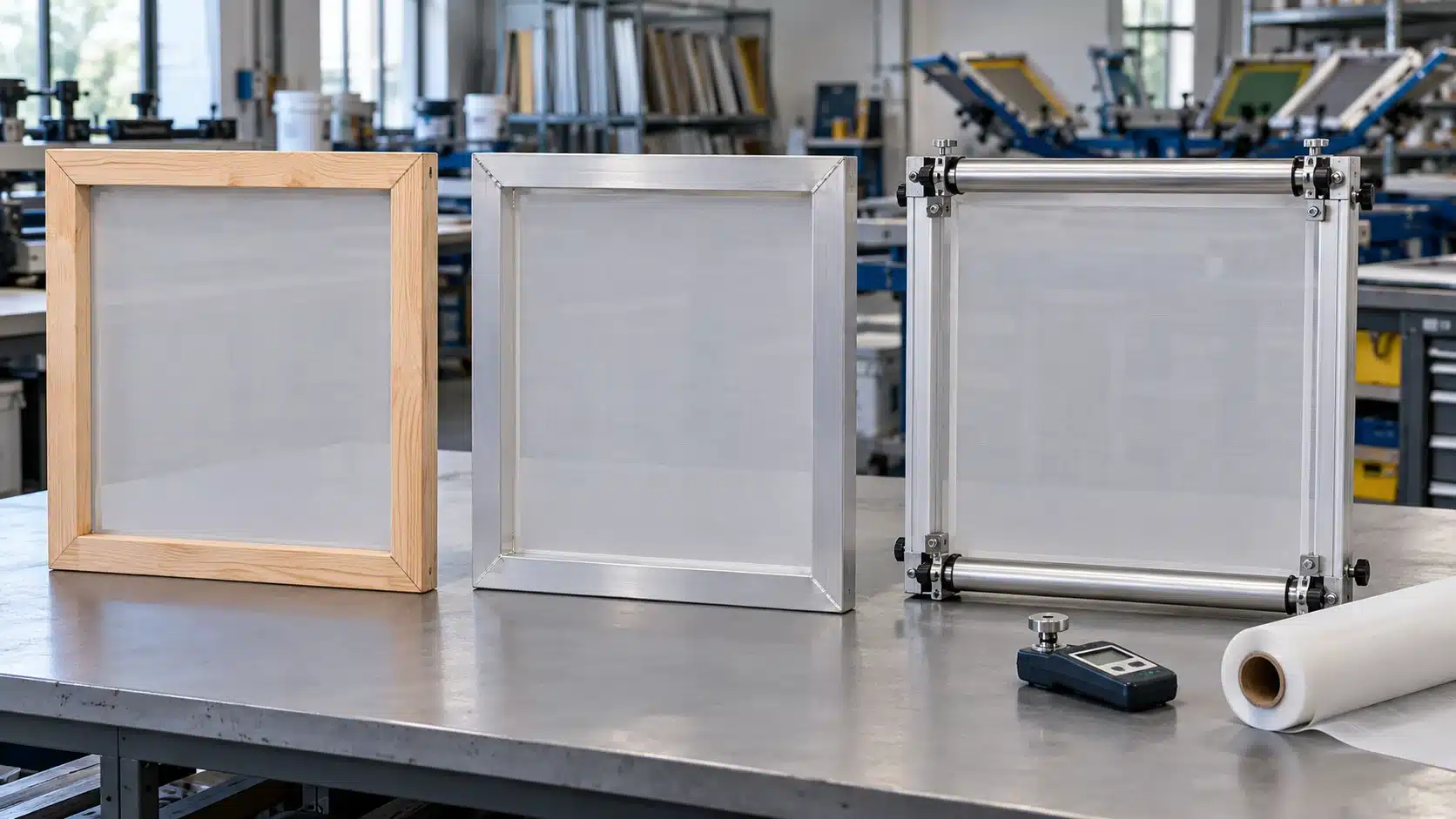
Buyers still deciding between static aluminum, wood and retensionable systems can first review Aluminum vs Wood vs Retensionable Screen Printing Frames. The sections below focus on writing a complete purchasing specification after the general frame system has been selected.
1. Define the Printing Job Before Requesting a Quote
A supplier cannot recommend the right frame from an outside dimension alone. Start the RFQ with the conditions that affect frame load, mesh choice and equipment fit:
- substrate and printing application;
- manual, automatic, long-table or industrial press;
- ink system and cleaning chemicals;
- maximum artwork and required registration marks;
- typical run length and registration tolerance;
- reclaim and re-meshing frequency;
- order quantity and repeat-order schedule.
A garment printer with frequently changing designs may prioritize low handling weight and ready-to-use screens. A factory printing overlays, glass or electronics may prioritize tension adjustment, dimensional stability and inspection records.
2. Confirm Frame Size and Equipment Compatibility
Frame size should be recorded as separate measurements rather than one nominal number:
- outside dimensions (OD);
- inside opening (ID);
- profile width, depth and wall thickness;
- maximum usable image area;
- overall frame thickness at the clamp position.
The usable image area is smaller than the inside opening because the stencil needs clearance for ink, registration marks and the full squeegee or flood-bar stroke. No single clearance value applies to every press or design.
Confirm the maximum frame size and thickness allowed by the exact press model, then check the exposure unit, coating equipment, drying cabinet, washout booth and storage rack. Equipment described for the same application can still accept different frame envelopes.
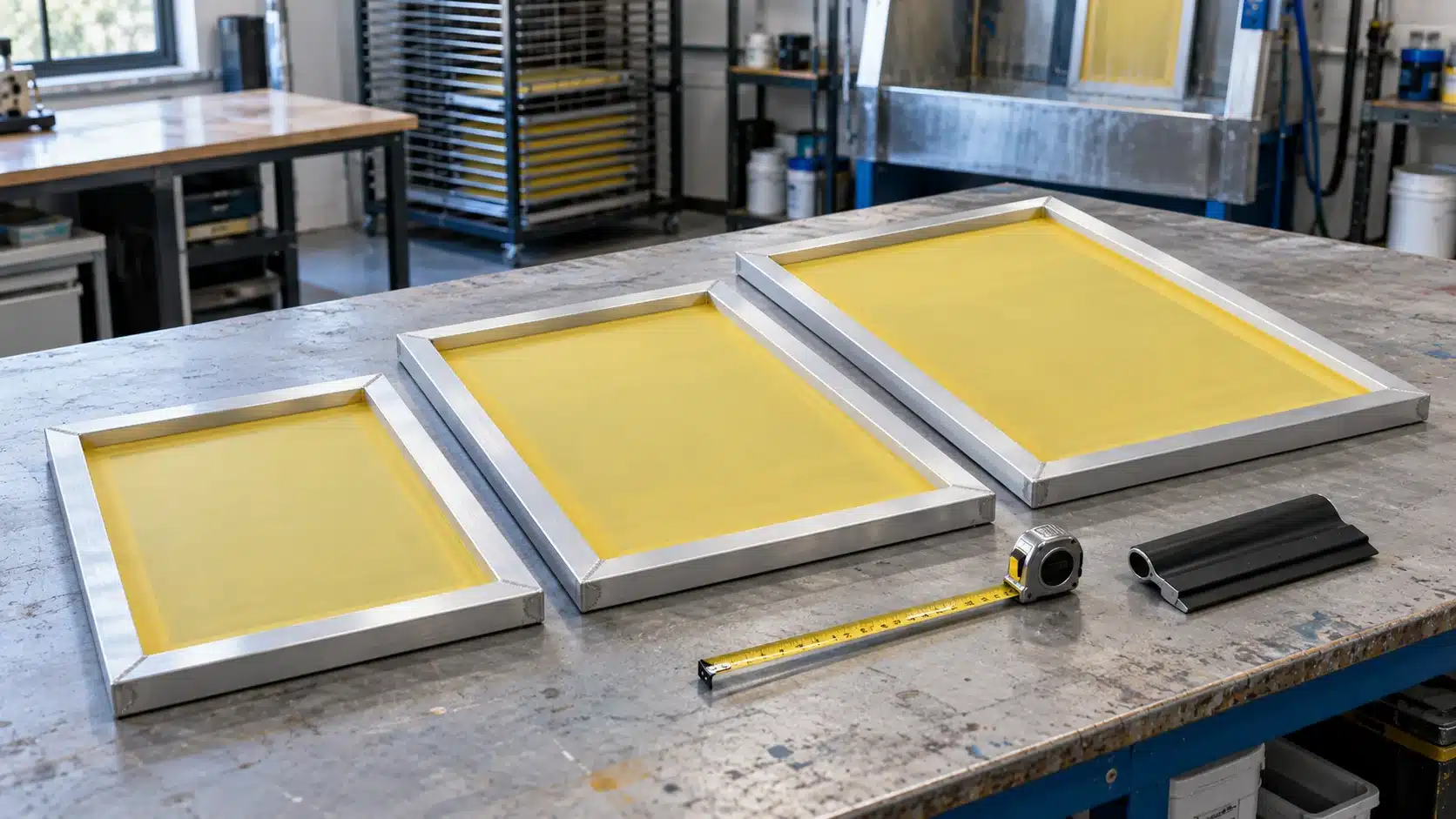
Use the Screen Printing Frame Size Guide to calculate OD, ID and usable image area. Attach a dimensioned drawing and identify each measurement clearly.
3. Select the Frame Construction
HANZE’s screen printing frame range includes standard textile frames, draw-bar frames and self-stretching systems. Each construction changes how the mesh is installed, maintained and replaced.
Pre-Stretched Welded Aluminum Frames
Pre-stretched frames arrive ready for coating and suit routine textile production or distributors supplying standard sizes. Because the screen is purchased as an assembly, the RFQ must define both mesh and tension.
Draw-Bar Frames
A screen printing draw-bar frame mechanically secures and adjusts the mesh. It suits work where controlled re-tensioning or tight registration justifies additional hardware and operator training. Specify the locking method, target tension, hardware and replacement parts.
Self-Stretching Frames
Self-stretching systems can reduce dependence on external re-meshing. Confirm the tools, mesh-loading method, training, spare components and press compatibility before comparing prices.
4. Match the Aluminum Profile to Frame Size and Tension
The profile must resist mesh load without becoming unnecessarily heavy or too large for the press clamps. Ask the supplier to state:
- aluminum alloy and temper;
- profile width and depth;
- wall thickness;
- finished frame weight;
- corner construction;
- recommended frame-size and tension range for that profile.
Larger spans and higher tension generally require a more rigid profile. Do not scale a small-frame profile to a much larger frame without verification.
For reference, HANZE’s 20 × 24 inch aluminum screen printing frame is currently specified with 6063-T5 aluminum and a 1-3/8 × 1-3/8 inch profile. It is a product example, not a universal specification.
5. Specify the Mesh, Not Only the Mesh Count
Mesh count alone does not fully describe screen fabric. Two meshes with the same count can use different thread diameters and therefore have different openings, open area, strength and ink-deposit behavior.
A pre-stretched frame RFQ should include:
| Mesh Field | Information to Specify |
|---|---|
| Material | Polyester, nylon or stainless steel |
| Mesh count | State per inch or per centimeter and identify the unit clearly |
| Thread diameter | Micron value or supplier’s full mesh designation |
| Weave and grade | Plain/twill where relevant; standard or high-modulus grade |
| Color | White, yellow or another required color |
| Mesh orientation | Straight or biased orientation when the process requires it |
| Supply condition | Pre-stretched, loose mesh or replacement panel |
| Traceability | Manufacturer/grade, lot reference or approved equivalent if required |
Polyester is widely used for garment, textile and general graphics work, but count and thread diameter depend on ink, stencil, detail and deposit. Buyers can compare screen printing mesh materials before finalizing the specification.
Do not accept an unapproved substitution merely because the nominal mesh count is unchanged. Request a revised data sheet or sample when thread diameter, grade or manufacturer changes.
6. Write a Measurable Tension Requirement
“High tension” is not an acceptance standard. A purchase specification should define:
- target tension or accepted range in N/cm;
- measurement points across the screen;
- warp and weft measurement directions;
- permitted variation between readings;
- measurement timing after stretching and stabilization;
- meter type, calibration status and reporting format.
The target must remain within the mesh manufacturer’s guidance and suit the process. If no validated target exists, the supplier should recommend a range for the exact mesh and application, then confirm it through an approved sample.
A practical purchase-order clause can read:
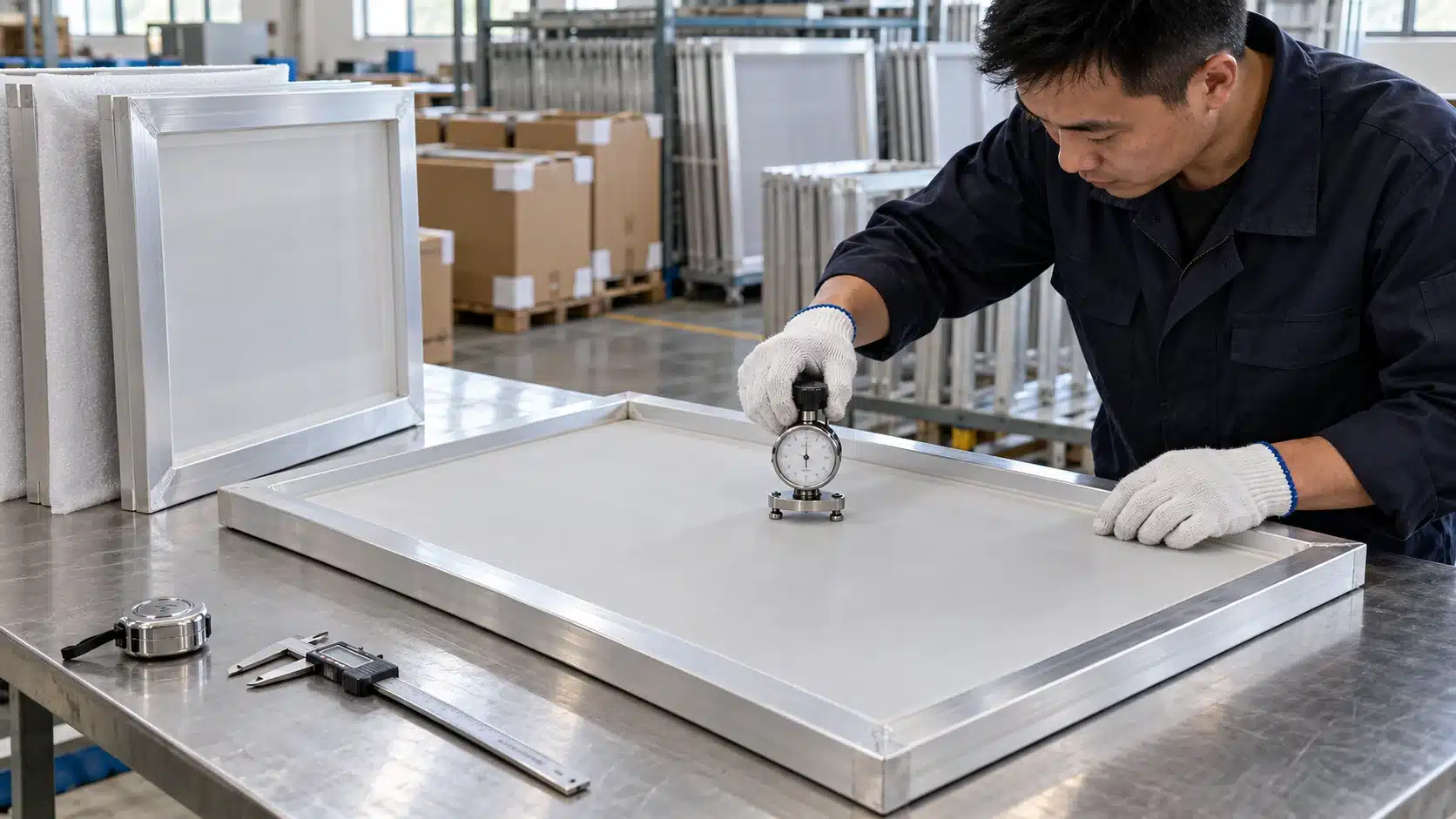
Delivered tension: buyer-approved target or range in N/cm, measured after stabilization at the center and agreed positions near each quadrant, in both mesh directions, using a calibrated tension meter. Acceptance tolerance and test conditions must be approved before bulk production.
Multi-point measurement identifies variation that a single center reading can miss. A suitable screen printing tension meter lets incoming inspectors compare the supplier’s report with received screens.
7. Inspect Adhesive, Welds and Surface Finish
On a static aluminum frame, good mesh and correct tension cannot compensate for weak bonding or poor frame construction.
Adhesive and Bonding Surface
Ask for the adhesive type or approved brand when chemical resistance matters. The bonding face should be prepared properly; sandblasting is commonly used. Confirm even bonding and adequate curing. Tell the supplier which ink-removal and reclaiming chemicals will be used.
Welded Corners
Check that corners are fully welded, sealed where required and ground smooth. Reject cracks, pinholes, sharp edges or projections that can damage mesh, operators or packing.
Flatness and Squareness
Define the inspection method and tolerance on the drawing. Useful checks include overall dimensions, diagonal measurements, contact with a verified flat surface and visible twisting. Avoid relying on descriptions such as “flat” or “square” without an agreed acceptance limit.
8. Approve a Sample and QC Plan Before Bulk Production
Custom frames and first orders should pass sample approval before mass production. The approved sample, drawing and specification sheet then become the inspection reference.
| Inspection Item | Evidence to Request |
|---|---|
| Dimensions and profile | Dimension report against the approved drawing |
| Squareness and flatness | Defined inspection method and recorded result |
| Mesh identity | Mesh label, grade or lot record where required |
| Tension | Multi-point tension map in N/cm |
| Welding and finish | Visual inspection record and clear sample photos |
| Adhesive bond | Adhesive identification and agreed workmanship check |
| Quantity and labeling | Carton list, frame identification and purchase-order match |
| Packaging | Packing photos and confirmed carton/pallet data |
Assign a frame or batch ID so repeat orders and complaints remain traceable. If using AQL or another sampling plan, state the inspection level, defect categories and acceptance numbers in the contract.
9. Compare MOQ, Lead Time and Total Landed Cost
Price changes with frame size, profile, mesh grade, tension, adhesive, quantity, labeling and packing. Ask the supplier to separate standard and customized items in the quotation.
Confirm the following commercial terms:
- MOQ by size and mesh specification;
- sample price and whether it is credited against a bulk order;
- tooling or setup charges for custom profiles and packaging;
- production lead time after sample approval;
- overrun or underrun policy;
- spare-frame or replacement-mesh availability;
- Incoterm, carton dimensions, gross weight and pallet details;
- warranty or remedy for dimensions, tension or transit damage outside the agreed specification.
Compare landed cost rather than frame price alone. Rework, damaged mesh and repeat-order variation can outweigh a lower unit price.
10. Specify Export Packaging and Shipping Protection
Mesh faces should not rub against frames, fasteners or cartons in transit. Protection may include separators, corner guards, rigid inner support, moisture-resistant outer packing and palletization.
Before shipment, request:
- packing method and materials;
- units per carton and cartons per pallet;
- carton and pallet dimensions;
- net and gross weight;
- photos of the packed goods;
- stacking limitations and container-loading plan for large orders.
Confirm destination-country treatment and marking requirements for wooden pallets or crates with the freight forwarder before production.
Frequently Asked Questions
What information is essential when ordering screen printing frames?
Provide the frame construction, OD, ID, profile, mesh, target tension, quantity, application and destination. Add the press model and a dimensioned drawing.
Should a frame be ordered by outside or inside dimensions?
Both should appear on the purchase order. Outside dimensions determine equipment and clamp fit, while inside dimensions help define the available working area. Never assume a nominal size tells the supplier which one you mean.
What tension should I specify for a pre-stretched screen?
There is no universal value for every mesh and application. Use the mesh manufacturer’s data, the printing process and validated production results to set a target range. Approve the range and measurement method on a sample before bulk production.
Is aluminum alloy alone enough to judge frame quality?
No. Alloy and temper matter, but profile geometry, wall thickness, welding, flatness, surface preparation and the relationship between frame size and target tension also affect the assembled screen.
Should I buy bare frames or pre-stretched frames?
Pre-stretched frames reduce setup when mesh and tension are specified correctly. Bare frames suit buyers with controlled in-house stretching, trained operators and mesh inventory.
Is a sample necessary before a bulk order?
A sample is strongly recommended for a new supplier, custom size, new mesh specification or high-volume program. It allows the buyer to confirm equipment fit, workmanship, tension and packing before committing to production quantities.
How should suppliers be compared?
Compare compliance with the same written specification, sample results, QC evidence, repeat-order control, packaging, lead time and remedy process. A quotation based only on nominal frame size and mesh count is not sufficient for a reliable comparison.