Loop Lock Fasteners vs Tagging Gun Fasteners: Which Is Better for Your Product?
Loop Lock Fasteners vs Tagging Gun Fasteners: Which Is Better for Your Product?
Choosing the right hang tag fastener is not only about length, price or color. For many products, the bigger question is whether the tag should pierce the product or attach without piercing it.
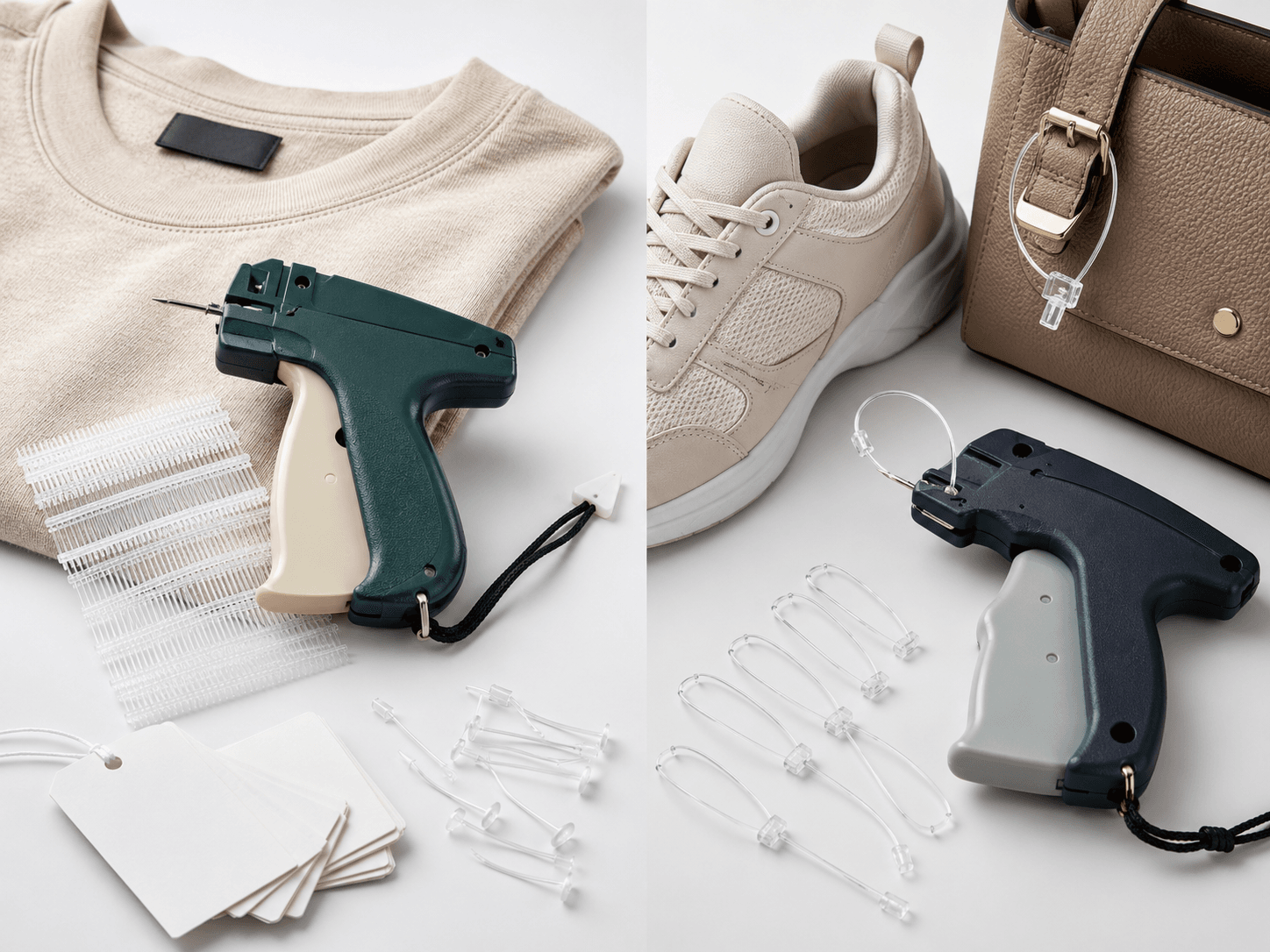
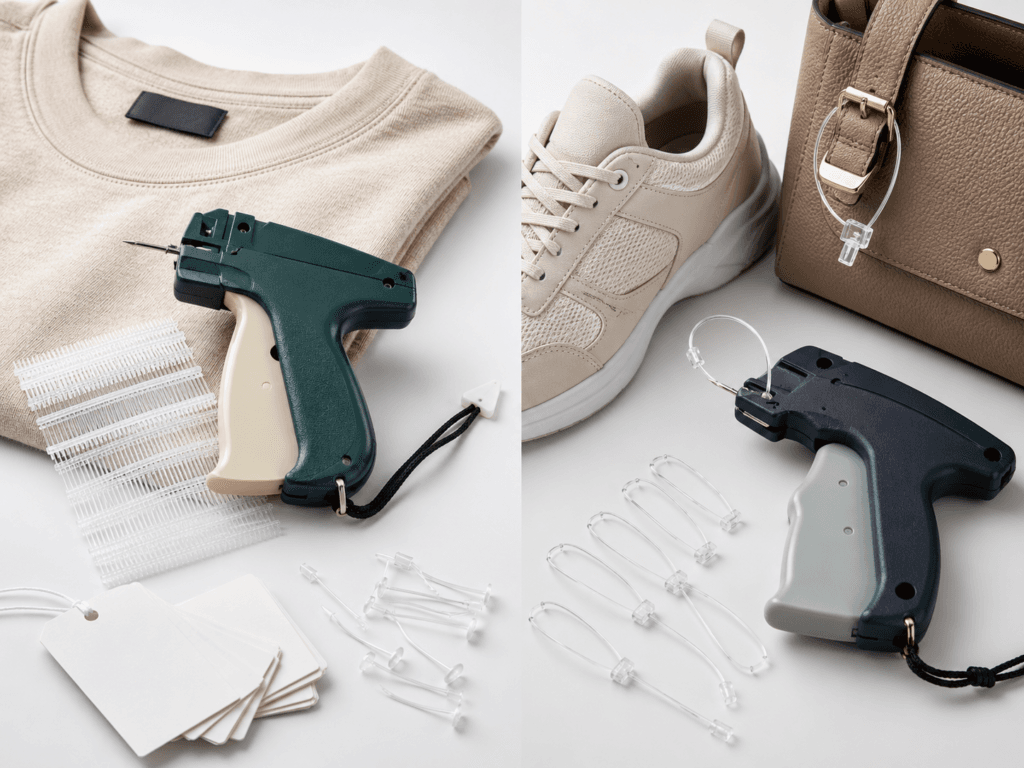
Tagging gun fasteners are widely used for garments and textile products. They are fast, cost-effective and practical for everyday clothing, towels, socks and many fabric goods. Loop lock fasteners, on the other hand, are better for products that should not be pierced, such as shoes, handbags, wallets, belts, sunglasses, accessories and many hard goods.
Using the wrong fastener can lead to visible holes, damaged surfaces, loose tags, poor retail display, tool jamming or customer complaints. This guide compares loop lock fasteners and tagging gun fasteners, explains where each type works best, and helps buyers choose the right tag attachment solution for different product categories.
What Are Tagging Gun Fasteners?
Tagging gun fasteners are plastic attachments used with a needle-style tagging gun. They are also called tag pins, tagging pins, barbs, tag barbs, plastic tag fasteners or garment tag fasteners.
They are commonly used to attach hang tags, price tags, size labels or product information tags to garments and textile products. The tagging gun needle passes through the fabric, care label, seam or another safe attachment point, and the trigger pushes one plastic fastener through the needle to secure the tag.
A typical tagging gun fastening process works like this:
• A strip of plastic fasteners is loaded into the tagging gun.
• The hang tag is placed on the needle.
• The needle is inserted through a safe point on the garment or label area.
• The trigger pushes one fastener through the needle.
• The fastener holds the hang tag to the product.
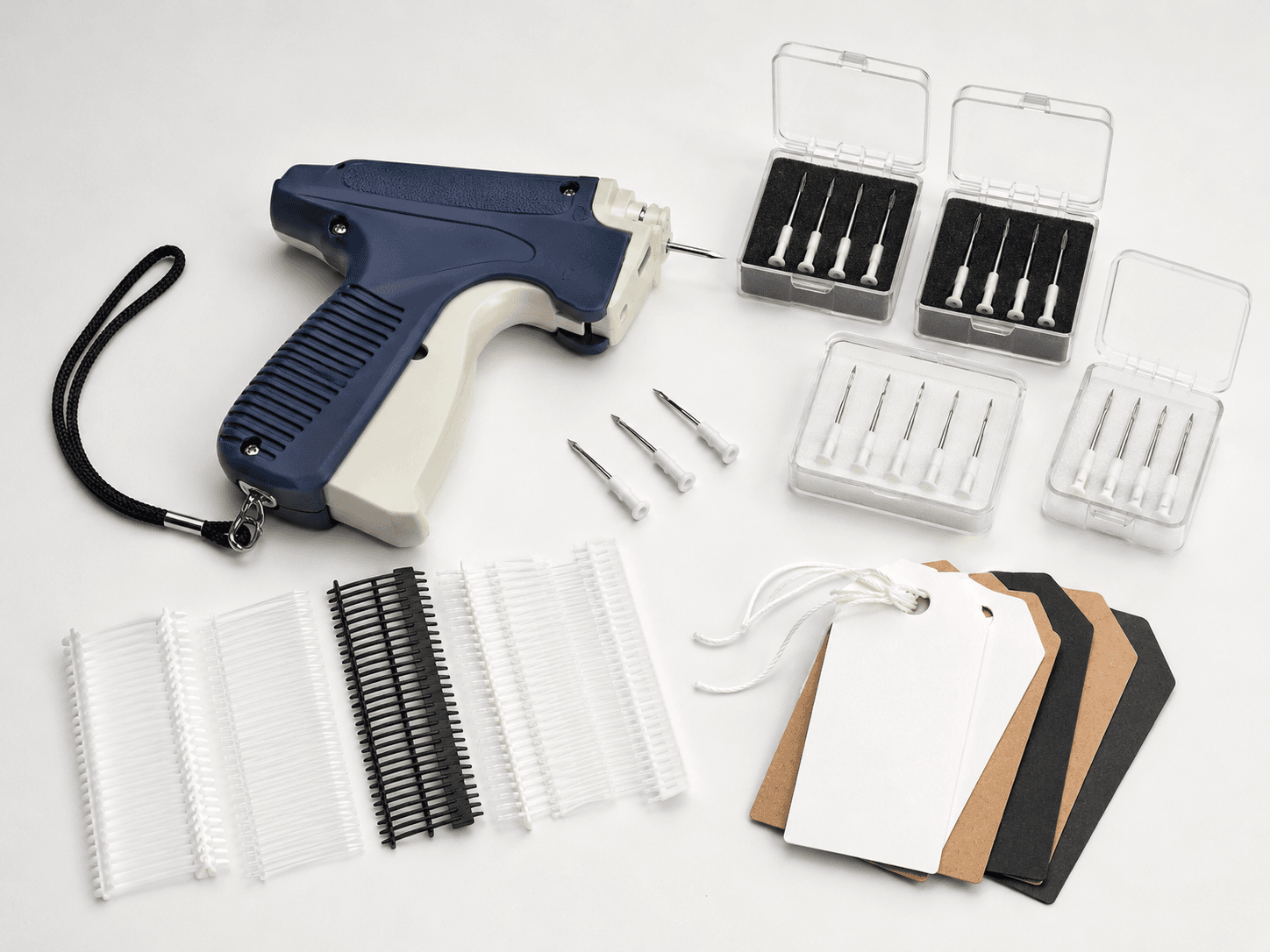
Common types of tagging gun fasteners include standard fasteners, fine fabric fasteners, long fasteners, heavy-duty fasteners and micro fasteners. Each type should be used with the correct tagging gun and needle system.
Tagging gun fasteners are suitable for many textile products, including T-shirts, denim, cotton garments, towels, socks, workwear, uniforms, regular apparel and some home textiles. Their main limitation is that they normally require a needle to pass through the product or an attached label area. For products that should not be punctured, loop lock fasteners or other non-piercing methods are usually better.
What Are Loop Lock Fasteners?
Loop lock fasteners are loop-style hang tag fasteners. Instead of using a needle to pierce the product, they pass through the hang tag hole, wrap around an existing product structure, and lock into a closed loop.
They are useful when the product has a natural attachment point, such as a handle, strap, eyelet, buckle, zipper pull, D-ring, belt hole or packaging hole. This makes them suitable for non-piercing tag attachment.
A loop lock fastener usually works like this:
• The loop passes through the hang tag hole.
• The loop wraps around a product attachment point.
• The fastener locks into a closed loop.
• The hang tag stays attached without piercing the main product surface.
Loop lock fasteners may be clear, black, colored or security-style, depending on the product and retail requirement. Some are hand-applied, while others are designed for use with a compatible loop tag gun or V-tool style applicator.
Loop lock fasteners are commonly used for shoes, handbags, wallets, belts, sunglasses, jewelry cards, hair accessories, small tools, gift items and retail hard goods. They are especially helpful when the product has a finished surface that should not be damaged.
Their main limitation is that they need a suitable attachment point. If a product does not have a strap, hole, ring, handle or packaging opening, a packaging card, hang tag string or other attachment solution may be required.
Loop Lock Fasteners vs Tagging Gun Fasteners: Main Differences
The main difference is simple: tagging gun fasteners usually pierce fabric or a label area, while loop lock fasteners attach around an existing product point without piercing the main surface.
| Comparison Point | Tagging Gun Fasteners | Loop Lock Fasteners |
|---|---|---|
| Attachment Method | Applied with a needle through fabric or label area | Wrapped around an existing product point |
| Best For | Garments and textile products | Shoes, bags, accessories and hard goods |
| Product Damage Risk | May leave holes if used in the wrong place | No need to pierce the main product surface |
| Tool Requirement | Requires compatible tagging gun and needle | Can be hand-applied or used with a compatible loop tag tool |
| Speed | Fast for garment tagging | Hand application is slower; tool application improves speed |
| Presentation | Practical and cost-efficient | Clean appearance for premium or non-textile products |
| Compatibility | Must match standard, fine or other gun system | Must match loop length, lock style and attachment point |
| Common Users | Clothing stores, garment factories, textile suppliers | Shoe sellers, handbag suppliers, accessory brands, hard goods retailers |
Both fastener types are useful. The best choice depends on product material, acceptable attachment method, retail presentation, operating speed and whether the product can be safely pierced.
When Should You Use Tagging Gun Fasteners?
Tagging gun fasteners are the better choice when the product is made from fabric and a safe tagging point is available. They are especially practical for clothing stores, garment factories, textile suppliers and packaging teams that need fast and repeatable tag attachment.
Use Them for Regular Garments
For regular garments such as T-shirts, shirts, uniforms, workwear, cotton clothing and polyester garments, standard tagging gun fasteners are often the most efficient option. They are easy to apply, widely available and suitable for high-volume tagging.
The tag should still be attached through a safe point. Common positions include a seam, side area, care label, collar label, waistband, cuff or another reinforced location.
Use Standard Fasteners for Common Fabrics
Standard fasteners are suitable for many everyday fabrics. They are commonly paired with standard tagging guns and standard needles.
They work well for cotton garments, denim, medium-weight polyester, workwear, towels and many regular retail apparel items. For most general garment tagging, standard fasteners are the main consumable.
Use Fine Fabric Fasteners for Delicate Garments
Fine fabric fasteners are designed for fine fabric tagging guns and fine needles. They are used when the fabric is more delicate and a smaller puncture is preferred.
They are suitable for silk, lace, lingerie, babywear, thin knits, lightweight fashion garments and premium apparel. However, fine fasteners do not make the process completely hole-free. Correct tag placement is still important.
For delicate garments, the safest points are usually the care label, sewn label, seam, strap or packaging card. Avoid the main visible fabric whenever possible.
Use Longer Fasteners for Thicker or Folded Goods
Longer fasteners can be useful for socks, folded garments, towels, thick fabrics, blankets and multi-layer textile products. They provide more space between the hang tag and the product, helping the tag sit more naturally.
However, longer is not always better. A fastener that is too long may swing loosely or look messy. The correct length should be tested on real product samples.
Avoid Tagging Gun Fasteners on Non-Piercing Products
A regular needle-style tagging gun should not be used directly on products that should not be punctured. Avoid using tagging gun fasteners directly on leather shoe uppers, handbag panels, wallet surfaces, sunglasses, jewelry, polished finishes, coated surfaces or fragile accessories.
For these products, loop lock fasteners, hang tag strings, snap lock cords or packaging card attachment are safer choices.
When Should You Use Loop Lock Fasteners?
Loop lock fasteners are better when the product should not be pierced or when the product already has a natural attachment point. They are especially useful for shoes, handbags, wallets, belts, sunglasses, accessories and hard goods.
Use Them When the Product Should Not Be Pierced
If a hole would damage the product, reduce its retail value or create a customer complaint, do not use a needle-style fastener on the main product surface. Loop lock fasteners allow the hang tag to be attached without puncturing the product.
This is important for leather, PU, coated fabric, rubber, plastic, metal, polished surfaces, lenses, decorative finishes and premium packaging.
Use Them for Shoes
Shoes usually have several safe attachment points. A loop lock fastener can attach the hang tag through or around:
• Shoelaces
• Eyelets
• Buckles
• Straps
• Pull tabs
• Packaging holes
Avoid piercing the shoe upper, toe box, heel counter, leather panel or decorative surface. A hang tag attached through the shoelace or eyelet is cleaner and safer for retail display.
Use Them for Handbags and Wallets
Handbags and wallets should not be pierced through the main panel. Loop lock fasteners can attach to:
• Handles
• Shoulder straps
• Zipper pulls
• D-rings
• Metal rings
• Buckles
• Packaging cards
This keeps the bag or wallet surface clean and avoids holes in leather, PU, coated canvas or decorative panels.
Use Them for Belts and Leather Goods
Belts are easy to tag with loop lock fasteners because they already have holes and buckles. A loop can pass through a belt hole or around the buckle without damaging the surface.
For leather goods, always use existing structures such as rings, straps, buckles or packaging holes. Do not pierce finished leather or PU surfaces unless the product has a designed tag hole.
Use Them for Sunglasses and Accessories
Sunglasses, jewelry, hair accessories, small tools, gift items and retail hard goods often work better with loop lock fasteners or string-based attachment.
For sunglasses, use the temple arm, packaging card or display hook. Do not attach tags to lenses or fragile hinge areas. For jewelry, use a jewelry card, chain loop, clasp or display card.
Use Them for Premium Retail Presentation
Loop lock fasteners and hang tag strings often look cleaner than standard plastic tag pins on non-textile products. For premium shoes, handbags, gifts and accessories, a neat loop-style attachment can improve retail presentation.
Product-by-Product Selection Guide
The following table gives practical guidance for choosing between loop lock fasteners and tagging gun fasteners.
| Product Type | Better Choice | Why |
|---|---|---|
| Cotton T-shirts | Tagging gun fasteners | Fast, low cost and suitable for regular fabric |
| Denim jeans | Tagging gun fasteners | Strong attachment through waistband, seam or label |
| Towels | Tagging gun fasteners | Suitable for textile packaging, especially with longer fasteners |
| Socks | Depends on packaging | Tagging fasteners work for fabric or card tagging; loop locks work with packaging holes |
| Silk garments | Fine fabric fasteners or string | Helps reduce visible holes; use care label or packaging card |
| Lingerie | Fine fabric fasteners, loop or string | Use care label, strap or packaging card |
| Shoes | Loop lock fasteners | Attach through shoelace, eyelet or buckle without piercing the upper |
| Handbags | Loop lock fasteners | Attach to handle, strap, zipper pull or D-ring |
| Wallets | Loop lock fasteners | Attach to zipper pull or packaging card |
| Belts | Loop lock fasteners | Attach through belt hole or buckle |
| Sunglasses | Loop lock fasteners | Attach to temple arm or packaging card |
| Jewelry | String, loop or card attachment | Avoid direct pressure on stones or delicate surfaces |
| Small tools | Loop lock fasteners | Use handle hole or packaging hole |
This table should be used as a starting point. Final selection should always be tested on real products.
Compatibility Rules Buyers Should Know
Compatibility is one of the most important factors when choosing fasteners. Many tagging problems happen because the tool, needle and fastener are not matched correctly.
Standard Fasteners Must Match Standard Tagging Guns
Standard fasteners are designed for standard tagging guns and standard needles. They should not be forced into fine fabric tools unless the tool is specifically designed for that system.
Fine Fasteners Must Match Fine Fabric Tagging Guns
Fine fasteners are designed for fine fabric tagging guns and fine needles. They are thinner and intended for more delicate materials. Mixing fine fasteners with standard guns can cause feeding problems or poor attachment.
Long Fastener Length Does Not Change the System
A long fastener is still part of its own system. For example, a long standard fastener should still be used with a compatible standard tagging gun and standard needle. Length does not make a fastener universal.
Loop Lock Fasteners Are a Separate Attachment Method
Loop lock fasteners are not the same as standard tagging pins. They are usually not applied through a regular needle-style garment tagging gun. Some loop fasteners can be applied by hand, while tool-applied loop systems require compatible loop tag tools.
Always Test Before a Large Order
Before buying in large quantities, test the fastener on real products. Check tag security, appearance, fastener length, product damage risk, tool compatibility and customer removal method.
Pros and Cons of Tagging Gun Fasteners
Tagging gun fasteners are widely used because they are practical and efficient. However, they are not suitable for every product.
Advantages
Tagging gun fasteners are fast to apply, especially for garment tagging. They are cost-effective for clothing stores, garment factories and packaging teams. They are available in many lengths and styles, making them flexible for different textile products.
They work well with standard retail tagging workflows and can be easily combined with tagging gun kits, replacement needles and bulk consumable orders.
Limitations
The main limitation is that they require piercing. If used in the wrong place, they may leave visible holes, damage delicate fabrics or reduce product appearance.
They are also not suitable for many hard goods, shoes, handbags, wallets or accessories. In addition, the tagging gun, needle and fastener must match. Wrong system matching can cause jamming, broken fasteners and poor feeding.
Pros and Cons of Loop Lock Fasteners
Loop lock fasteners are useful for products that need non-piercing tag attachment. They also have limitations that buyers should consider.
Advantages
Loop lock fasteners attach without piercing the main product surface. They are better for shoes, bags, wallets, belts, sunglasses, jewelry cards, accessories and hard goods.
They can use existing holes, straps, handles, buckles and rings. They also provide a clean retail appearance for premium products. Some loop lock fasteners can be applied by hand, while compatible loop tag tools can improve efficiency for higher-volume operations.
Limitations
Loop lock fasteners need a suitable attachment point. If a product has no handle, strap, eyelet, hole, buckle or packaging opening, another method may be required.
Hand application can be slower than using a tagging gun on garments. Loop length also matters. A loop that is too short may pull tightly against the product, while a loop that is too long may look messy or catch during packing.
Loop lock fasteners are not always the best choice for regular garment tagging. For simple textile products, standard or fine tagging gun fasteners are usually faster.
How to Choose the Right Fastener for Your Product
The best fastener depends on product material, attachment point, retail appearance and operating volume.
Step 1: Identify the Product Material
Start by identifying the product material. Is it cotton, polyester, denim, towel fabric, silk, lace, leather, PU, metal, plastic, glass, coated fabric or a polished surface?
Fabric products may accept needle-based tagging if a safe point is available. Finished hard goods and premium surfaces should usually use non-piercing attachment.
Step 2: Decide Whether Piercing Is Acceptable
If the product can be pierced through a safe point such as a seam, care label, cuff, waistband or packaging card, tagging gun fasteners may be suitable.
If the product should not be pierced, use loop lock fasteners, hang tag strings, snap lock cords or packaging card attachment.
Step 3: Find the Safest Attachment Point
For textile products, suitable points may include:
• Seam
• Care label
• Cuff
• Waistband
• Hem
• Packaging card
For non-textile products, suitable points may include:
• Eyelet
• Strap
• Handle
• Buckle
• Zipper pull
• D-ring
• Packaging hole
The safest point should hold the tag securely without damaging the product or affecting customer use.
Step 4: Choose the Fastener Type
Choose from standard fasteners, fine fabric fasteners, longer fasteners, loop lock fasteners, hang tag strings or snap lock cords.
For regular garments, standard fasteners are usually suitable. For delicate garments, fine fasteners or non-piercing methods may be better. For shoes and accessories, loop lock fasteners are usually the better choice.
Step 5: Test Tag Security and Appearance
Before confirming the final fastener, test it on real products. Check whether the tag stays secure, whether the product surface is damaged, whether the fastener length looks right, and whether the tag can be removed in an acceptable way.
Bulk Purchasing Checklist
For wholesalers, distributors, retail supply sellers and factory procurement teams, fasteners should be purchased as part of a complete tagging system.
For Tagging Gun Fasteners
Check the following before ordering:
• Standard, fine or micro category
• Fastener length
• Compatible tagging gun model
• Needle compatibility
• Quantity per clip
• Quantity per box
• Color options
• Material quality
• Packaging method
• Reorder availability
For Loop Lock Fasteners
Check the following before ordering:
• Loop length
• Locking style
• Material
• Color
• Hand-applied or tool-applied design
• Compatible loop tag gun if needed
• Product attachment point
• Removal method
• Carton packing
• Sample performance
For Mixed Product Suppliers
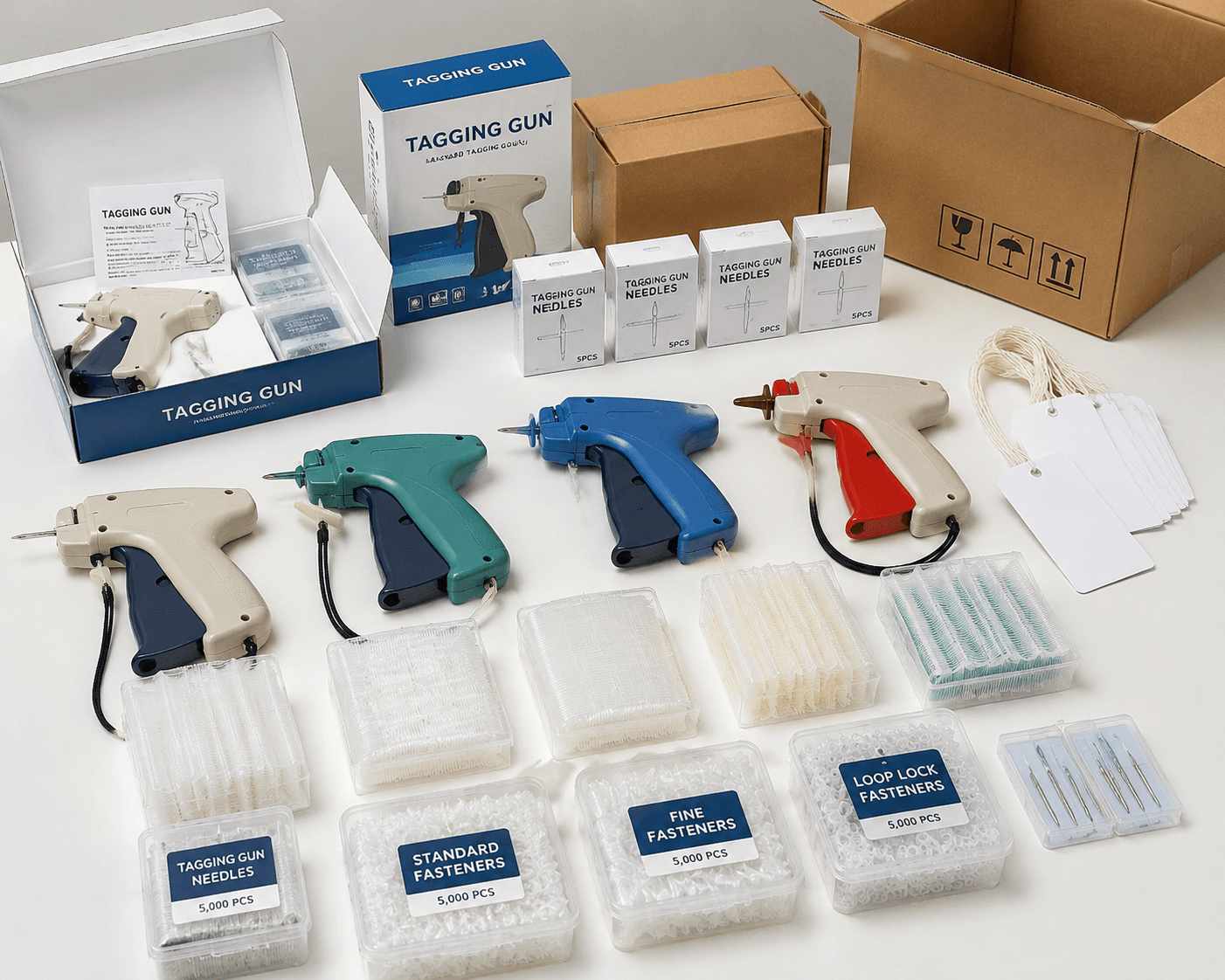
If your customers handle both clothing and accessories, consider stocking a broader range of tag attachment products:
• Standard fasteners
• Fine fasteners
• Longer fasteners
• Loop lock fasteners
• Hang tag strings
• Replacement needles
• Standard tagging guns
• Fine fabric tagging guns
• Loop tag guns
This helps serve garment stores, fashion brands, shoe sellers, handbag suppliers, accessory distributors and packaging teams with different needs.
Common Mistakes to Avoid
Using Tagging Gun Fasteners on Products That Should Not Be Pierced
Do not use a regular needle-style tagging gun on shoe uppers, bag panels, wallet surfaces, lenses, jewelry or decorative surfaces. A visible hole can make the product look damaged.
Using Loop Locks When There Is No Secure Attachment Point
Loop lock fasteners work best when there is a handle, strap, eyelet, hole, buckle or packaging opening. If the product has no secure point, use a packaging card or another attachment method.
Choosing Fasteners Only by Price
Low price alone does not guarantee good performance. Weak fasteners may break, jam, look poor or create customer complaints. Always test strength, appearance and compatibility.
Mixing Standard and Fine Systems
Standard and fine systems should not be mixed casually. Wrong fasteners can cause jamming, misfeeding and poor attachment.
Ignoring Final Retail Appearance
The fastener should support the product display. A loop that is too long, a plastic color that does not match the product, or a tag position that blocks important details can reduce retail appeal.
Skipping Sample Testing
Different products behave differently. A fastener that works on one handbag handle may not fit another. A tag pin that works on cotton may damage silk. Test before placing a large order.
Related Reading
For fastener length planning, read our tagging gun fastener sizes guide.
For complete tool and fastener selection, refer to our guide on how to choose the right tagging gun and fasteners.
For standard and fine tool differences, read our standard vs fine tagging gun guide.
For delicate garment tagging, see our guide on how to tag delicate clothing without leaving holes.
For shoes, handbags and accessories, read our guide on how to tag them without piercing.
For wholesale sourcing and inventory planning, review our guide on how to source tagging guns in bulk.
FAQ
What is the difference between loop lock fasteners and tagging gun fasteners?
Tagging gun fasteners are usually applied with a needle tagging gun and pierce fabric or a label area. Loop lock fasteners wrap around an existing product point, such as a handle, strap, eyelet or buckle, without piercing the main product surface.
Are loop lock fasteners better than tagging gun fasteners?
Not always. Loop lock fasteners are better for shoes, handbags, wallets, belts and accessories that should not be pierced. Tagging gun fasteners are better for regular garments and textile products where needle attachment is acceptable.
Can I use loop lock fasteners for clothing?
Yes, if the clothing has a suitable loop, buttonhole, strap, packaging hole or label point. However, for regular garment tagging, standard or fine tagging gun fasteners are usually faster.
Can I use tagging gun fasteners on shoes?
It is not recommended to pierce the shoe upper. For shoes, use loop lock fasteners around shoelaces, eyelets, buckles, straps or packaging holes.
Do loop lock fasteners need a tool?
Some loop lock fasteners can be applied by hand. For higher-volume applications, a compatible loop tag gun or V-tool style applicator can improve speed and consistency.
Are standard and fine tagging gun fasteners interchangeable?
No. Standard fasteners should be used with standard tagging guns, and fine fasteners should be used with fine fabric tagging guns. Mixing systems may cause jamming or poor feeding.
Which fastener is best for handbags?
Loop lock fasteners, hang tag strings or snap lock cords are usually better for handbags because they can attach to handles, straps, zipper pulls or D-rings without piercing the bag panel.
Which fastener is best for delicate garments?
Fine fabric fasteners, hang tag strings or packaging card attachment are better for delicate garments. The safest point is usually a care label, seam or packaging card.
What length loop lock fastener should I choose?
Choose the loop length according to the attachment point. Short loops work for small accessories, medium loops work for shoes and wallets, and longer loops are better for handbags, belts or bulky straps.
What should I test before buying fasteners in bulk?
Test compatibility, tag security, fastener strength, product appearance, removal method, color, length and whether the product surface is damaged after tagging.
Conclusion
Loop lock fasteners and tagging gun fasteners are both useful hang tag attachment solutions, but they are designed for different products. Tagging gun fasteners are practical and efficient for garments, towels, socks and textile products where piercing through a safe point is acceptable. Loop lock fasteners are better for shoes, handbags, wallets, belts, sunglasses and accessories that should not be pierced.
The best choice depends on product material, acceptable attachment method, retail presentation, fastener compatibility and daily tagging volume. Before placing a large order, test both the product appearance and the fastener performance on real samples.
Looking for loop lock fasteners, tagging gun fasteners, fine fabric fasteners or compatible tagging tools? HANZE supplies standard tag fasteners, fine fasteners, loop lock fasteners, loop tag guns, replacement needles and garment tagging accessories for retailers, garment factories, wholesalers and distributors. Contact us for samples, bulk pricing and suitable product recommendations.