How to Tag Shoes, Handbags and Accessories Without Piercing Them
Shoes, handbags, wallets, belts, sunglasses and fashion accessories should not be tagged in the same way as regular garments. These products often have hard surfaces, leather-like materials, coated finishes, straps, handles, buckles, zipper pulls or decorative details. If a standard needle tagging gun is used in the wrong place, it may leave holes, scratch the product surface or reduce the retail value of the item.
For these products, the goal is simple: attach the hang tag securely without piercing the main material. Non-piercing tagging methods such as loop lock fasteners, hang tag strings, snap lock cords and loop tag guns can help retailers, factories, wholesalers and packaging teams apply hang tags through existing openings, straps, handles, buckles or packaging holes.
This guide explains how to tag shoes, handbags and accessories without piercing them, how to choose the right attachment point, and how business buyers can select suitable loop fasteners and tagging tools for different product categories.
Why Shoes, Handbags and Accessories Should Not Be Pierced
Shoes, handbags and accessories are often made from materials that are not suitable for standard needle tagging. Leather, PU, coated fabric, rubber, plastic, metal, resin and decorative surfaces are not like cotton fabric. A needle that works well on a T-shirt may damage a shoe upper, handbag panel or wallet surface.
Holes can reduce product value. A small hole in a leather shoe, handbag flap, wallet panel or sunglass accessory may be seen as a defect by the customer. For premium retail goods, gift items and fashion accessories, the hang tag should support presentation instead of damaging the product.
Many accessories already have natural attachment points. Shoes may have shoelaces, eyelets, straps or buckles. Bags may have handles, shoulder straps, zipper pulls, D-rings or metal rings. Belts have belt holes and buckles. Sunglasses have temple arms or packaging cards. Jewelry and hair accessories often come with display cards or product holes. These areas allow tags to be attached without piercing the main product surface.
Non-piercing methods also look more professional. A clean loop around a handle, strap or zipper pull usually looks better than a plastic pin forced through a visible surface. For trade buyers and packaging teams, this also helps reduce damaged goods, repacking work and customer complaints.
Best Non-Piercing Tagging Methods
There are several ways to attach hang tags without piercing the product. The best method depends on the product type, tag style, order volume, retail presentation and available attachment point.
Loop Lock Fasteners
Loop lock fasteners are plastic loop-style tag fasteners. They pass through the hang tag hole, wrap around a product attachment point, and lock into a closed loop. They are commonly used when the product has a strap, handle, eyelet, buckle, zipper pull, ring or packaging hole.
Loop lock fasteners are suitable for shoes, handbags, wallets, belts, sunglasses, toys, small accessories, gift items and retail hard goods. They are simple, practical and do not require a needle to pierce the product.
For small batches, loop lock fasteners can usually be applied by hand. For larger volumes, a compatible loop tag gun or V-tool style applicator may help improve speed and consistency.
Loop Tag Gun or V-Tool Style Tagging Tool
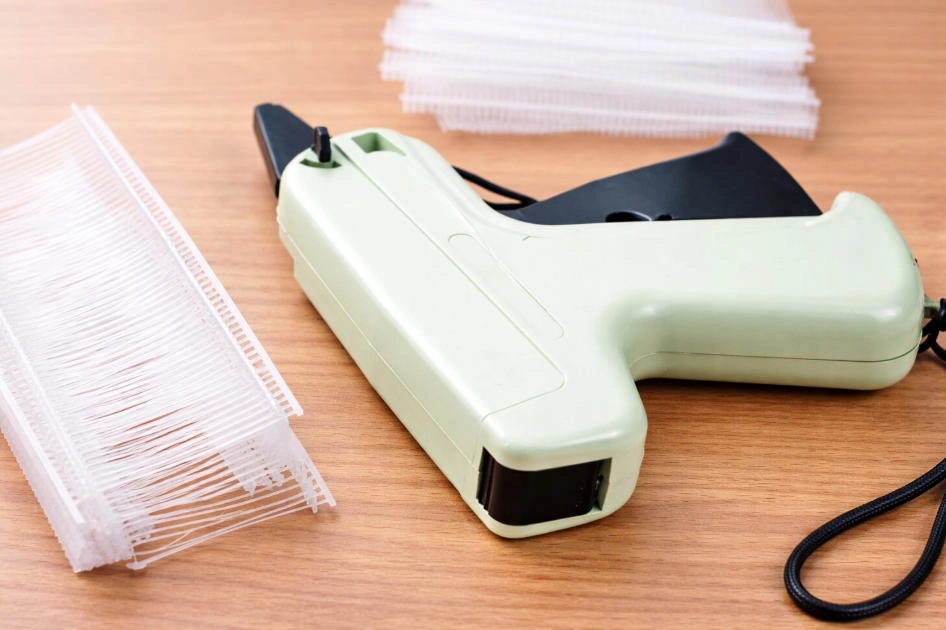
A loop tag gun is designed to apply loop-fastened tags more efficiently than hand application. Instead of driving a needle through the product, the tool helps close a loop fastener around an existing product point.
This type of tool is especially useful for products such as belts, handbags, wallets, sunglasses, sporting goods, kitchen utensils and other hard goods. It is also practical for retail packaging teams that need to tag many items repeatedly.
The key advantage is efficiency. Hand-applied loop fasteners are flexible, but they can become slow when the order volume increases. A loop tag gun can help reduce repetitive handwork and keep tag placement more consistent.
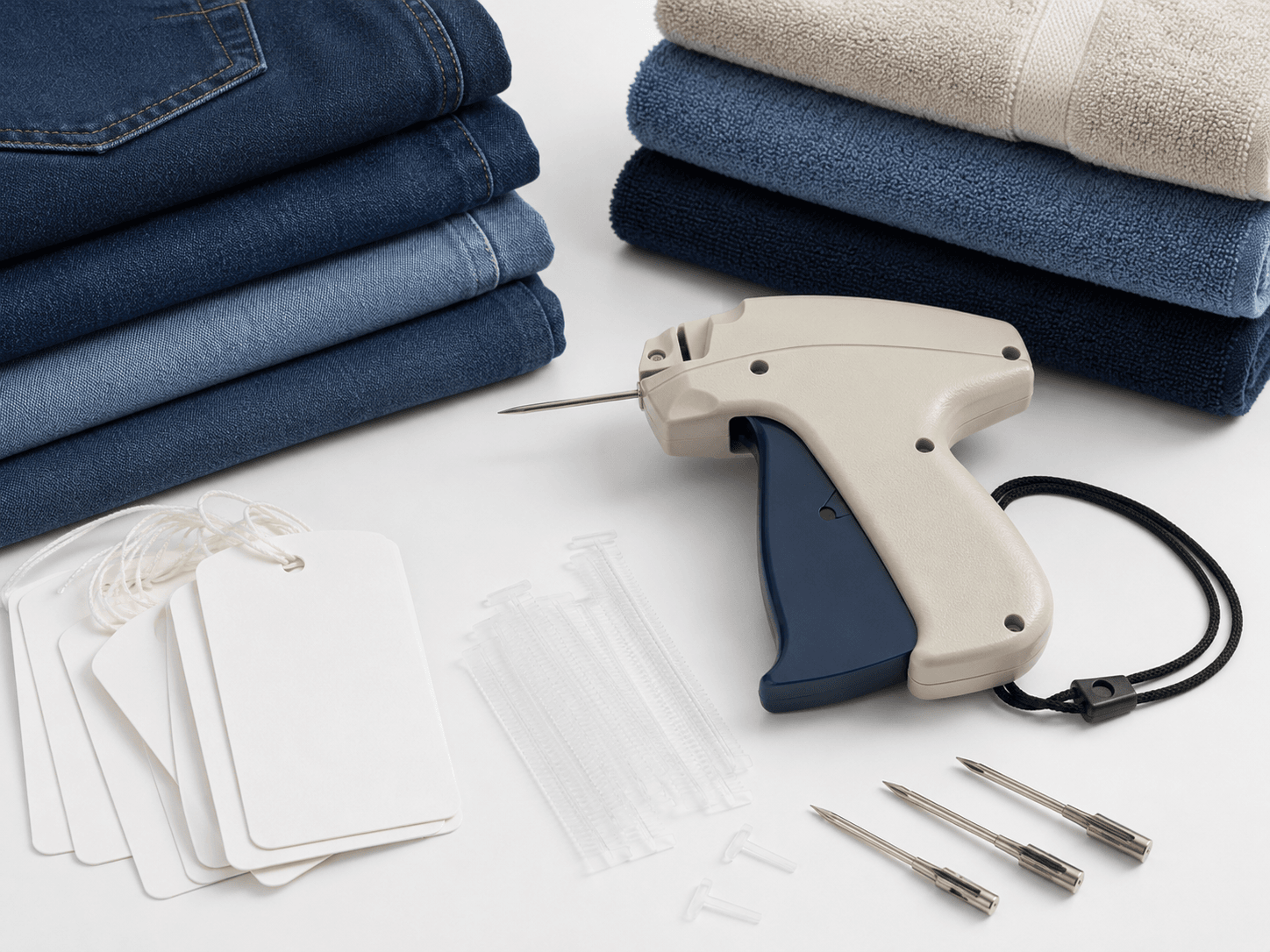
Buyers should remember that loop tag guns and loop fasteners must be compatible. Different tools may require specific loop pins or fastener clips. Always confirm the fastener size, tool model and loading method before placing a bulk order.
Hang Tag String
Hang tag string is a good choice for premium products and boutique packaging. It can be made from cotton, polyester, nylon, elastic cord or other materials depending on the product style. It usually passes through the hang tag hole and then loops around a product point such as a handle, buttonhole, strap, zipper pull or packaging hole.
Hang tag string works well for premium shoes, handbags, scarves, jewelry, gift items, leather goods and handmade accessories. It offers a softer and more branded appearance than plain plastic loops.
This method is especially suitable when appearance matters more than tagging speed. For luxury or fashion products, a well-chosen string can improve the perceived value of the product.
Snap Lock Cord
Snap lock cord is similar to hang tag string, but it includes a small locking mechanism. The cord passes through the hang tag and around the product attachment point, then snaps closed.
It is easy to use and does not normally require a special tool. This makes it useful for boutiques, online sellers, sample rooms and small packaging teams. It is also suitable for products that require a neat, clean and removable tag attachment.
Snap lock cords are not always the best choice for very high-volume operations because manual closing still takes time. For large order volumes, a loop tag gun may be more efficient.
Packaging Card Attachment
If the product does not have a safe attachment point, the tag can be attached to the packaging instead of the product itself. A header card, display card, product sleeve, insert card or hanging card can hold the tag without touching the main product surface.
Packaging card attachment works well for jewelry, hair accessories, small tools, gift sets, shoe accessories, small leather goods, packaged scarves and other products where the surface should remain untouched.
This method is also useful when the product is too fragile, too smooth or too high-value to contact directly with a fastener.
Loop Lock Fasteners vs Loop Tag Gun vs Hang Tag String
Different non-piercing methods serve different needs. A boutique store may prefer hang tag string for appearance, while a handbag factory or accessories distributor may prefer a loop tag gun for efficiency.
| Solution | Best For | Advantages | Limitations |
|---|---|---|---|
| Hand-applied loop lock fasteners | Small batches, samples, mixed products | Low cost, flexible, no needle piercing | Slower for large quantities |
| Loop tag gun or V-tool style applicator | Bulk tagging, hard goods, retail packaging lines | Faster, more consistent, suitable for repeated work | Requires compatible loop fasteners |
| Hang tag string | Premium packaging, fashion accessories, boutique goods | Better appearance, soft presentation, no piercing | Slower than tool-based tagging |
| Snap lock cord | Retail display, online sellers, small teams | Easy to close, clean look, no special tool required | Not ideal for very high-volume work |
| Packaging card attachment | Jewelry, small accessories, gift packs | Protects product completely | Requires suitable packaging design |
For small batches, hand-applied loop locks or snap lock cords are often enough. For premium products, hang tag string may look more refined. For large-volume retail tagging, a loop tag gun can improve speed. For products with no suitable attachment point, packaging card attachment is usually the safest solution.
How to Tag Shoes Without Piercing Them
Shoes should not be tagged through the main upper material unless the product design specifically allows it. Leather, PU, mesh, coated fabric and decorative panels can be damaged by punctures. The safer approach is to use existing openings or structural parts.
Use Shoelaces
For sneakers, canvas shoes and casual footwear, shoelaces are one of the best attachment points. A loop lock fastener or hang tag string can pass around the shoelace and hold the tag securely without touching the upper.
This method is simple, clean and easy to remove. It also keeps the hang tag visible for retail display.
Use Shoe Eyelets
Eyelets or lace holes are another practical option. A loop fastener or string can pass through the eyelet without piercing the shoe material. This works well for sneakers, boots, lace-up leather shoes and canvas shoes.
Before bulk tagging, check that the loop does not scratch the eyelet finish or pull too tightly against the upper.
Use Buckles or Straps
For sandals, women’s shoes, children’s shoes, slippers and buckle shoes, the tag can often be attached to a strap, buckle or ankle loop. This avoids piercing soft or decorative upper materials.
The fastener should be long enough to sit naturally, but not so long that it swings or catches during packing.
Use Packaging Holes or Shoe Hangers
Some shoes are sold with packaging cards, display hangers or shoe supports. If the packaging includes a hole or loop, the hang tag can be attached to the packaging instead of the shoe.
This is useful for slippers, children’s shoes, shoe accessories and lightweight footwear.
Avoid Piercing the Shoe Upper
Avoid piercing leather uppers, PU uppers, mesh panels, decorative surfaces, toe boxes and heel counters. These areas are visible and can be damaged easily. A hole on the shoe upper may make the product look used or defective.
How to Tag Handbags Without Piercing Them
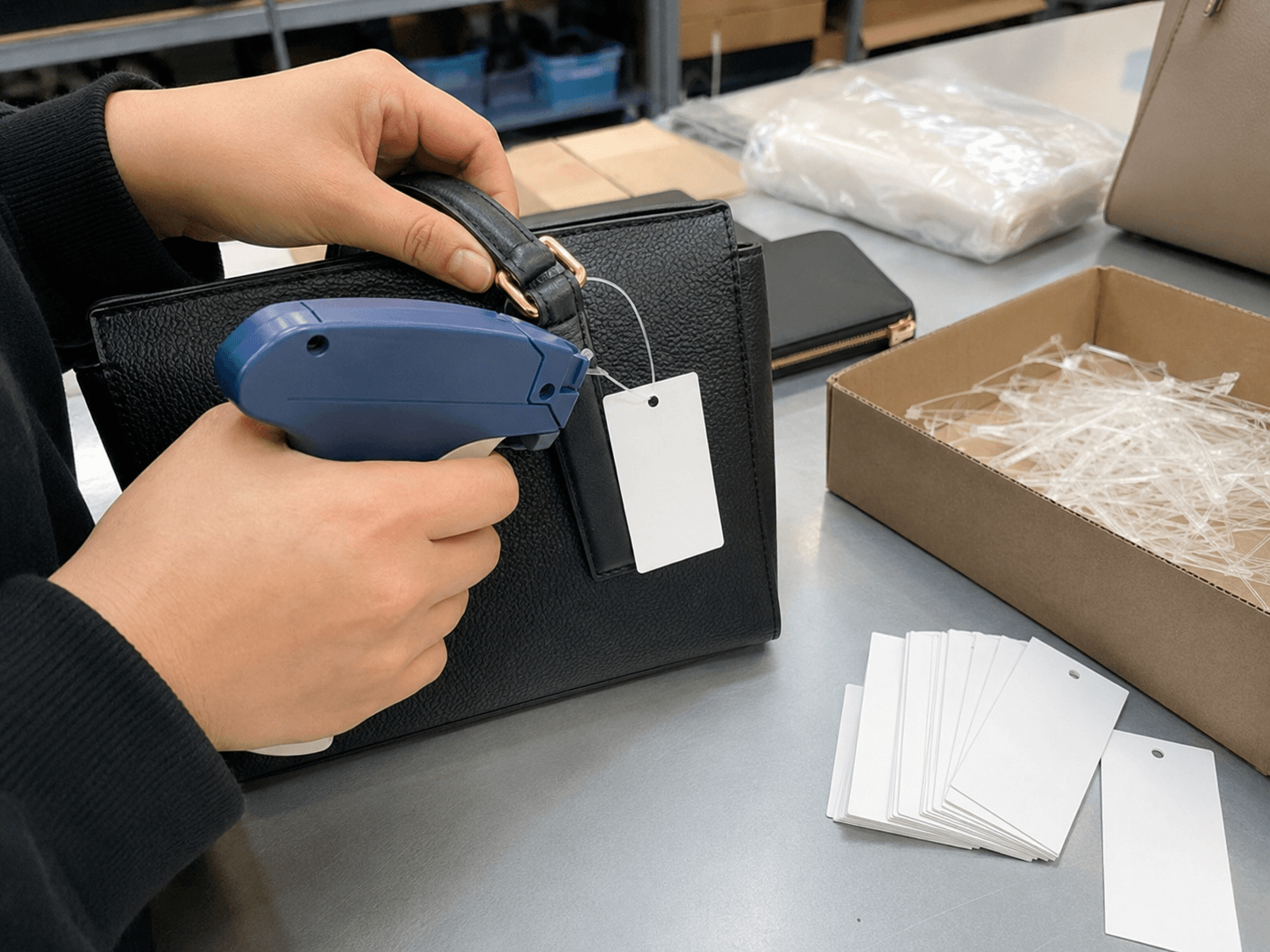
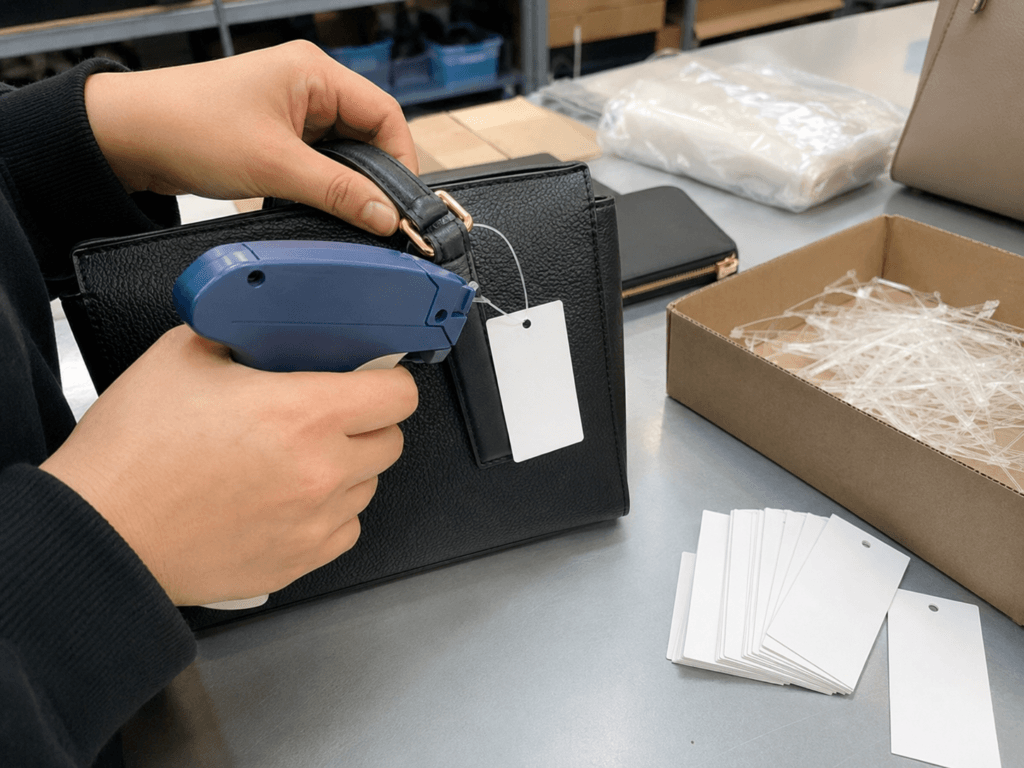
Handbags usually have several natural tag points. The tag should be attached to the hardware or strap structure rather than the main leather or PU panel.
Use Bag Handles
The handle is the most common place to attach a hang tag. A loop lock fastener, hang tag string or snap lock cord can wrap around the handle without damaging the bag surface.
This works well for tote bags, handbags, shopping bags and many fashion bags.
Use Shoulder Straps
For crossbody bags, backpacks and shoulder bags, the tag can be attached to the shoulder strap or strap connector. If the strap is removable, the tag can be placed near the metal ring or buckle.
Avoid placing the tag where it may rub against the main bag surface during packing or shipping.
Use Zipper Pulls
Zipper pulls are useful attachment points for handbags, wallets, pouches and luggage accessories. A string or loop fastener can pass through the zipper pull hole without piercing the product.
This method is especially suitable for small bags, cosmetic bags, wallets and zippered leather goods.
Use Metal Rings, D-Rings or Buckles
Many bags include metal hardware such as D-rings, O-rings, chain loops, buckles or strap adjusters. These are strong and natural attachment points for loop fasteners.
When using metal hardware, check that the fastener does not scratch polished metal or coated finishes.
Avoid Piercing Leather or PU Panels
Do not tag directly through the main leather, PU, coated canvas, printed panel, flap, side panel or decorative surface. Even a small hole may reduce the retail value of the bag.
How to Tag Wallets, Belts and Leather Goods
Wallets, belts and leather goods require careful tagging because their surfaces are often smooth, finished or decorative.
Wallets
For wallets, the best attachment points are zipper pulls, button loops, packaging cards, display holes or suitable inner product structures. If the wallet is packaged in a box or sleeve, attaching the tag to the packaging may be safer.
Avoid piercing the front wallet panel, card slot panel, folded edge or decorative leather surface.
Belts
Belts are one of the easiest leather goods to tag without piercing because they already have holes and buckles. The hang tag can be attached through a belt hole, around the buckle, through a belt loop or onto a packaging hook.
A loop lock fastener or loop tag gun can work well for bulk belt tagging. For premium belts, hang tag string may provide a more refined appearance.
Leather Goods
For leather goods, use existing structures whenever possible. Zipper pulls, buckles, straps, handles, D-rings and packaging cards are safer than the leather surface itself.
Ordinary needle tagging should be avoided on finished leather or PU surfaces unless the product design specifically includes a tag hole.
How to Tag Sunglasses, Jewelry and Small Accessories
Small accessories need a secure but clean tagging method. The attachment point should not scratch, bend or interfere with the product.
Sunglasses
Sunglasses can be tagged around the temple arm, through a packaging card, around a display hook or through a case zipper pull. Do not attach tags to lenses. Avoid fragile hinge areas if the fastener may pull or scratch the product.
For retail display, the tag should be visible without blocking the lens or damaging the frame finish.
Jewelry
Jewelry is usually tagged through a jewelry card, chain loop, bracelet clasp, earring card hole or packaging card. Fine chains and delicate stones should not be stressed by the fastener.
For premium jewelry, soft string or custom packaging cards often look better than plain plastic loops.
Hair Accessories
Hair clips, headbands, elastic bands and other hair accessories are usually tagged through a packaging card, elastic loop, clip handle or display hole. Avoid attaching tags to decorative surfaces that may scratch or deform.
Sporting Goods and Small Hard Goods
Small hard goods such as tools, kitchen utensils, outdoor accessories and sporting goods often have handle holes, hanging holes or packaging holes. These are ideal for loop lock fasteners or loop tag guns.
Avoid attaching tags to the functional surface of the product when a packaging or handle hole is available.
Product-by-Product Tagging Recommendation Table
| Product Type | Best Attachment Point | Recommended Method | Avoid |
|---|---|---|---|
| Sneakers | Shoelace, eyelet | Loop lock fastener, hang tag string | Shoe upper, toe box |
| Sandals | Strap, buckle | Loop lock fastener, snap lock cord | Soft upper, decorative surface |
| Leather shoes | Lace hole, buckle, packaging hole | Hang tag string, loop lock fastener | Leather upper |
| Handbags | Handle, strap, D-ring | Loop lock, loop tag gun, string | Main leather or PU panel |
| Wallets | Zipper pull, packaging card | Loop fastener, string, card attachment | Front wallet panel |
| Belts | Belt hole, buckle | Loop tag gun, loop lock fastener | Belt surface if avoidable |
| Sunglasses | Temple arm, packaging card | Loop lock, loop tag gun | Lens, fragile hinge area |
| Jewelry | Jewelry card, clasp, chain loop | String, packaging card | Direct pressure on delicate stones |
| Hair accessories | Card hole, elastic loop | Snap lock cord, loop fastener | Decorative surface |
| Small tools | Handle hole, packaging hole | Loop lock, loop tag gun | Product body if unnecessary |
| Kitchen utensils | Handle hole, hanging hole | Loop tag gun, loop fastener | Main functional surface |
Step-by-Step Guide: How to Apply a Non-Piercing Hang Tag
A standard process helps keep tag placement consistent and prevents damage during bulk packaging.
Step 1: Check Whether the Product Has a Natural Attachment Point
Look for a shoelace, eyelet, handle, strap, buckle, zipper pull, D-ring, buttonhole, belt hole, display hook or packaging hole. If no safe point exists, consider using a packaging card instead.
Step 2: Choose the Right Fastener Type
For small quantities, hand-applied loop lock fasteners or snap lock cords are practical. For premium goods, hang tag string may look better. For larger quantities, a loop tag gun can improve speed and consistency.
Step 3: Pass the Loop Through the Hang Tag
Start by passing the loop, string or cord through the hole in the hang tag. Make sure the hang tag hole is large enough for the fastener and does not tear when pulled.
Step 4: Wrap Around the Selected Product Point
Wrap the fastener around the shoelace, handle, zipper pull, strap, buckle, ring, eyelet or packaging hole. Do not wrap it around a weak or decorative point that may break or scratch.
Step 5: Lock or Fasten the Loop
Close the loop lock, snap the cord shut or use the loop tag gun according to the tool and fastener instructions. The tag should be secure but not overly tight.
Step 6: Check Tag Position and Retail Appearance
After tagging, check whether the hang tag is visible, straight and secure. Make sure it does not rub against a delicate surface, block a key product feature, or hang so loosely that it may tangle during shipping.
Common Mistakes to Avoid
Non-piercing tagging is simple, but mistakes can still damage products or reduce presentation quality.
Piercing the Main Product Surface
The most important mistake to avoid is piercing the product surface. Do not create holes in shoe uppers, handbag panels, wallet surfaces, leather goods, sunglasses lenses or decorative finishes.
Choosing a Loop Fastener That Is Too Short
A loop that is too short may pull the tag tightly against the product. This can distort straps, press into leather, scratch surfaces or make the tag difficult to read.
Choosing a Loop Fastener That Is Too Long
A loop that is too long may swing loosely, tangle with other products or look untidy on the shelf. It may also catch during packing and shipping.
Attaching the Tag to a Weak Point
Avoid fragile chains, thin decorative parts, loose stitching, delicate charms or weak elastic points. The attachment point should hold the tag without damaging the product.
Using Manual Loops for Very High-Volume Orders
Hand-applied loops are flexible, but they can slow down large orders. If a team needs to tag many hard goods every day, a loop tag gun may improve efficiency.
Ignoring the Product Finish
Polished metal, coated hardware, mirror finishes, lenses, printed leather and glossy PU surfaces can be scratched by careless tagging. Always check contact points before bulk application.
How to Choose Loop Fastener Length
Loop fastener length should match the product attachment point. The goal is to hold the tag securely while allowing it to sit naturally.
Short Loops for Small Accessories
Short loops are suitable for jewelry cards, small wallets, small tools, hair accessories and compact product packaging. They keep the tag close to the item and create a neat appearance.
Medium Loops for Shoes and Wallets
Medium loops are suitable for sneakers, sandals, shoe eyelets, wallet zipper pulls, small bags and belt holes. They provide enough room without making the tag look loose.
Long Loops for Handbags and Bulky Items
Longer loops are useful for tote bags, backpacks, thick straps, large handles, sporting goods and larger hard goods. They provide more room around thicker attachment points.
Test Before Bulk Tagging
The same loop length may perform differently on different products. A shoe eyelet, handbag handle and belt buckle may all require different loop lengths. Test with real samples before confirming the final fastener size.
Loop Tag Gun Buying Guide for Business Buyers
When choosing a loop tag gun or V-tool style applicator, buyers should confirm the product category, tagging volume and fastener compatibility before ordering.
Confirm Product Category
First, identify the main products to be tagged. Shoes, handbags, wallets, belts, sunglasses, sporting goods, small tools and kitchen utensils may require different loop lengths and attachment methods.
Confirm Daily Tagging Volume
Small batches can be handled with manual loop lock fasteners or snap lock cords. For larger quantities, a loop tag gun can help improve speed and reduce repetitive manual work.
Confirm Loop Fastener Compatibility
Not every loop fastener fits every tool. Confirm whether the tool requires specific loop pins, clips or fastener types. Check length options, material, color, loading method and packaging quantity.
Confirm Loop Length Options
A good supplier should be able to provide several common loop lengths for testing. This is especially useful for distributors and factories that handle multiple product categories.
Confirm Packaging and Supply Options
Trade buyers may need bulk cartons, private label packaging, mixed loop sizes, replacement parts, sample packs and stable repeat supply. These details should be confirmed before large orders.
Confirm Operator Training Needs
Even simple loop tagging tools require consistent operation. Workers should know how to choose an attachment point, how to close the loop properly, and how to avoid scratching the product surface.
Manual Loop Fastener or Loop Tag Gun?
| Buyer Type | Recommended Solution | Reason |
|---|---|---|
| Boutique store | Hang tag string or hand loop lock | Better appearance and flexibility for small batches |
| Online seller | Hand loop lock fasteners | Low cost and easy to use |
| Shoe wholesaler | Loop lock or loop tag gun | Suitable for different shoe styles |
| Handbag factory | Loop tag gun | Faster for repeated tag application |
| Accessories distributor | Loop tag gun with mixed loop sizes | Suitable for many product categories |
| Premium brand | Hang tag string and packaging card | Better brand presentation |
| Warehouse packing line | Loop tag gun | Improves speed and consistency |
Non-Piercing Tagging SOP for Retail and Wholesale Packaging
A clear operating process helps prevent damage and keeps tag placement consistent across different workers.
Classify Products by Attachment Point
Group products by the way they can be tagged:
• Products with holes: eyelets, belt holes, packaging holes
• Products with loops: handles, straps, D-rings, zipper pulls
• Products with no safe attachment point: packaging card required
• Premium products: string or custom loop solution preferred
Create a Standard Tag Placement Guide
Each product category should have a fixed tagging point. For example, sneakers may use shoelaces, handbags may use handles, wallets may use zipper pulls, and belts may use belt holes.
This prevents workers from choosing random positions that may damage the product.
Keep Loop Sizes Separated
Different loop lengths should be stored separately. Mixing short, medium and long loops can lead to poor appearance or insecure attachment.
Test Tag Security
After tagging, gently check whether the tag stays in place. It should not fall off easily, but it should also not pull tightly against the product.
Check Product Surface After Tagging
Inspect the product surface after tagging. Make sure the loop does not scratch leather, PU, coated metal, paint, lenses or decorative details.
Train Operators for Consistency
Workers should understand both speed and care. The fastest method is not always the safest. A short training process can reduce damage, improve presentation and support stable packaging quality.
Related Reading
For fabric products that need low-damage tagging, read our guide on how to tag delicate clothing without leaving holes.
For general tool and fastener selection, refer to our guide on how to choose the right tagging gun and fasteners.
For fastener length selection, review our tagging gun fastener sizes guide.
For comparing regular needle tools, see our standard vs fine tagging gun guide.
For tool issues such as jamming, mismatched consumables or operator errors, read our guide to common tagging gun problems.
FAQ
How do you tag shoes without piercing them?
Use the shoelace, eyelet, buckle, strap or packaging hole as the attachment point. A loop lock fastener, hang tag string or loop tag gun can attach the hang tag without piercing the shoe upper.
What is the best way to attach hang tags to handbags?
The best points are usually the handle, shoulder strap, zipper pull, D-ring or metal buckle. Avoid piercing the main leather or PU panel.
What is a loop lock fastener?
A loop lock fastener is a plastic loop-style tag fastener that passes through a hang tag and around a product attachment point, then locks into a closed loop.
What is a loop tag gun?
A loop tag gun is a tool used to apply loop-fastened tags efficiently. It is commonly used for hard goods and accessories where the product should not be pierced by a standard tagging needle.
Can I use a regular tagging gun on shoes or handbags?
A regular needle tagging gun is not recommended for the main surface of shoes, handbags or leather goods because it can leave holes or damage the product. Use a non-piercing loop solution instead.
Are loop lock fasteners suitable for leather goods?
Yes, if they are attached to a handle, strap, zipper pull, buckle, D-ring or packaging hole. They should not be forced through the leather surface.
Which is better, hang tag string or loop lock fastener?
Hang tag string is better for premium presentation and small batches. Loop lock fasteners are better for faster retail tagging and bulk packaging.
When should I use a loop tag gun?
Use a loop tag gun when you need to apply loop-fastened tags in larger quantities, especially for shoes, handbags, belts, wallets, sunglasses, sporting goods or other hard goods.
Can loop fasteners be removed?
Many loop fasteners can be cut off with scissors or a small cutting tool. Some security-style loops are designed to show tampering or be difficult to remove without damaging the loop or tag. Choose the fastener type according to your retail security and packaging needs.
What loop fastener length should I choose?
Choose short loops for small accessories, medium loops for shoes and wallets, and longer loops for handbags, bulky straps or larger hard goods. Always test with real samples before bulk purchase.
Conclusion
Shoes, handbags, wallets, belts, sunglasses and accessories should not be tagged the same way as regular garments. Instead of piercing the main product surface, use existing attachment points such as shoelaces, eyelets, straps, handles, zipper pulls, buckles, D-rings and packaging holes.
For small batches or premium products, hang tag strings, snap lock cords and hand-applied loop lock fasteners can provide a clean non-piercing solution. For larger retail or factory packaging operations, a loop tag gun can improve speed and consistency.
The best solution depends on product type, attachment point, loop length, presentation requirements and daily tagging volume. Before placing a bulk order, test the loop fastener or tagging tool on real products to confirm appearance, security and ease of use.
Looking for non-piercing tagging solutions for shoes, handbags, wallets, belts or accessories? HANZE supplies loop lock fasteners, loop tag guns, hang tag fasteners and garment tagging accessories for retailers, factories, wholesalers and distributors. Contact us for bulk pricing, samples and suitable product recommendations.