Product Category
Screen Printing Mesh Wholesale (Polyester & Stainless Steel)
When you source screen printing mesh for production, the real goal is repeatability: stable tension behavior, consistent openings, and predictable ink transfer from sample to mass run. HANZE groups our mesh options into three proven routes—Monofilament Polyester Screen Printing Mesh, NBC Alpha & Beta Polyester Monofilament Mesh, and ASADA Stainless Steel Wire Mesh—so purchasing teams can shortlist quickly by detail level, durability target, and process stability.
From garment and graphic printing to industrial applications, the right mesh selection helps reduce rework, improves registration accuracy, and keeps ink deposit consistent across long runs. If you share your ink system, substrate, and target detail (solid fills / fine lines / halftones), we can recommend a suitable mesh range and roll format for sampling and bulk orders.
Screen Printing Mesh Type
1) Monofilament Polyester Screen Printing Mesh (PET) — Versatile & Cost-Effective
Best for: textile printing, general graphics, packaging work, and standard daily production where stable supply and broad specs matter.
Why choose it: wide mesh-count coverage, flexible widths, and a strong cost-performance ratio for repeat procurement.
Typical specification range (as listed):
•Material: 100% monofilament polyester yarn (PET), plain weave
•Thread diameter: 27–400 μm
•Mesh count: 6T–180T / 15–460 mesh
•Width: 60–375 cm
•Roll length: 30m / 50m / 100m per roll (or as requested)
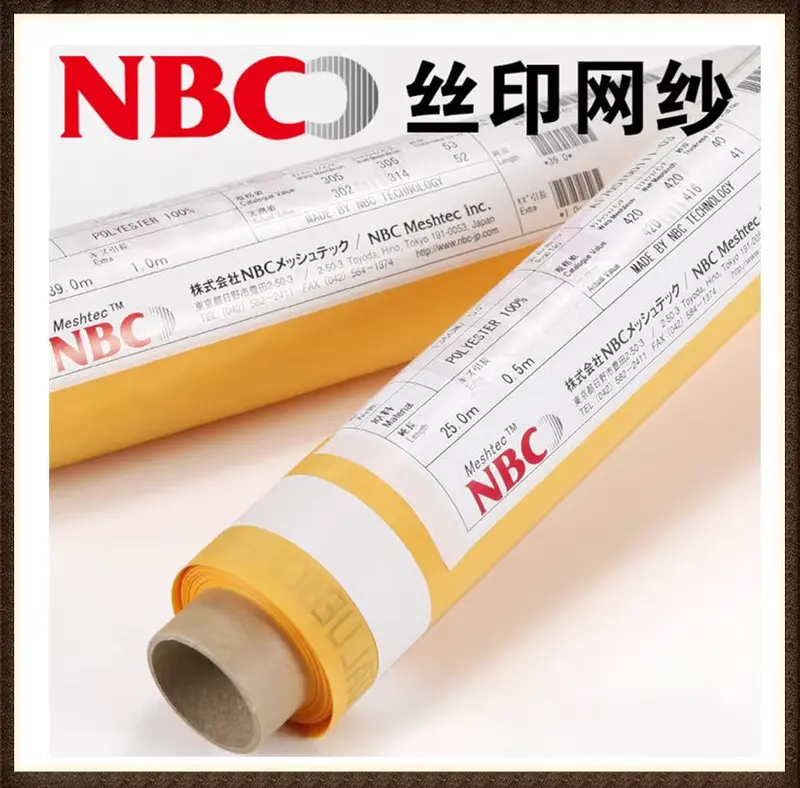
2) NBC Alpha & Beta Polyester Monofilament Mesh (Japan) — Precision & Repeatability
Best for: buyers who prioritize tension stability + controlled openings + predictable ink transfer across production runs. NBC is commonly selected when you want fewer variables between batches, especially for finer graphics and precision work.
Quick series guidance (as positioned):
•Alpha Series: precision applications (e.g., electronics / fine graphics)
•Beta Series: reliable, cost-effective standard printing
Common supply format (as listed):
•Width: 115cm / 136cm / 155cm
•Length: 30m/roll
3) ASADA Stainless Steel Wire Mesh — High-Stability for Demanding Printing
Best for: high-precision industrial printing, high-tension conditions, and processes where dimensional stability is critical (e.g., solder paste / multilayer patterns / high-viscosity materials). ASADA meshes are positioned around maintaining flatness, ink uniformity, and printing consistency under demanding cycles.
Series highlights (as listed):
•SHS Series: high open area (up to 65%) to support efficient ink release in solder paste and bump printing
•HS-D Series: ultra-hard mesh with ~3× tensile strength for high-viscosity and multilayer pattern applications
Quick Comparison Table
| What you prioritize | Recommended mesh | Why it works |
|---|---|---|
| Cost-performance + broad availability | PET Monofilament Polyester Mesh | Wide mesh count (15–460) and flexible widths/roll lengths for standardization |
| Repeatability + controlled openings | NBC Alpha/Beta | Positioned for stable tension behavior + consistent openings + predictable ink transfer |
| High-tension stability + industrial precision | ASADA Stainless Steel Mesh | SHS high open area; HS-D strength; flatness & consistency under long cycles |
Mesh Count Help
Not sure which mesh count to choose? Start with our practical guide—110 vs 156 mesh, how mesh affects ink deposit and detail, and how to match mesh count to your print goal.
Read: Complete Guide to Choose the Right Screen Printing Mesh Size
Why Source Screen Printing Mesh from HANZE
•Product line coverage: PET monofilament mesh, NBC mesh series, and ASADA stainless steel mesh under one category for easier sourcing.
•Specification-driven supply: mesh count, thread diameter, width, and roll length options aligned to production planning.
•Repeat-order mindset: built for consistent purchasing—stable formats and clear selection routes for different printing demands.
FAQ
Q1: Which screen printing mesh is best for high-detail printing?
For higher detail and repeatability, many buyers shortlist NBC Alpha for precision use, or ASADA stainless steel mesh when dimensional stability under demanding cycles is required.
Q2: What details should I send for a fast quotation?
Share mesh type (PET / NBC / stainless), mesh count, width/roll length, ink type, substrate, and your target detail level. This helps confirm a practical spec before sampling.
Q3: Do you offer bulk rolls for production?
Yes—our listings include standard roll formats (e.g., 30m/roll options) and multiple widths depending on series.
Q4: When should I choose stainless steel mesh instead of polyester mesh?
Choose stainless steel when you need higher stability for industrial precision work, higher tension conditions, or materials like solder paste / multilayer patterns where consistency under stress is a priority.
Q5: How do I pick mesh count quickly (110 vs 156 etc.)?
Mesh count directly affects ink deposit and detail; many shops use 110 and 156 as common starting points, then adjust for coverage and line sharpness.
Get Bulk Pricing / Mesh Recommendation
Tell us your application, ink type, substrate, and desired detail level. We’ll recommend the right mesh type (PET / NBC / stainless) and confirm suitable widths and roll lengths for sampling and bulk supply.