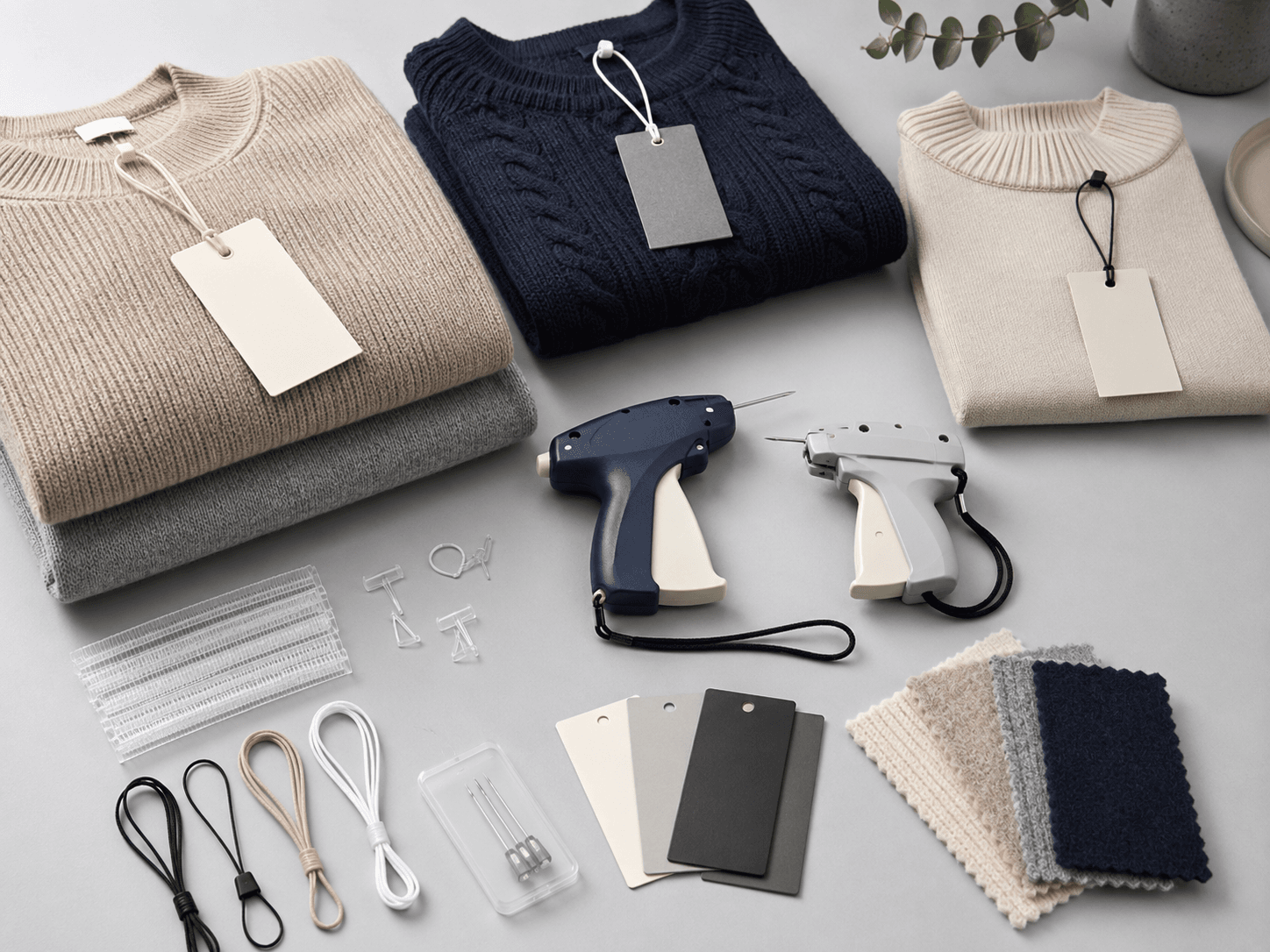
Cómo etiquetar de forma segura prendas de punto, suéteres y prendas de lana.
Cómo etiquetar de forma segura prendas de punto, suéteres y prendas de lana.
Knitwear requires a more careful tagging approach than woven shirts, denim or ordinary cotton garments. Sweaters and wool clothing are made from connected yarn loops that can stretch, pull or snag when a needle enters the wrong area.
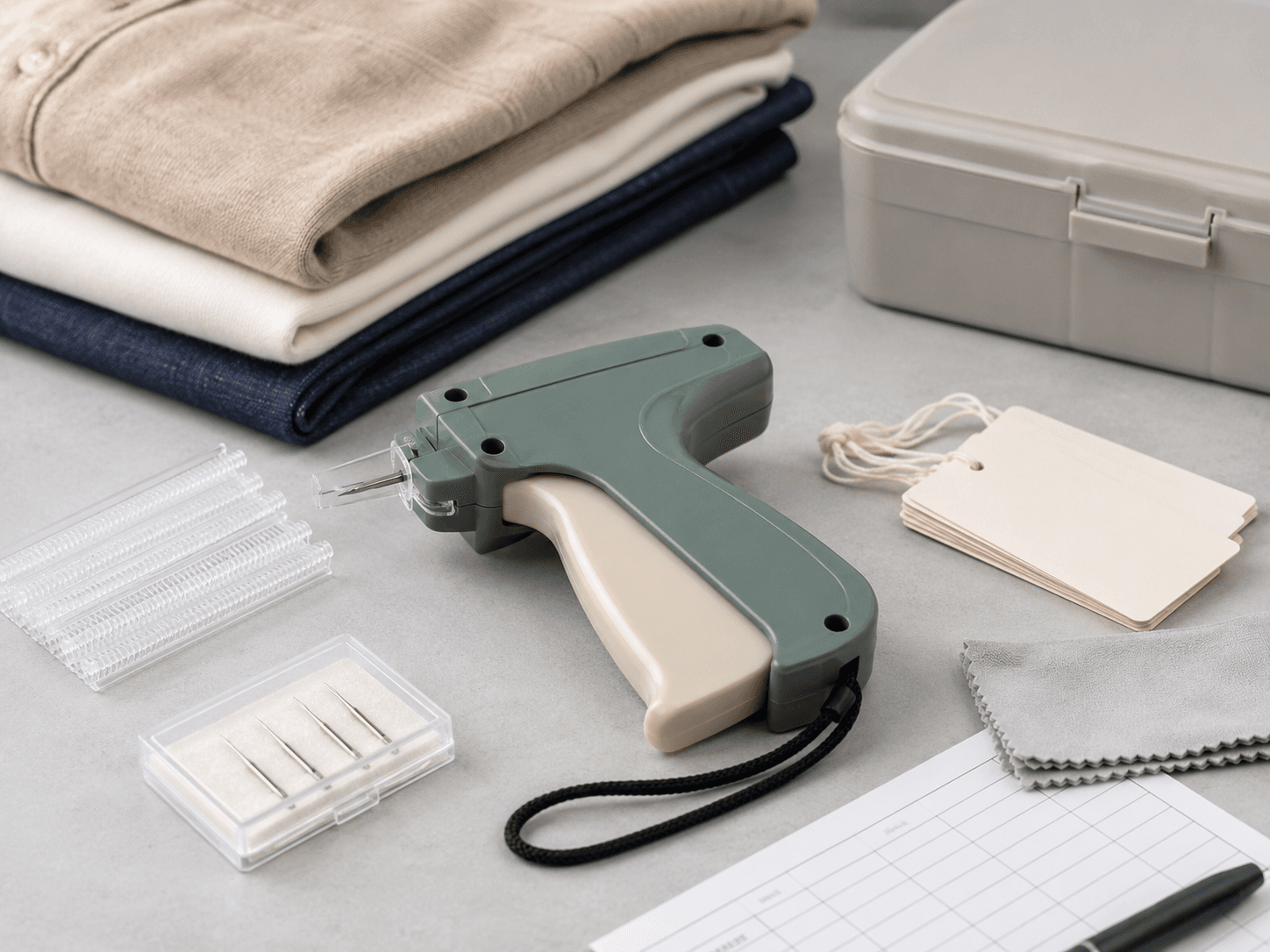
A pistola de etiquetado can be used on many knitted garments, but no single tool is suitable for every sweater. A tightly knitted cotton garment may accept a standard fastener through a care label, while lightweight merino, cashmere or open-knit clothing may require a fine-fabric or non-piercing solution.
The safest method depends on knit density, yarn thickness, garment weight, tag placement and retail presentation. Before bulk production, always test the complete combination of tool, needle, fastener and attachment point on the actual garment.
Why Knitwear Is More Difficult to Tag
Knitted fabrics are formed from interconnected yarn loops. A needle may pass cleanly through an opening between loops, but it may also catch, split or pull the yarn if the angle, needle condition or tag position is unsuitable.
Knitwear also varies significantly. A fine-gauge merino top, rib-knit cardigan, cable-knit wool sweater and open-knit fashion garment do not behave in the same way. Material thickness alone cannot determine the correct tagging system.
Stretch adds another challenge. When a sweater is pulled tight during tagging, its loops open and the puncture point may become more visible after the garment returns to its natural shape. Garments should therefore remain flat and unstretched during application.
Visible yarn damage can reduce the retail value of knitwear. Pulled loops, distorted stitches and punctures on a front panel are often more noticeable than similar marks on an ordinary woven garment.
Best Hang Tag Attachment Methods for Knitwear
Several methods can be used depending on the garment construction and attachment point.
| Método de adjunto | Uso recomendado | Ventaja principal | Limitación |
|---|---|---|---|
| Pistola de etiquetado estándar | Stable cotton knits and reinforced labels | Rápido y económico | May be too aggressive for delicate or open knits |
| Fine-fabric tagging gun | Tejidos ligeros, de punto apretado o delicados. | Helps reduce the risk of holes and snags | Requiere agujas finas y sujetadores compatibles. |
| Long-needle tagging gun | Thick wool garments and controlled multiple layers | Provides greater reach | A longer needle does not prevent yarn snagging |
| cierre de bucle | Buttonholes, zipper pulls, sewn loops and straps | Does not pierce the main knitted surface | Requires a strong attachment point |
| Cordón para etiqueta colgante | Cashmere, premium wool and boutique knitwear | Clean non-piercing presentation | Más lento de aplicar manualmente |
| Packaging band or card | Folded sweaters and gift packaging | Keeps the garment surface untouched | Must be planned as part of the packaging |
Avery Dennison positions its Fine Fabric tools and fasteners for delicate and tightly knitted materials and states that they reduce the risk of holes and snags. Fine systems may also be applied through woven labels or stitching rather than the main fabric surface.
Can You Use a Standard Tagging Gun on Knitwear?
A standard tagging gun can work on some knitted garments. Uline lists cotton and knits among the recommended materials for its standard gun, while clearly separating that system from fine-fabric needles and fasteners.
Standard tools are more likely to be suitable when:
- The knit is tight and stable
- The yarn is not especially delicate
- A strong care or brand label is available
- The attachment point is reinforced
- Testing shows no pulled yarn or visible damage
Cotton knit sweaters, stable jersey garments and some workwear knits may fit this category. The needle should still enter through a sewn label, seam or discreet area whenever possible.
A standard system may be unsuitable for cashmere, fine merino, loose open knits, thin rib structures, lightweight baby knitwear and decorative knitted panels. A larger needle can disturb the yarn structure even when the garment feels thick.
The term “standard” does not mean universal. Standard guns must use compatible standard needles and fasteners. Fine components should not be inserted into a standard tool.
When to Use a Fine-Fabric Tagging Gun
Fine-fabric tagging systems use smaller-profile needles and fasteners. They are designed to reduce damage risk on delicate materials rather than guarantee a completely hole-free result.
A fine system may be considered for:
- Fine-gauge knit tops
- Suéteres ligeros
- Merino wool garments
- Delicate wool blends
- Soft knitted babywear
- Thin knitted accessories
- Premium garments with tightly knitted surfaces
Avery Dennison describes several fine-fabric tools as suitable for delicate and tightly knitted fabrics. Uline’s fine-fabric gun is designed for materials such as silk, nylon, satin, microfiber and linen, illustrating the smaller system’s intended use on sensitive materials.
Fine guns, needles and fasteners must be used as a compatible set. Standard fasteners can jam a fine-fabric gun, while fine components may not feed correctly in a standard system.
A fine needle is not automatically suitable for every sweater. Chunky knits, heavy cable patterns and dense seam junctions may create excessive resistance. A better attachment point or non-piercing method may be safer than forcing a fine needle through thick material.
When Is a Long-Needle Tagging Gun Appropriate?
A long-needle tagging gun is intended for deeper reach. It may be useful for thick wool garments, folded knitwear, bulky winter products or controlled layers that a regular needle cannot reach comfortably.
Uline recommends its long-needle tool for wool, denim, towels, rugs, mats and multiple layers of thick material. The same product page makes clear that the tool requires its own compatible long replacement needles.
Long reach should not be confused with delicate-fabric protection:
- A aguja larga provides additional reach.
- A aguja fina reduces the puncture profile for sensitive materials.
- A heavy-duty needle is intended for greater material resistance.
A long needle can still snag loose yarn. It should not be forced through the thickest cable pattern or a junction containing several seams. Look for a strong but accessible care label, seam allowance or packaging point.
Best Tag Placement for Sweaters and Wool Garments
Correct placement is often more important than selecting the most expensive tool.
Sewn Care Label
A care label is usually the first position to test. The needle passes through the label material rather than the visible knitted panel.
Before approval, confirm that:
- The label is securely sewn
- The label is wide enough
- The fastener will not tear the label
- The tag hangs naturally
- The fastener does not pull the label into the sweater
Brand or Neck Label
A neck label is useful when the hang tag needs to remain near the collar. Choose a fastener length that leaves enough space without pulling the label tightly against the knit.
Avoid passing the needle through the visible neckline unless testing confirms that the fabric remains undamaged.
Side or Inner Seam
A stable inner seam may provide a discreet attachment point. Insert through the seam allowance or sewn structure rather than an individual visible yarn loop.
Avoid very thick seam intersections, where excessive resistance may bend the needle.
Ojal
Cardigans and buttoned sweaters often provide a natural non-piercing attachment point. A loop fastener or hang-tag string can pass through a buttonhole without puncturing the main knitted surface.
The loop should not pull the buttonhole out of shape.
Pull de cremallera
For zip sweaters, a loop fastener can attach the hang tag to the zipper pull. Check that the fastener does not scratch the zipper finish or rub against delicate yarn during shipping.
Packaging Band or Card
A paper band, folded card or retail sleeve may be the safest option for cashmere, gift sweaters and delicate wool products. The tag remains attached to the packaging while the garment surface stays untouched.
Áreas a evitar
Do not tag through highly visible or structurally sensitive areas unless a tested specification requires it.
Evitar:
- Front chest panels
- Cable-knit patterns
- Open-knit holes
- Bordado decorativo
- Loose ribbing
- Thin cuffs
- Shoulder decorations
- Highly visible sleeves
- Individual thick yarn strands
- Areas containing sequins or embellishments
A customer should not discover a pulled loop after removing the hang tag.
Product-by-Product Recommendations
| Tipo de Producto | Metodo preferido | Colocación sugerida |
|---|---|---|
| Cotton knit sweater | Standard or fine system after testing | Care label or inner side seam |
| Fine-gauge knit top | Fine-fabric fastener | Sewn label or reinforced inner seam |
| Merino wool sweater | Fine system or non-piercing attachment | Care label, neck label or buttonhole |
| Jersey de cachemir | Se prefiere el método sin perforación. | Packaging band, buttonhole or sewn loop |
| Chunky wool sweater | Long needle or loop method after testing | Strong label, inner seam or packaging |
| Open-knit garment | String, loop or packaging method | Buttonhole, sewn loop or card |
| Cárdigan | Loop fastener or string | Buttonhole or neck label |
| Zip sweater | cierre de bucle | Zipper pull or sewn label |
| Bufanda de punto | String or packaging card | Brand label or packaging |
| Wool coat with knitted sections | Standard or long system after testing | Inner label or reinforced woven seam |
These are starting points rather than universal rules. Final approval should always be based on actual production samples.
Step-by-Step: How to Tag Knitwear Safely
1. Identify the Knit Structure
Examine whether the fabric is tightly knitted, open, ribbed, lightweight, chunky or highly elastic. Check the yarn thickness and whether decorative patterns create raised or loose areas.
2. Find the Safest Attachment Point
Use the following order as a practical starting point:
- Packaging band or card
- Buttonhole, zipper pull or existing loop
- Sewn care or brand label
- Reinforced inner seam
- Main knitted surface only after successful testing
3. Choose a Compatible System
Select a standard, fine, long-needle or non-piercing system according to the approved position. Confirm that the gun, needle and fastener belong to the same system.
4. Keep the Garment Flat
Place the sweater on a stable surface without stretching it. Smooth folds around the intended attachment point.
Avery Dennison’s operating instructions recommend testing the fastening system on a small sample of every material before use.
5. Insert the Needle Smoothly
Push the needle through the approved point without twisting, rocking or forcing it. A sudden increase in resistance may indicate that the needle has reached a dense seam, thick yarn or unsuitable layer.
Stop and reposition rather than applying more force.
6. Inspect the Finished Tag
Comprobar:
- Pulled yarn
- Enlarged loops
- Visible punctures
- Distorted labels
- Compressed knitwear
- Excessive fastener tension
- Loose hang tags
- Damage after fastener removal
The appearance after removal matters because customers may pull or cut the fastener in different ways.
How to Prevent Snags and Pulled Yarn
Use an Undamaged Needle
A dull, bent or burred needle is more likely to catch a yarn loop. Inspect the needle regularly and replace it when its condition changes.
Do Not Stretch the Garment
Tagging a stretched sweater can open the loops and make the attachment point more visible. Allow the fabric to remain in its natural state.
Avoid Visible Yarn Strands
Do not deliberately insert the needle through a thick individual strand. Use labels, seam allowances and packaging features instead.
Stop When Resistance Changes
A needle that no longer enters smoothly should not be forced. Check whether the selected point contains a dense seam or multiple yarn layers.
Test Tag Removal
Cut or remove the fastener during sample approval and inspect the fabric. Some damage only becomes visible when the attachment is taken out.
Choosing Fastener Length for Knitwear
Fastener length should match the attachment point rather than simply the overall garment thickness.
A fastener that is too short can:
- Compress a thick sweater
- Pull a label tightly against the knit
- Place tension on yarn loops
- Distort the neckline or seam
A fastener that is unnecessarily long can:
- Tangle during packing
- Catch on nearby garments
- Move across delicate yarn
- Look untidy on a retail display
A thick sweater tagged through a thin care label may not require the longest available fastener. Select the shortest length that allows the tag to hang naturally without pulling the garment.
Production Standards for Knitwear Factories
High-volume sweater tagging should follow a product-specific specification rather than operator preference.
For each product, record:
- Modelo de herramienta
- Sistema de agujas
- Tipo de sujetador
- Longitud del sujetador
- Approved tag position
- Tag orientation
- Método de eliminación
- Criterios de calidad
Keep standard, fine and long-needle systems in separate trays or workstations. Similar-looking fasteners can be mixed easily, resulting in jams and inconsistent attachment.
Inspect the first three to five tagged garments at the beginning of each production batch. Look for snagging, stretched loops, tag tension and placement errors.
Place an approved tagged sample at the workstation. A physical sample often communicates the required position more clearly than written instructions alone.
Recurring yarn damage should trigger a review of the method. Operators should not be instructed to apply more force to overcome a poor tool or location choice.
Common Mistakes When Tagging Knitwear
Tagging Through the Front Panel
The front panel is highly visible and often contains decorative knit structures. Damage is difficult to hide.
Assuming Every Wool Garment Needs a Long Needle
Some wool garments are light and delicate. A fine or non-piercing solution may be more appropriate than a longer needle.
Assuming Fine Needles Fit Every Sweater
Fine needles may bend or feed poorly when forced through dense or chunky knitted material.
Pulling the Garment Tight
Stretching the knit before inserting the needle can distort the yarn loops.
Ignoring Fastener Tension
Even a suitable needle can cause damage when the fastener is too short and pulls the tag tightly against the garment.
Omitir la prueba de muestra
Different knit constructions produce different results. Manufacturer instructions recommend testing the complete fastening system on each material before regular use.
Lista de verificación de selección
| Pregunta | Dirección recomendada |
|---|---|
| Is the knit tight and stable? | Test a standard or fine system |
| Is it fine merino or delicate wool? | Consider a fine or non-piercing attachment |
| Is the garment thick or folded? | Consider long reach, but test for snagging |
| Is there a care or brand label? | Test attachment through the label |
| Is there a buttonhole or zipper pull? | Consider a loop or string |
| Is the knit open or decorative? | Avoid direct puncture |
| Is presentation especially important? | Use a packaging band or hang-tag string |
| Is the order high volume? | Standardize the approved tool and placement |
Lectura relacionada
For general tool selection, read How to Choose the Right Tagging Gun and Fasteners.
For a detailed tool comparison, see Standard vs Fine Tagging Gun.
For replacement needle compatibility, read the Guía de agujas para pistolas de etiquetado.
For attachment length guidance, review the Guía de tamaños de sujetadores para pistolas de etiquetado.
For other sensitive materials, see Cómo etiquetar prendas delicadas sin dejar agujeros.
For thick textile products, read Tagging Gun for Denim, Towels and Thick Fabrics.
Preguntas frecuentes
Can I use a tagging gun on a sweater?
Yes. Many sweaters can be tagged with a compatible standard or fine-fabric system when a safe label or reinforced seam is available. Test the exact garment before production.
What is the best tagging gun for knitwear?
There is no universal option. Standard tools may suit stable cotton knits, fine-fabric tools may suit lightweight or tightly knitted fabrics, and long-needle tools may help when greater reach is required.
Where should I attach a hang tag to a sweater?
Care labels, brand labels, inner seams, buttonholes, zipper pulls and packaging bands are better starting points than a visible front panel.
Will a tagging gun snag wool?
It can if the needle is damaged, the knit is loose or the position is unsuitable. Use a compatible undamaged needle and test the full fastening method on the actual garment.
Is a fine needle always better for wool garments?
No. Fine needles can reduce damage risk on delicate material but may not be strong enough for thick seams or chunky knitwear.
Do thick wool sweaters need a long needle?
A long needle may help when deeper reach is required, but thickness alone does not determine the correct system. Knit structure and attachment position also matter.
Can I attach a sweater tag without piercing it?
Yes. Buttonholes, zipper pulls, sewn loops, hang-tag strings and packaging bands can provide non-piercing options.
Should cashmere be tagged with a gun?
Avoid puncturing the visible cashmere surface whenever possible. A fine system may be tested through a sewn label, but strings, loops and packaging attachments are often safer starting points.
How can factories reduce snagging during sweater tagging?
Approve one tool, fastener and attachment point for each product. Keep garments unstretched, inspect needles and check the first tagged pieces before full production.
Conclusión
Safe knitwear tagging depends on more than fastener length. Knit structure, yarn thickness, garment weight and attachment location all affect the finished result.
Standard tagging guns may work well on stable knitted garments and sewn labels. Fine-fabric systems can reduce the risk of holes and snags on sensitive knitwear, while long-needle tools provide additional reach for thick wool garments and controlled layers. Loop fasteners, strings and packaging bands are better choices when the knitted surface should not be pierced.
Before bulk production, test the complete tool, needle, fastener and tag position on the actual sweater.
Looking for tagging guns and fasteners for knitwear, sweaters or wool garments? HANZE supplies standard, fine-fabric, long-needle and non-piercing tagging solutions for clothing manufacturers, wholesalers, retailers and packaging teams. Contáctanos Para obtener muestras, información sobre compatibilidad y precios por volumen.